


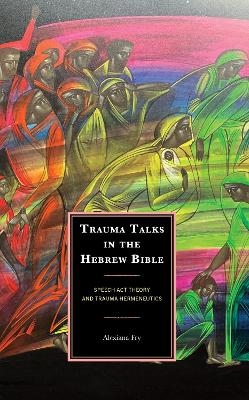
Trauma Talks in the Hebrew Bible
Speech Act Theory and Trauma Hermeneutics
Seiten
2023
Lexington Books (Verlag)
978-1-6669-0055-2 (ISBN)
Lexington Books (Verlag)
978-1-6669-0055-2 (ISBN)
Resisting binary understandings of the human experience, Trauma Talks in the Hebrew Bible calls to attention the fluidity and polyvalency in the Hebrew Bible. Alexiana Fry argues for a more holistic approach in studying texts embracing both the bodies of the past, and our own bodies.
If one of the many ways out of trauma’s impact is through words, then why not use a theory closely attached to words and their impact alongside current trauma theories in understanding historical narratives? In Trauma Talks in the Hebrew Bible: Speech Act Theory and Trauma Hermeneutics, Alexiana Fry utilizes a diverse methodology of speech act theory and trauma hermeneutics to argue for a more fluid and holistic approach in re-interpreting narratives in the Hebrew Bible. Examining a more dissociative “objective” manner in reading, each chapter asks the question of “what about our own bodies?” Purposely provoking attunement with oneself to embrace “empathic unsettlement,” the book refuses to give any semblance of finality. Through the many types of performative utterances and traumas both individual and collective—Joshua, Judges, Samuel, Ecclesiastes, and Hosea—Fry investigates the varied layers that constitute their many meanings. The reader is invited into an awareness and openness that is the human experience in biblical studies.
If one of the many ways out of trauma’s impact is through words, then why not use a theory closely attached to words and their impact alongside current trauma theories in understanding historical narratives? In Trauma Talks in the Hebrew Bible: Speech Act Theory and Trauma Hermeneutics, Alexiana Fry utilizes a diverse methodology of speech act theory and trauma hermeneutics to argue for a more fluid and holistic approach in re-interpreting narratives in the Hebrew Bible. Examining a more dissociative “objective” manner in reading, each chapter asks the question of “what about our own bodies?” Purposely provoking attunement with oneself to embrace “empathic unsettlement,” the book refuses to give any semblance of finality. Through the many types of performative utterances and traumas both individual and collective—Joshua, Judges, Samuel, Ecclesiastes, and Hosea—Fry investigates the varied layers that constitute their many meanings. The reader is invited into an awareness and openness that is the human experience in biblical studies.
Alexiana Fry is postdoc scholar at the University of Copenhagen.
Acknowledgments
Introduction: Standing on Chicken Legs
Chapter One: An In-Between Hermeneutics: Fluid Methods for Polyvalent Passages
Chapter Two: Hashtag Does Her Body (Still) Speak: Judges 19 and Hosea
Chapter Three: Moral Injury, YHWH, Saul, and a Witch: 1 Samuel 28
Chapter Four: Qoheleth’s Coping Cries as Instruction: Ecclesiastes 7
Chapter Five: We are All Witnesses: Joshua 24
Conclusion: Evolving Together
Appendix
Bibliography
About the Author
| Erscheinungsdatum | 28.09.2023 |
|---|---|
| Zusatzinfo | 1 b/w photos; |
| Sprache | englisch |
| Maße | 160 x 239 mm |
| Gewicht | 408 g |
| Themenwelt | Religion / Theologie ► Christentum ► Kirchengeschichte |
| Geisteswissenschaften ► Religion / Theologie ► Judentum | |
| ISBN-10 | 1-6669-0055-9 / 1666900559 |
| ISBN-13 | 978-1-6669-0055-2 / 9781666900552 |
| Zustand | Neuware |
| Informationen gemäß Produktsicherheitsverordnung (GPSR) | |
| Haben Sie eine Frage zum Produkt? |
Mehr entdecken
aus dem Bereich

aus dem Bereich
eine andere Geschichte der Papststadt
Buch | Softcover (2024)
C.H.Beck (Verlag)
CHF 25,20
die Macht des Dunklen in unserer Zeit und wie wir ihr entgegentreten
Buch | Hardcover (2025)
Verlag Herder
CHF 27,90


