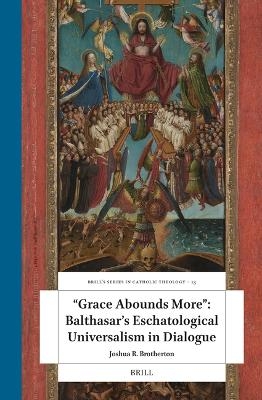
“Grace Abounds More”: Balthasar’s Eschatological Universalism in Dialogue
Brill (Verlag)
978-90-04-68166-8 (ISBN)
The problem of eternal damnation is one that should trouble all believers and impels many to seek answers to fundamental questions outside of the Church. For this reason, theologians with a missionary heart of the last century or more from across the ecclesial spectrum have sought to refashion the gospel in our own estranged image. In dialogue with one of the leading figures of this movement, Joshua Brotherton tackles the question of the plausibility that all will be saved. Sympathetic to their cause, this volume seeks to revise the way in which they envision the reconciliation of divine love and moral evil.
Joshua R. Brotherton, Ph.D. (2015), Catholic University of America, is Adjunct Professor at St Thomas University, Miami, US. and has published many academic articles and one monograph, One of the Trinity Has Suffered: Balthasar’s Theology of Divine Suffering in Dialogue (Emmaus Academic, 2020).
Acknowledgements
Credits
Introduction: The Fact of Balthasar’s Subjunctive Universalism and Its Presuppositions
1 The Crux of Balthasar’s Eschatology: What is Balthasar’s “Controversial” Hope?
2 Presuppositions of Balthasar’s Hope: The Framework
Part 1: Balthasar’s Hope: Interpretation and Speculation
1 Theodramatic Hope for Universal Salvation: Suspension of Judgment
1 Commentary on Balthasar’s Interpretation of Revelation
2 Ralph Martin’s Critique
3 Edward Oakes’ Response
4 Grisez and Ryan
5 Towards a Resolution: Suspension of Judgment
6 Excursus on Judas and Ratzinger
2 The “Mechanics” of Universal Salvation: The Possibility of Universal Conversion in Death
1 The Possibility of Universal Conversion
2 The Possibility of Conversion in Death
3 Hell as Self-Annihilation
4 Hope for Universal Conversion in Death
5 Conclusion
Part 2: Behind the Presuppositions of Balthasarian Hope
3 The Possibility of Refusing Grace: Freedom and Predestinarianism
1 Universalistic Theodrama and the Problem of Evil
2 Balthasar’s Inherited Augustinian Framework in the Theology of Grace
3 Tracing Balthasar’s Treatment of Grace and Freedom
4 Perspectives on Finite Freedom
5 Universal Hope and Predestination
6 Christocentrism and the Ghost of Barthian Augustinianism in Balthasarian Theology
7 Conclusion
4 The Desiderium Naturale and Theological Hope
1 Balthasar on the Nature – Grace Problematic
2 Balthasar’s Argument from Theological Hope
3 The Lonergan-Maritain Alternative
4 Potential Eschatological Implications
5 Conclusion
Part 3: Towards a Resolution to Balthasar’s Aporia
5 An Eschatological Alternative to Universalism in Light of the Theology of Grace
1 Maritain Answers the Balthasarian Dilemma
2 Challenges to Maritain’s Proposal
3 An Alternative to Balthasar’s Universalism
4 Another Theodramatic Eschatology?
5 Conclusion
6 Going Beyond Balthasar: The Universalist Rationalization of Evil
1 The Problem of Freedom in the Universalist Framework
2 Bulgakov’s Influence on Balthasar
3 Philosophical Influences on Bulgakov’s Sophiology
4 An Assessment of Bulgakov’s Eschatology
5 Bulgakov and Balthasar Contrasted
6 Conclusion
7 Excursus: Review of David Bentley Hart’s “That All Shall Be Saved”
Conclusion: Reclaiming Balthasar’s Theodramatic Eschatology?
Bibliography
Index
| Erscheinungsdatum | 19.12.2023 |
|---|---|
| Reihe/Serie | Brill's Studies in Catholic Theology ; 13 |
| Verlagsort | Leiden |
| Sprache | englisch |
| Maße | 155 x 235 mm |
| Gewicht | 610 g |
| Themenwelt | Religion / Theologie ► Christentum ► Kirchengeschichte |
| ISBN-10 | 90-04-68166-3 / 9004681663 |
| ISBN-13 | 978-90-04-68166-8 / 9789004681668 |
| Zustand | Neuware |
| Informationen gemäß Produktsicherheitsverordnung (GPSR) | |
| Haben Sie eine Frage zum Produkt? |
aus dem Bereich