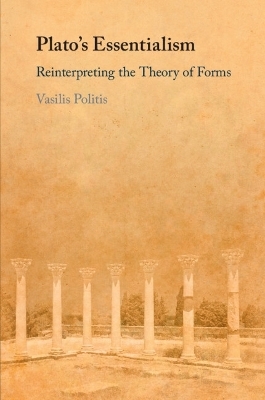
Plato's Essentialism
Cambridge University Press (Verlag)
978-1-108-98655-7 (ISBN)
In this book, Vasilis Politis argues that Plato's Forms are essences, not merely things that have an essence. Politis shows that understanding Plato's theory of Forms as a theory of essence presents a serious challenge to contemporary philosophers who regard essentialism as little more than an optional item on the philosophical menu. This approach, he suggests, also constitutes a sharp critique of those who view Aristotelian essentialism as the only sensible position: Plato's essentialism, Politis demonstrates, is a well-argued, rigorous, and coherent theory, and a viable competitor to that of Aristotle. This book will appeal to students and scholars with an interest in the intersection between philosophy and the history of philosophy.
Vasilis Politis is Professor of Philosophy at Trinity College Dublin. He is author of numerous books, including The Structure of Enquiry in Plato's Early Dialogues (Cambridge, 2015) and The Aporetic Tradition in Ancient Philosophy (with George Karamanolis, Cambridge, 2018).
Introduction; 1. Why Cannot the ti esti Question Be Answered by Example and Exemplar? Hippias Major; 2. Why Cannot Essences, or Forms, be Perceived by the Senses? Hippias Major. Phaedo. Republic; 3. Why are Essences, or Forms, Unitary, Uniform and Non-Composite? Why are they Changeless? Eternal? Are they Logically Independent of Each Other? Phaedo and Republic; 4. The Relation between Knowledge and Enquiry in the Phaedo; 5. Why are Essences, or Forms, Distinct from Sense-Perceptible Things? Phaedo 74 and Republic V. 478–479; 6. Why are Essences, or Forms, the Basis of all Causation and Explanation? Phaedo 95–105; 7. What is the Role of Essences, or Forms, in Judgements about Sense-Perceptible and Physical Things? Republic VII. 523–525; 8. Why does Thinking of Things Require Essences, or Forms? Parmenides; 9. Why are Essences, or Forms, Separate from Physical Things? Also Timaeus and Philebus; 10. What Yokes Together Mind and World? Phaedo 99–100 and Republic VI. 505–509; Conclusion: Forms Simply are Essences, not Things that have Essences.
| Erscheinungsdatum | 15.08.2023 |
|---|---|
| Zusatzinfo | Worked examples or Exercises |
| Verlagsort | Cambridge |
| Sprache | englisch |
| Maße | 152 x 228 mm |
| Gewicht | 390 g |
| Themenwelt | Geisteswissenschaften ► Philosophie ► Philosophie Altertum / Antike |
| ISBN-10 | 1-108-98655-2 / 1108986552 |
| ISBN-13 | 978-1-108-98655-7 / 9781108986557 |
| Zustand | Neuware |
| Informationen gemäß Produktsicherheitsverordnung (GPSR) | |
| Haben Sie eine Frage zum Produkt? |
aus dem Bereich