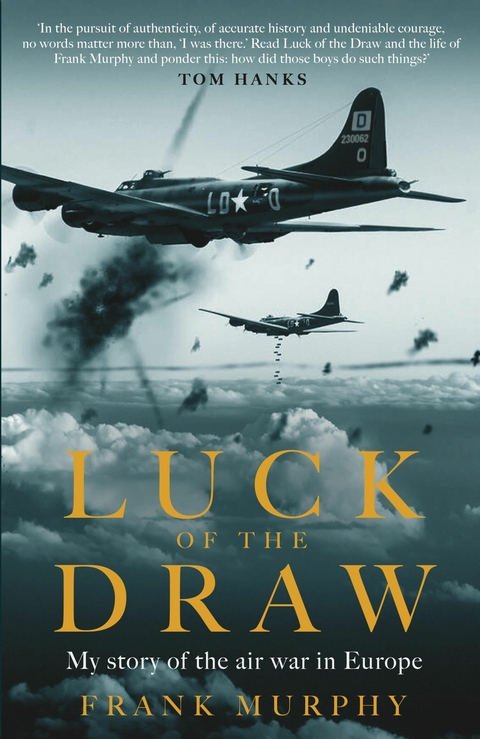
Luck of the Draw (eBook)
Elliott & Thompson (Verlag)
978-1-78396-736-0 (ISBN)
Frank Murphy survived months in a German POW camp after being shot out of his B-17 Flying Fortress. His bravery earned him the Distinguished Flying Cross, the Purple Heart, and the Air Medal. The incredible stories of Murphy and his 8th Air Force's 100th Bomb Group will be featured in the upcoming Steven Spielberg and Tom Hanks TV Series, Masters of the Air.
The captivating story of WWII Airman Frank Murphy, who features in new TV miniseries Masters of the Air. THE INSTANT NEW YORK TIMES BESTSELLER"e;In the pursuit of authenticity, of accurate history and undeniable courage, no words matter more than, 'I was there.' Read Luck of the Draw and the life of Frank Murphy and ponder this: how did those boys do such things?"e; Tom HanksThe epic true story of an American hero who flew during WWII, featured in the Steven Spielberg and Tom Hanks TV Series, Masters of the Air. Beginning on August 17, 1942, American heavy bomber crews of the Eighth Air Force took off for combat in the hostile skies over occupied Europe. The final price was staggering. 4,300 B-17s and B-24s failed to return; nearly 28,000 men were taken prisoner or interned in a neutral country, and a further 26,000 made the ultimate sacrifice. Luck of the Draw is more than a war story. It's the incredible, inspiring story of Frank Murphy, one of the few survivors from the 100th Bombardment Group, who cheated death for months in a German POW camp after being shot out of his B-17 Flying Fortress. Now with a new foreword written by his granddaughter Chloe Melas, of NBC, and daughter Elizabeth Murphy.
FOREWORD TO THE 2023 EDITION
by Elizabeth Murphy and Chloe Melas
Tucked inside our den’s floor-to-ceiling bookcases was a red leather-bound notebook full of my dad’s World War II memorabilia. As a twelve-year-old child, I don’t think I realized how special and tender these grainy, faded black-and-white photographs, Western Union telegrams, letters, and other mementos that my dad had somehow managed to save and collect from his time as a prisoner of war were.
They were covered in plastic sheets to protect the images, and I and my siblings (Frank, Patty, and Kevin) knew not to touch them directly but to handle them with care. Dad never talked much about his experiences during the war. I only knew he had been a navigator; his plane had been shot out of the air during an intense firefight, and he had remnants of shrapnel in his left arm and shoulder, which sometimes flared up.
Later, Dad would flesh out the story and describe how he parachuted for the first time on that day, October 10, 1943, and landed in a German farmer’s field near Münster. The occupants quickly came to his aid and took him inside their house and held him till the German police came to arrest him. Dad did speak of the German family’s kindness and that he gave a small boy a stick of chewing gum. My dad was on his twenty-first mission when his luck quite literally ran out. But he was one of the lucky ones. Forty-six members of the “Bloody Hundredth” were killed in that air battle, two of whom were members of his crew. His parents had no idea what had happened to him. They were only notified that he was missing in action. A few weeks later, they received a Western Union telegram and learned he was a prisoner of war at Stalag Luft III in Sagan, Germany.
Over the years, my dad largely kept his wartime memories to himself, rarely speaking of his harrowing experiences. But as children, we were fascinated when we learned he was held for eighteen months in the same prison camp as seen in the 1963 movie The Great Escape. We were completely enthralled—especially when he recounted how his own barracks had been digging a tunnel, but their efforts were unsuccessful.
In 1971, during my freshman year of college at Mercer University, I was taking a course on World War II and asked my dad if I could take his red notebook to my professor and share with my class. I remember the awe on my professor’s face as he leafed through the notebook. He peppered me with questions. What squadron was Dad in? Was he injured during the battle? How did he survive the prison camp? Many of his questions I couldn’t answer, as Dad had locked those memories and experiences away for decades.
One thing I always knew from an early age was how much my dad loved airplanes. He could identify almost any plane he spotted flying in the sky. His more than thirty-year career as a lawyer for the Lockheed Corporation suited him well. He traveled around the world negotiating contracts for airplanes with foreign governments. By the late ’70s, Dad was assigned to manage their office in Riyadh, Saudi Arabia. At this point, my siblings and I were grown. I was completing my master’s degree at Northern Arizona University. My mother, Ann, was finally able to travel with my dad. While living in Riyadh, they would frequently take vacations to neighboring countries. My mother, who was an avid reader and always traveled with a suitcase lined with paperback books, happened to be reading Len Deighton’s 1982 historical novel, Goodbye, Mickey Mouse, while they were on a flight to London. My mom recalls turning to my dad and telling him he needed to read it immediately, because it detailed the Allied invasion of Europe. Dad finished the book before the plane touched down on the tarmac and phoned the publisher from his hotel. He knew he had to get in touch with men he had flown with and was hoping Deighton could help. Deighton contacted Dad and told him veterans were holding 100th Bomb Group reunions. My father was shocked, as he had no idea these reunions existed. This was all the spark my dad needed. According to my mother, when he went to his first reunion, they said, “Frank, we’ve been looking for you for years. We thought you were dead!”
In the early ’90s, when I began writing my first children’s book, my dad came to me and said he had been thinking of writing a memoir about his time during the war for our family and friends. I enthusiastically encouraged him, and for his birthday in 1992, I gave him a book called How to Write Your Own Life Story. A few years later, my family moved to Dallas, Texas, and Dad and I kept in touch with phone calls and letters, and he sent me copies of parts of manuscripts, as it seemed he was always writing about the war.
Writing Luck of the Draw was a labor of love and took several years to complete. When his book was published, he gave me a copy, and only then did I realize the depth of pain, isolation, and sheer endurance and resilience he had needed to withstand the horrors of war. I found myself rereading page after page, as it seemed more like a movie than real life. Finally, Dad was ready to talk about his war experiences. It was like lifting a veil. I believe it was why he so enjoyed the reunions and speaking to groups of veterans later in life.
Frank D. Murphy was my dad but also my hero. He was soft-spoken, compassionate, and a true Southern gentleman. But even the pain and agony of war could not harden his heart. It’s been immensely gratifying to see his grandchildren, especially my daughter, Chloe, take a profound interest in his wartime experiences and carry the mantle. After all, it’s the next generation that will make sure we never forget these brave men who sacrificed their lives for the freedoms we have today.
—Elizabeth Murphy
As a little girl, I spent most of my weekends at my grandparents’ home in Atlanta, Georgia, where my grandfather would tell me bits and pieces about his World War II combat missions. His stories sounded like fairy tales, conjuring up images of him flying over mountains and oceans in far-off lands.
As I got older, I began to ask more questions and explore his home office, which was frozen in time with photos all over the walls and newspaper headlines from his time during the war. To this day, my grandmother has kept that room intact.
Every time I return to Atlanta from New York, where I live now, I sit in his desk chair and try to remember the sound of his soft Southern voice telling me about how he survived and that—just like the title of his book—it came down to “the luck of the draw.”
There are too many memories to recount and not enough pages to do him justice. But as I sit here writing, I can still hear him telling me about the death march from Stalag Luft III to Moosburg’s Stalag VIIA, a prisoner of war camp in Bavaria about twenty miles northeast of Munich. What he didn’t know was that they would march for the next three days and nights in subzero temperatures with little rest and hardly any food or water. Many men did not make it, with my grandfather recounting how men would collapse in the snow from the exhaustion and freezing weather. He said they would plead with the others not to give up. He even traded his shoes with a fellow soldier, as his leather soles were soaked, and he was given a pair of wooden clogs. I have one of those shoes—we don’t know what happened to the other.
My grandfather’s bravery during the war earned him the Air Medal with three Oak Leaf Clusters, the Purple Heart, and the Prisoner of War Medal.
Once I reached college at Auburn University, my interest in his combat missions and experience as a POW only heightened. During the summer of 2006 after my freshman year, I was studying abroad in London—just a few hours away from Royal Air Force Station 139, where my grandfather flew his perilous missions.
That summer, I learned my grandfather was diagnosed with cancer. I decided to make the two-hour train ride from London to Thorpe Abbotts, which is now a museum.
I’ll never forget the museum’s caretaker, Carol Batley, walking me into the air traffic control tower on the base, which is now filled with uniforms in glass cases and some personal belongings of the men who were stationed there—including my grandfather’s.
We walked in, and she said, “Hello, boys,” as if they were all still standing there in the control tower. The hair on my arms stood straight up; it’s a moment I’ll never forget.
I then found myself on the runway, where I called my grandfather from my tiny prepaid Vodafone. At eighty-four years old, it was the first and last time I ever heard him cry.
“I’m here,” I said to him.
He broke down, responding, “That’s where it all began.”
He died that next summer almost to the day, on June 16, 2007, at the age of eighty-five. Going there was one of the best decisions I’ve ever made.
I went back to England in the fall of 2021 for the chance of a lifetime. My family and I went to the set of Masters of the Air, the Tom Hanks– and Steven Spielberg–produced television series for Apple TV+. The show tells the stories of the 100th Bomb Group, and I can gratefully say my grandfather is a character.
After months of thinking we might not be able to go to the set due to COVID-19 travel restrictions, we finally made it, a few hours north of London not too far from my grandfather’s air force base. Although this time I...
| Erscheint lt. Verlag | 5.10.2023 |
|---|---|
| Verlagsort | London |
| Sprache | englisch |
| Themenwelt | Geschichte ► Allgemeine Geschichte ► 1918 bis 1945 |
| Geschichte ► Teilgebiete der Geschichte ► Militärgeschichte | |
| Schlagworte | Air Medal • ambrose • Anne Frank • Apple TV • Austin Butler • band of brothers • best new history • best new world war 2 • Beyond the Tracks • bomber pilot • books for history lovers • Boyd • Boy in Striped Pajamas • Boy in the Striped Pajamas • Boyne • Captain Corelli's Mandolin • Choice • Concentration Camp • Damien Lewis • D-Day • De Jong • diary of a young girl • Donald L. Miller • Ebert • Eger • Eject! • escape artist • fairweather • finkelstein • Frankl • Frank Murphy • Freedland • Germany • gifts for him • Hartinger • Himmler • History • history lovers • Hitler • Hitler Stalin Mum and Dad • Holocaust • Joseph Kessel • Keneally • kinder transport • Kor • Lily’s Promise • Man’s Search for Meaning • Masters of the Air • Maus • Memoir • Nazi • nazi billionaires • Phantom Major • Pilot • POW camp • Prisoner of War Medal • purple heart • Reit • Rushton • Saboteur of Aushwitz • SAS Brothers in Arms • Schindler’s Arc • Schindler’s List • Shoa • soldier • Spiegelman • Stephen Spielberg • Steven Speilberg • Steven Spielberg apple tv series • Third Reich • Tom hanks series • True story • Twins of Aushwitz • Until the Eyes Shut • Village in the Third Reich • Volunteer • war • Winkle • Woody Harrelson • World War 2 • ww2 • WWII |
| ISBN-10 | 1-78396-736-6 / 1783967366 |
| ISBN-13 | 978-1-78396-736-0 / 9781783967360 |
| Informationen gemäß Produktsicherheitsverordnung (GPSR) | |
| Haben Sie eine Frage zum Produkt? |
 EPUB (Adobe DRM)
Kopierschutz: Adobe-DRM
Adobe-DRM ist ein Kopierschutz, der das eBook vor Mißbrauch schützen soll. Dabei wird das eBook bereits beim Download auf Ihre persönliche Adobe-ID autorisiert. Lesen können Sie das eBook dann nur auf den Geräten, welche ebenfalls auf Ihre Adobe-ID registriert sind.
Details zum Adobe-DRM
Dateiformat: EPUB (Electronic Publication)
EPUB ist ein offener Standard für eBooks und eignet sich besonders zur Darstellung von Belletristik und Sachbüchern. Der Fließtext wird dynamisch an die Display- und Schriftgröße angepasst. Auch für mobile Lesegeräte ist EPUB daher gut geeignet.
Systemvoraussetzungen:
PC/Mac: Mit einem PC oder Mac können Sie dieses eBook lesen. Sie benötigen eine
eReader: Dieses eBook kann mit (fast) allen eBook-Readern gelesen werden. Mit dem amazon-Kindle ist es aber nicht kompatibel.
Smartphone/Tablet: Egal ob Apple oder Android, dieses eBook können Sie lesen. Sie benötigen eine
Geräteliste und zusätzliche Hinweise
Buying eBooks from abroad
For tax law reasons we can sell eBooks just within Germany and Switzerland. Regrettably we cannot fulfill eBook-orders from other countries.
aus dem Bereich