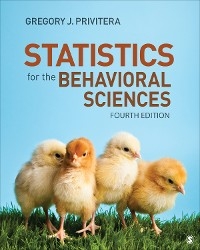
Statistics for the Behavioral Sciences (eBook)
2133 Seiten
Sage Publications, Inc (Verlag)
978-1-5443-6282-3 (ISBN)
PART I. INTRODUCTION AND DESCRIPTIVE STATISTICS
1. Introduction to Statistics
1.1 The Use of Statistics in Science
1.2 Descriptive and Inferential Statistics
1.3 Research Methods and Statistics
1.4 Scales of Measurement
1.5 Types of Variables for Which Data Are Measured
1.6 SPSS in Focus: Entering and Defining Variables
2. Summarizing Data: Frequency Distributions in Tables and Graphs
2.1 Why Summarize Data?
2.2 Simple Frequency Distributions for Grouped Data
2.3 Other Ways of Summarizing Grouped Data in Frequency Distributions
2.4 Identifying Percentile Points and Percentile Ranks
2.5 SPSS in Focus: Frequency Distributions for Quantitative Data
2.6 Frequency Distributions for Ungrouped Data
2.7 SPSS in Focus: Frequency Distributions for Categorical Data
2.8 Pictorial Frequency Distributions
2.9 Graphing Distributions: Continuous Data
2.10 Stem-and-Leaf Displays
2.11 Graphing Distributions: Discrete and Categorical Data
2.12 SPSS in Focus: Histograms, Bar Charts, Pie Charts, and Stem-and-Leaf Displays
3. Summarizing Data: Central Tendency
3.1 Introduction to Central Tendency
3.2 Measures of Central Tendency: The Mean
3.3 Measures of Central Tendency: The Weighted Mean
3.4 Measures of Central Tendency: The Median and the Mode
3.5 Characteristics of the Mean
3.6 Choosing an Appropriate Measure of Central Tendency
3.7 SPSS in Focus: Mean, Median, and Mode
4. Summarizing Data: Variability
4.1 Introduction to Variability
4.2 The Range
4.3 Quartiles and Interquartiles
4.4 The Variance
4.5 The Computational Formula for Variance
4.6 Explaining Variance for Populations and Samples
4.7 The Standard Deviation
4.8 The Informativeness of Standard Deviation
4.9 SPSS in Focus: Range, Quartiles, Variance, and Standard Deviation
PART II. PROBABILITY AND THE FOUNDATIONS OF INFERENTIAL STATISTICS
5. Probability
5.1 Introduction to Probability
5.2 Probability and Relative Frequency
5.3 The Relationship Between Multiple Outcomes
5.4 Conditional Probabilities and Bayes’s Theorem
5.5 SPSS in Focus: Probability Tables
5.6 Probability Distributions
5.7 The Mean of a Probability Distribution and Expected Value
5.8 The Variance and Standard Deviation of a Probability Distribution
5.9 Expected Value and the Binomial Distribution
6. Probability, Normal Distributions, and z Scores
6.1 Characteristics of the Normal Distribution
6.2 The Standard Normal Distribution and the z Transformation
6.3 The Unit Normal Table: A Brief Introduction
6.4 Locating Proportions
6.5 Locating Scores
6.6 SPSS in Focus: Converting Raw Scores to Standard z Scores
6.7 The Normal Approximation to the Binomial Distribution
7. Probability and Sampling Distributions
7.1 Selecting Samples From Populations
7.2 Selecting a Sample: Who’s In and Who’s Out?
7.3 Sampling Distributions: The Mean
7.4 Sampling Distributions: The Variance
7.5 The Standard Error of the Mean
7.6 Factors That Decrease Standard Error
7.7 SPSS in Focus: Estimating the Standard Error of the Mean
7.8 Standard Normal Transformations With Sampling Distributions
8. Hypothesis Testing: Significance, Effect Size, Estimation, and Power
8.1 The Informativeness of Evaluating Effects in Science
8.2 Inferential Statistics and Applying the Steps to Hypothesis Testing
8.3 Making a Decision: Types of Error
8.4 Testing for Significance: Examples Using the z Test
8.5 Measuring the Size of an Effect: Cohen’s d
8.6 Confidence Intervals for the One-Sample z Test
8.7 Factors That Influence Power
8.8 Assumptions of Parametric Testing: Normality and Nonparametric Alternatives
8.9 SPSS in Focus: A Preview for Analyzing Inferential Statistics
PART III. MAKING INFERENCES ABOUT ONE OR TWO MEANS
9. Testing Means: One-Sample t Test With Confidence Intervals
9.1 Going From z to t
9.2 The Degrees of Freedom
9.3 Reading the t Table
9.4 Computing the One-Sample t Test
9.5 Effect Size for the One-Sample t Test
9.6 Confidence Intervals for the One-Sample t Test
9.7 Inferring Significance and Effect Size From a Confidence Interval
9.8 SPSS in Focus: One-Sample t Test and Confidence Intervals
10. Testing Means: Two-Independent-Sample t Tests With Confidence Intervals
10.1 Introduction to the Between-Subjects Design
10.2 Selecting Two Independent Samples
10.3 Variability and Comparing Differences Between Two Groups
10.4 Computing the Two-Independent-Sample t Test
10.5 Effect Size for the Two-Independent-Sample t Test
10.6 Confidence Intervals for the Two-Independent-Sample t Test
10.7 Inferring Significance and Effect Size From a Confidence Interval
10.8 SPSS in Focus: Two-Independent-Sample t Test and Confidence Intervals
11. Testing Means: The Related-Samples t Test With Confidence Intervals
11.1 Selecting Related Samples
11.2 Advantages of Selecting Related Samples
11.3 Introduction to the Related-Samples t Test
11.4 Computing the Related-Samples t Test
11.5 Measuring Effect Size for the Related-Samples t Test
11.6 Confidence Intervals for the Related-Samples t Test
11.7 Inferring Significance and Effect Size From a Confidence Interval
11.8 SPSS in Focus: Related-Samples t Test and Confidence Intervals
PART IV. MAKING INFERENCES ABOUT THE VARIABILITY OF TWO OR MORE MEANS
12. Analysis of Variance: One-Way Between-Subjects Design
12.1 Introduction to Analysis of Variance
12.2 Selecting Two or More Independent Samples
12.3 The Test Statistic and Sources of Variation
12.4 Degrees of Freedom
12.5 The One-Way Between-Subjects ANOVA
12.6 Post Hoc Tests
12.7 Measuring Effect Size
12.8 SPSS in Focus: The One-Way Between-Subjects ANOVA
13. Analysis of Variance: One-Way Within-Subjects (Repeated-Measures) Design
13.1 Analysis of Variance for a Within-Subjects Factor
13.2 The Test Statistic and Sources of Variation
13.3 Degrees of Freedom
13.4 The One-Way Within-Subjects ANOVA
13.5 Post Hoc Comparisons: Bonferroni Procedure
13.6 Measuring Effect Size
13.7 SPSS in Focus: The One-Way Within-Subjects ANOVA
13.8 The Within-Subjects Design: Consistency and Power
14. Analysis of Variance: Two-Way Between-Subjects Factorial Design
14.1 Analysis of Variance With Two Factors
14.2 Designs for the Two-Way ANOVA
14.3 Describing Variability: Main Effects and Interactions
14.4 The Two-Way Between-Subjects ANOVA
14.5 Analyzing Main Effects and Interactions
14.6 Measuring Effect Size
14.7 SPSS in Focus: The Two-Way Between-Subjects ANOVA
PART V. MAKING INFERENCES ABOUT PATTERNS, FREQUENCIES, AND ORDINAL DATA
15. Correlation
15.1 The Structure of a Correlational Design
15.2 The Pearson Test Statistic and Sources of Variability
15.3 Assumptions for the Pearson Correlation Coefficient
15.4 Pearson Correlation Coefficient
15.5 Effect Size: The Coefficient of Determination
15.6 SPSS in Focus: Pearson Correlation Coefficient
15.7 Limitations in Interpretation: Causality, Outliers, and Restriction of Range
15.8 Alternative to Pearson’s r: Spearman Correlation Coefficient
15.9 SPSS in Focus: Spearman Correlation Coefficient
15.10 Alternative to Pearson’s r: Point-Biserial Correlation Coefficient
15.11 SPSS in Focus: Point-Biserial Correlation Coefficient
15.12 Alternative to Pearson’s r: Phi Correlation Coefficient
15.13 SPSS in Focus: Phi Correlation Coefficient
16. Linear Regression and Multiple Regression
16.1 The Structure of Linear Regression
16.2 What Makes the Regression Line the Best-Fitting Line?
16.3 The Slope and y-Intercept of a Straight Line
16.4 Using the Method of Least Squares to Find the Best Fit
16.5 Evaluating Significance Using Analysis of Regression
16.6 Using the Standard Error of Estimate to Measure Accuracy
16.7 SPSS in Focus: Analysis of Regression
16.8 Introduction to Multiple Regression
16.9 Evaluating Significance Using Multiple Regression
16.10 The ß Coefficient for Multiple Regression
16.11 Evaluating Significance for the Relative Contribution of Each Predictor Variable
16.12 SPSS in Focus: Multiple Regression Analysis
17. Nonparametric Tests: Chi-Square Tests
17.1 Introduction to the Chi-Square Test
17.2 Comparing Observed and Expected Frequencies for the Goodness-of-Fit Test
17.3 The Test Statistic and Degrees of Freedom for the Goodness-of-Fit Test
17.4 Computing the Chi-Square Goodness-of-Fit Test
17.5 Interpreting the Chi-Square Goodness-of-Fit Test
17.6 SPSS in Focus: The Chi-Square Goodness-of-Fit Test
17.7 Introduction to the Chi-Square Test for Independence
17.8 Computing the Chi-Square Test for Independence
17.9 The Relationship Between Chi-Square and the Phi Coefficient
17.10 Measures of Effect Size
17.11 SPSS in Focus: The Chi-Square Test for Independence
18. Nonparametric Tests: Tests for Ordinal Data
18.1 Tests for Ordinal Data
18.2 The Sign Test
18.3 SPSS in Focus: Computing the Related-Samples Sign Test
18.4 The Wilcoxon Signed-Ranks T Test
18.5 SPSS in Focus: Computing the Wilcoxon Signed-Ranks T Test
18.6 The Mann-Whitney U Test
18.7 SPSS in Focus: Computing the Mann-Whitney U Test
18.8 The Kruskal-Wallis H Test
18.9 SPSS in Focus: Computing the Kruskal-Wallis H Test
18.10 The Friedman Test
18.11 SPSS in Focus: Computing the Friedman Test
Appendix B. Basic Math Review and Summation Notation
Appendix A. Overview of Core Statistical Concepts in the Behavioral Sciences
Appendix C. SPSS General Instructions Guide With Steps for Evaluating Assumptions for Inferential Statistics
Appendix D. Statistical Tables
Appendix E. Chapter Solutions for Even-Numbered Problems
Glossary
References
Index
| Erscheint lt. Verlag | 18.7.2023 |
|---|---|
| Verlagsort | Thousand Oaks |
| Sprache | englisch |
| Themenwelt | Geisteswissenschaften ► Psychologie |
| Schlagworte | Behavioral Sciences • Gregory J. Privitera • Statistical Computation • Statistical Interpretation • Statistical Theory • Statistics • Statistics for the Behavioral Sciences • statistics in psychology |
| ISBN-10 | 1-5443-6282-X / 154436282X |
| ISBN-13 | 978-1-5443-6282-3 / 9781544362823 |
| Informationen gemäß Produktsicherheitsverordnung (GPSR) | |
| Haben Sie eine Frage zum Produkt? |
 EPUB (Adobe DRM)
Kopierschutz: Adobe-DRM
Adobe-DRM ist ein Kopierschutz, der das eBook vor Mißbrauch schützen soll. Dabei wird das eBook bereits beim Download auf Ihre persönliche Adobe-ID autorisiert. Lesen können Sie das eBook dann nur auf den Geräten, welche ebenfalls auf Ihre Adobe-ID registriert sind.
Details zum Adobe-DRM
Dateiformat: EPUB (Electronic Publication)
EPUB ist ein offener Standard für eBooks und eignet sich besonders zur Darstellung von Belletristik und Sachbüchern. Der Fließtext wird dynamisch an die Display- und Schriftgröße angepasst. Auch für mobile Lesegeräte ist EPUB daher gut geeignet.
Systemvoraussetzungen:
PC/Mac: Mit einem PC oder Mac können Sie dieses eBook lesen. Sie benötigen eine
eReader: Dieses eBook kann mit (fast) allen eBook-Readern gelesen werden. Mit dem amazon-Kindle ist es aber nicht kompatibel.
Smartphone/Tablet: Egal ob Apple oder Android, dieses eBook können Sie lesen. Sie benötigen eine
Geräteliste und zusätzliche Hinweise
Buying eBooks from abroad
For tax law reasons we can sell eBooks just within Germany and Switzerland. Regrettably we cannot fulfill eBook-orders from other countries.
aus dem Bereich