


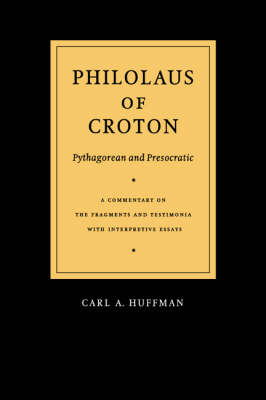
Philolaus of Croton: Pythagorean and Presocratic
A Commentary on the Fragments and Testimonia with Interpretive Essays
Seiten
1993
Cambridge University Press (Verlag)
978-0-521-41525-5 (ISBN)
Cambridge University Press (Verlag)
978-0-521-41525-5 (ISBN)
This is the first comprehensive study for nearly 200 years of what remains of the writings of the Presocratic philosopher Philolaus of Croton (470–390 BC). Professor Huffman presents the fragments and testimonia with accompanying translations and introductory chapters and interpretive commentary.
This is the first comprehensive study for nearly 200 years of what remains of the writings of the Presocratic philosopher Philolaus of Croton (c. 470–385 BC). These fragments are crucial to our understanding of one of the most influential schools of ancient philosophy, the Pythagoreans; they also show close ties with the main lines of development of Presocratic thought, and represent a significant response to thinkers such as Parmenides and Anaxagoras. Professor Huffman presents the fragments and testimonia (including the spurious fragments in a separate section for reference) with accompanying translations and introductory chapters and interpretive commentary. He not only produces further argument for the authenticity of much that used to be neglected, but also undertakes a critique of Aristotle's testimony, opening the way for a quite new reading of fifth-century Pythagoreanism in general and of Philolaus in particular. Philolaus is revealed as a serious natural philosopher.
This is the first comprehensive study for nearly 200 years of what remains of the writings of the Presocratic philosopher Philolaus of Croton (c. 470–385 BC). These fragments are crucial to our understanding of one of the most influential schools of ancient philosophy, the Pythagoreans; they also show close ties with the main lines of development of Presocratic thought, and represent a significant response to thinkers such as Parmenides and Anaxagoras. Professor Huffman presents the fragments and testimonia (including the spurious fragments in a separate section for reference) with accompanying translations and introductory chapters and interpretive commentary. He not only produces further argument for the authenticity of much that used to be neglected, but also undertakes a critique of Aristotle's testimony, opening the way for a quite new reading of fifth-century Pythagoreanism in general and of Philolaus in particular. Philolaus is revealed as a serious natural philosopher.
Part I. Introduction: 1. Life and writings; 2. Authenticity; Part II. Philolaus' Philosophy: 3. Limiters and unlimiteds; 4. Number and Harmonia; 5. Philolaus' use of archai and the method of hypothesis; Part III. Genuine Fragments and Testimonia: 6. Basic principles; 7. Epistemology; 8. Cosmogony; 9. Astronomy; 10. Embryology and medicine; 11. Soul and psychic faculties; 12. Miscellaneous genuine fragments and testimonia; Part IV. Spurious or Doubtful Fragments and Testimonia: 13. The world soul; 14. Fragments and testimonia on number; 15. Fragments and testimonia on music; 16. Gods and angles; 17. Fragments and testimonia on cosmology; 18. Fragments on soul; 19. Miscellaneous fragments and testimonia; Bibliography; Indexes.
| Erscheint lt. Verlag | 22.7.1993 |
|---|---|
| Übersetzer | Carl A. Huffman |
| Zusatzinfo | 1 Line drawings, unspecified |
| Verlagsort | Cambridge |
| Sprache | englisch |
| Maße | 158 x 236 mm |
| Gewicht | 832 g |
| Themenwelt | Geisteswissenschaften ► Philosophie ► Philosophie Altertum / Antike |
| ISBN-10 | 0-521-41525-X / 052141525X |
| ISBN-13 | 978-0-521-41525-5 / 9780521415255 |
| Zustand | Neuware |
| Informationen gemäß Produktsicherheitsverordnung (GPSR) | |
| Haben Sie eine Frage zum Produkt? |
Mehr entdecken
aus dem Bereich
aus dem Bereich
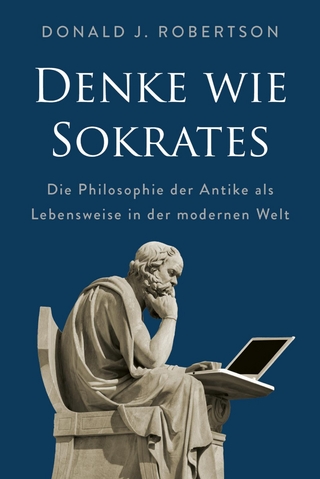
Die Philosophie der Antike als Lebensweise in der modernen Welt
Buch | Hardcover (2025)
FinanzBuch Verlag
CHF 25,20


