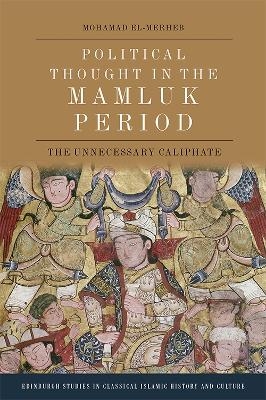
Political Thought in the Mamluk Period
Edinburgh University Press (Verlag)
978-1-4744-7965-3 (ISBN)
Political Thought in the Mamluk Period covers the political thought produced by legal theorists, jurists, judges and administrators of the late Ayyubid and early Mamluk period as they tackled a central question: how best to govern their communities. It proposes a taxonomy of the main themes and concerns of this political thought under the three ideals of the rule of law, limited government and legitimate delegation of power. Further, it recommends a contextualist approach for interpreting Islamic political texts based on their narrow social, intellectual and political contexts.
Mohamad El Merheb is Assistant Professor of Medieval History at the University of Groningen. He is a historian of Islamic political thought and studies the ideal of ‘the rule of law’ as expressed in advice literature under the Mamluks, Ayyubids, and Seljuqs. Mohamad’s other research interests include the crusades, the depiction of kings Louis IX and Frederic II in Islamic historiography, and professional mobility in pre-modern Islam. His recent projects include a collected volume entitled Professional Mobility in Islamic Societies (700-1750), New Concepts and Approaches (Brill, 2021).
IntroductionWhat is Islamic political thought?SourcesReading Ayyubid and Mamluk political thoughtThemes, concerns and idealsChapters outline
1. Reading Islamic political thoughtThe longue duréeImposed paradigms i) Theory of the caliphate ii) The fall of BaghdadThe mythology of genreAvailability of textsContextualising political thoughtIntellectual, social and cultural contextPolitical languages, conventions and discourses
2. Ibn Jamaʿa’s synthesis and praxis of Shafiʿi political thoughtIbn Jamaʿa: a biography The Political Thought of Ibn JamaʿaBeginnings: the MustanadCrystallisation: the MukhtasarSynthesis: the TahrirThe praxis of Ibn Jamaʿa’s political thoughtConclusion
3. Sufi political thoughtThe Sufis and the production of political thoughtSufism and politicsMisbah al-hidaya: Sufi political thoughtCoercive authority by right of necessityEthics, mysticism and the rule of law i) Ethics and practical philosophy ii) Restraint of the ruler’s powerThe Sufi theory of delegationThe primacy of Sufi counselConclusion
4. The late Ayyubid and early Mamluk context: Ibn Talha and al-QarafiIbn Talha: taming sultanic powerIbn Talha: life and workThe blending of genresModeration of power by ethicsCoercive power: legitimacy, necessity and justiceAdministration, delegation and the shariʿaA genealogical missing link?Al-Qarafi: the granularisation of the Prophet’s authorities
5. Mamluk historiography as a form of political thoughtAl-Subki’s biography of Ibn ʿAbd al-SalamThe politics of al-Subki’s historiographyA Shafiʿi Lieu de M é moire?Politics and madhhabsConventions preservedThe contours of Shafiʿi political thought i) De-legitimation of sultan al-Salih Ismaʿil ii) Moderating rulers: the reign of al-Salih Ayyub iii) Caliph, sultan, amirs and ʿulamaʾ iv) Defending the populace v) Baybars: Legitimation and tensionShafiʿi political thought in a later Subki workConclusion
BibliographyPrimary sourcesSecondary sources
| Erscheinungsdatum | 21.10.2023 |
|---|---|
| Reihe/Serie | Edinburgh Studies in Classical Islamic History and Culture |
| Verlagsort | Edinburgh |
| Sprache | englisch |
| Maße | 156 x 234 mm |
| Themenwelt | Geisteswissenschaften ► Religion / Theologie ► Islam |
| ISBN-10 | 1-4744-7965-0 / 1474479650 |
| ISBN-13 | 978-1-4744-7965-3 / 9781474479653 |
| Zustand | Neuware |
| Informationen gemäß Produktsicherheitsverordnung (GPSR) | |
| Haben Sie eine Frage zum Produkt? |
aus dem Bereich