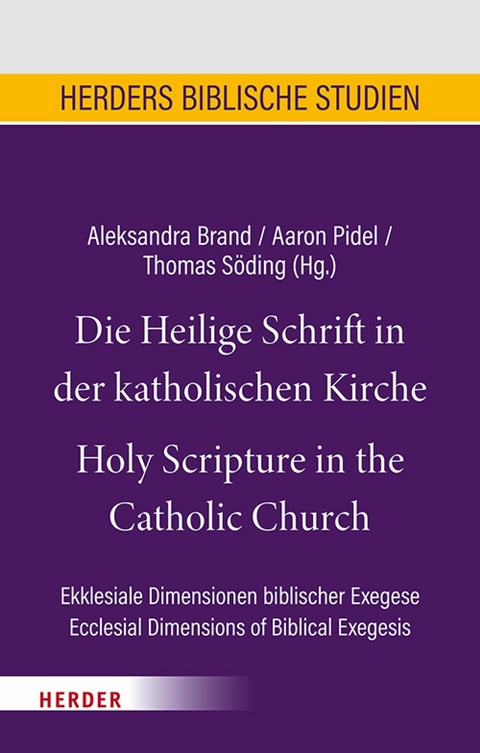
Die Heilige Schrift in der katholischen Kirche/Holy Scripture in the Catholic Church (eBook)
385 Seiten
Verlag Herder GmbH
978-3-451-84702-8 (ISBN)
Aleksandra Brand, Dr. theol., Oberassistentin am Lehrstuhl für Exegese des Neuen Testaments an der Universität Luzern. Aaron Pidel, Dr. theol., Professor für Dogmatik an der Päpstlichen Universität Rom, Gregoriana. Thomas Söding, geb. 1956, Dr. theol., Professor für Neues Testament an der Katholisch-Theologischen Fakultät der Ruhr-Universität Bochum, Berater der Glaubenskommission der Deutschen Bischofskonferenz, seit 2021 Vizepräsident des Zentralkomitees deutscher Katholiken und Vizepräsident des Synodalen Weges, Mitglied der Akademie der Wissenschaften und der Künste Nordrhein-Westfalen. Gary A. Anderson, PhD theol., Hesburgh Professor of Catholic Thought, Department of Theology, University of Notre Dame, Indiana. Markus Bockmuehl, PhD theol., Dean Ireland's Professor of the Exegesis of Holy Scripture, Keble College, Faculty of Theology and religion, University of Oxford. Aleksandra Brand, Dr. theol., Oberassistentin am Lehrstuhl für Exegese des Neuen Testaments an der Universität Luzern. Reinhard Feldmeier (Dr. theol., geb. 1952), ist Professor für Neues Testament in Göttingen. Seine Forschungsschwerpunkte umfassen die Religionsgeschichte der hellenistischen Welt, die Synoptischen Evangelien, die Katholischen Briefe und Aposteltraditionen sowie die Biblische Gotteslehre. Prof. Feldmeier ist unter anderem Mitherausgeber der »Biblischen Notizen« im Herder Verlag. Antony Giambrone OP, PhD theol., Professeur École biblique et archéologique française de Jérusalem. Daniel Lanzinger, Dr. theol., Professor für Neues Testament an der Theologischen Fakultät Paderborn. Aaron Pidel, Dr. theol., Professor für Dogmatik an der Päpstlichen Universität Rom, Gregoriana. Katharina Pyschny, geb. 1984; Studium der Kath. Theologie und Germanistik in Köln, Bonn, Bochum u. Jerusalem. Wiss. MA am Lehrstuhl für AT an der Ruhr-Univ. Bochum (derzeit auf einem dreijährigen Forschungsaufenthalt an der Universität Lausanne, Schweiz). Forschungsschwerpunkte: Exegese des AT (insb. Pentateuch), Führungskonzepte im Alten Testament, (Religions-)Geschichte des antiken Israels, Materielle Kultur Israels/Palästinas, Altorientalische Ikonographie. Johanna Rahner, geboren 1962, ist seit 2014 Professorin für Dogmatik, Dogmengeschichte und Ökumenische Theologie an der Katholisch-Theologischen Fakultät der Eberhard-Karls-Universität Tübingen. Zahlreiche Veröffentlichungen zu ekklesiologischen, sakramententheologischen und ökumenischen Fragestellungen. Dorothea Sattler, geb. 1961, Dr. theol. habil., Professorin für Ökumenische Theologie und Dogmatik sowie Direktorin des Ökumenischen Instituts der Katholisch-Theologischen Fakultät der Westfälischen Wilhelms-Universität Münster, Sprecherin des Sachbereichs 1 'Theologie, Pastoral und Ökumene' des ZdK, Mitglied in der Ökumene-Kommission der Deutschen Bischofskonferenz, wissenschaftliche Leiterin des Ökumenischen Arbeitskreises evangelischer und katholischer Theologen (zusammen mit Prof. Dr. Volker Leppin), Co-Vorsitzende des Synodalforums 'Frauen in Diensten und Ämtern in der Kirche'. Ursula Schumacher, geboren 1979, ist Professorin für Dogmatik an der Theologischen Fakultät der Universität Luzern. Studium der Katholischen Theologie, Hispanistik und Pädagogik an den Universitäten Bochum und San Cristóbal de La Laguna, Promotion in Augsburg (2013), anschließend Referendariat und Tätigkeit in der kirchlichen Erwachsenenbildung, Lehrbeauftragte an der Universität Fribourg und Professorin an der Pädagogischen Hochschule Karlsruhe. Forschungsschwerpunkte unter anderem im Bereich der Gnadenlehre und der Theologiegeschichte des 19. und 20. Jahrhunderts. Thomas Söding, geb. 1956, Dr. theol.
Aleksandra Brand, Dr. theol., Oberassistentin am Lehrstuhl für Exegese des Neuen Testaments an der Universität Luzern. Aaron Pidel, Dr. theol., Professor für Dogmatik an der Päpstlichen Universität Rom, Gregoriana. Thomas Söding, geb. 1956, Dr. theol., Professor für Neues Testament an der Katholisch-Theologischen Fakultät der Ruhr-Universität Bochum, Berater der Glaubenskommission der Deutschen Bischofskonferenz, seit 2021 Vizepräsident des Zentralkomitees deutscher Katholiken und Vizepräsident des Synodalen Weges, Mitglied der Akademie der Wissenschaften und der Künste Nordrhein-Westfalen. Gary A. Anderson, PhD theol., Hesburgh Professor of Catholic Thought, Department of Theology, University of Notre Dame, Indiana. Markus Bockmuehl, PhD theol., Dean Ireland's Professor of the Exegesis of Holy Scripture, Keble College, Faculty of Theology and religion, University of Oxford. Aleksandra Brand, Dr. theol., Oberassistentin am Lehrstuhl für Exegese des Neuen Testaments an der Universität Luzern. Reinhard Feldmeier (Dr. theol., geb. 1952), ist Professor für Neues Testament in Göttingen. Seine Forschungsschwerpunkte umfassen die Religionsgeschichte der hellenistischen Welt, die Synoptischen Evangelien, die Katholischen Briefe und Aposteltraditionen sowie die Biblische Gotteslehre. Prof. Feldmeier ist unter anderem Mitherausgeber der »Biblischen Notizen« im Herder Verlag. Antony Giambrone OP, PhD theol., Professeur École biblique et archéologique française de Jérusalem. Daniel Lanzinger, Dr. theol., Professor für Neues Testament an der Theologischen Fakultät Paderborn. Aaron Pidel, Dr. theol., Professor für Dogmatik an der Päpstlichen Universität Rom, Gregoriana. Katharina Pyschny, geb. 1984; Studium der Kath. Theologie und Germanistik in Köln, Bonn, Bochum u. Jerusalem. Wiss. MA am Lehrstuhl für AT an der Ruhr-Univ. Bochum (derzeit auf einem dreijährigen Forschungsaufenthalt an der Universität Lausanne, Schweiz). Forschungsschwerpunkte: Exegese des AT (insb. Pentateuch), Führungskonzepte im Alten Testament, (Religions-)Geschichte des antiken Israels, Materielle Kultur Israels/Palästinas, Altorientalische Ikonographie. Johanna Rahner, geboren 1962, ist seit 2014 Professorin für Dogmatik, Dogmengeschichte und Ökumenische Theologie an der Katholisch-Theologischen Fakultät der Eberhard-Karls-Universität Tübingen. Zahlreiche Veröffentlichungen zu ekklesiologischen, sakramententheologischen und ökumenischen Fragestellungen. Dorothea Sattler, geb. 1961, Dr. theol. habil., Professorin für Ökumenische Theologie und Dogmatik sowie Direktorin des Ökumenischen Instituts der Katholisch-Theologischen Fakultät der Westfälischen Wilhelms-Universität Münster, Sprecherin des Sachbereichs 1 "Theologie, Pastoral und Ökumene" des ZdK, Mitglied in der Ökumene-Kommission der Deutschen Bischofskonferenz, wissenschaftliche Leiterin des Ökumenischen Arbeitskreises evangelischer und katholischer Theologen (zusammen mit Prof. Dr. Volker Leppin), Co-Vorsitzende des Synodalforums "Frauen in Diensten und Ämtern in der Kirche". Ursula Schumacher, geboren 1979, ist Professorin für Dogmatik an der Theologischen Fakultät der Universität Luzern. Studium der Katholischen Theologie, Hispanistik und Pädagogik an den Universitäten Bochum und San Cristóbal de La Laguna, Promotion in Augsburg (2013), anschließend Referendariat und Tätigkeit in der kirchlichen Erwachsenenbildung, Lehrbeauftragte an der Universität Fribourg und Professorin an der Pädagogischen Hochschule Karlsruhe. Forschungsschwerpunkte unter anderem im Bereich der Gnadenlehre und der Theologiegeschichte des 19. und 20. Jahrhunderts. Thomas Söding, geb. 1956, Dr. theol.
Titel 1
Impressum 5
Vorwort 6
Inhaltsverzeichnis · Content 8
I. Grundlagen und Horizonte: Wort Gottes – Schrift – Glaube – Exegese · Foundations and horizons: Word of God – Scripture – Faith – Exegesis 12
Thomas Söding: Listening to the Word of God 14
1. Hermeneutical perspectives: The Word of God in human words 15
1.1 The hermeneutical program of Hebrews 15
1.2 New Testament resonances of the Word of God theology 17
1.3 Communicative revelation theology in the New Testament 19
2. Hermeneutical tasks: The community of faith in troubles of life 21
2.1 Strengthen the faith in personal uncertainty 22
2.2 Strengthen the community in social upheavals 25
2.3 Ethically sensitive ecclesiology in the New Testament 27
3. Hermeneutical means: Theological orientation through reading the Bible 28
3.1 The competence of the magisterium and the freedom of theology 28
3.2 Biblical theology and inter-religious dialogue 31
3.3 The service in the world in the name of God 33
List of literature cited 34
Aaron Pidel, SJ: The Exegete’s Task According to Dei Verbum 12 37
1. Elliptical v. Two-Step Integration 38
2. The Inescapable Heteronomy of Historical Reasoning 43
2.1 Blondel on the “Science” of History 43
2.2 Troeltsch on the “Science” of History 44
2.3 Circularity of Troeltschian Historiography 47
3. Interpretation of Dei Verbum 12 50
Conclusion 53
List of literature cited 54
Aleksandra Brand: Hermeneutik des Zeugnisses 57
1. Problemanzeige: Zeugnis als Mythos? 57
2. Exegetische Diskussion: Zeugnisse von Zeugnissen 62
2.1 Die historische Perspektive auf die Gestalt Jesu von Nazareth – Chancen und Risiken 62
2.2 Hermeneutische Perspektiven einer historisch-kritisch aufgeklärten Biblischen Theologie 64
2.3 Biblische Perspektive auf den Begriff des Zeugnisses als hermeneutischer Kategorie 66
3. Synthese: Offenbarung im Zeugnis 70
Verzeichnis der zitierten Literatur 75
II. Kanon und Inspiration in der Gemeinschaft des Glaubens · Canon and Inspiration in the community of faith 78
Karl-Wilhelm Niebuhr: The Gospel of Jesus secundum scripturas 80
1. One Gospel and Four Gospels 80
2. The ‘Historical Jesus’ of New Testament Studies 81
3. The Jesus of History and the Biblical Christ in the Church 84
4. Hermeneutical Perspectives 89
4.1. Sola Scriptura after 2017 89
4.2. The Bible in the Life of the Church 90
4.3. The Church as creatura verbi 90
List of literature cited 91
Anthony Giambrone: Watson’s “Canonical Perspective” and the Historical Jesus 93
1. The concept of Watson 94
1.1 Watson’s “Canonical Perspective” 94
1.2 A Theological “Trajectory”? 99
2. The Canonical Jesus of History: “Q” and the Ipsissima vox 101
3. Conclusion 111
List of literature cited 111
Reinhard Feldmeier: Inspired Witnesses and the Formation of the Church 113
1. Inspiration and the Path of the Church 113
2. The Inspired Witnesses of the Scriptures 114
3. The Inspired Son of God 115
4. The Inspired Preachers 116
5. From inspirator to gubernator: On the Way to Becoming the Third Person of the Trinity 118
Markus Bockmuehl: Scripture, Dissent and Ecclesial Discernment in the Second Century 120
1. Origen (c. 185–254) 121
2. Clement of Alexandria (c. 150–215) 123
3. Irenaeus of Lyon (c. 130–200) 126
4. Tertullian (c.160–225) 130
5. Concluding Remarks 132
List of literature cited 135
III. Die Wahrheit der Schrift in den Augen des Glaubens · The truth of the Scripture in the eyes of faith 136
Ursula Schumacher: The use of Scripture in Neo-Scholastic dogmatics 138
1. Introduction: Neo-Scholastic use of Scripture in recent perception 138
2. A closer look: Cracks in the system 139
2.1 Magisterium and Scriptural Evidence: An Instructive Methodological Discussion 140
2.2 Beaten at its own game? How Neo-Scholastic principles could be turned against Neo-Scholasticism 145
3. Concluding remarks 149
List of literature cited 150
Johanna Rahner: Beyond Neo-Scholasticism 153
1. Beyond Neo-Scholasticism – the difficult heritage of the 19th century 153
2. A necessary re-constellation 155
3. An unintended side-effect or collateral damage? 160
4. Scripture – tradition – magisterium: A typically Catholic view of the matter 162
5. Institutional consequences – still to be put into practise 163
List of literature cited 165
Philippe Van den Heede: Jesus and Scripture in the Gospel of John 166
1. Scripture and Testimony 168
2. Jesus’s teaching on Scripture 170
3. Scripture and conflicts of interpretation 171
3.1. Conflicts over the Sabbath 173
3.2. The accusation of blasphemy 174
3.3. The accusation of self-testimony 176
4. The Christological fulfilment of Scripture 178
List of literature cited 181
Robert Vorholt: The Truth of Freedom 184
1. The semantic background 184
2. The liberating act of God in Jesus Christ 185
3. Freed to freedom 187
3.1 Being free in Christ 187
3.2 Practical freedom 188
3.3 The concept of Syneidesis 190
3.4 Freedom and Syneidesis 192
3.5 The truth of freedom in the church 192
4. Conclusion 195
List of literature cited 196
IV. Das Alte Testament in kirchlicher Rezeption · The Old Testament in ecclesial reception 198
Katharina Pyschny: The Book for the People 200
1. The Canonical Process and the Use of the Old Testament in the New 202
2. The “Christological” Interpretation of Ex 34:29–35 in 2 Cor 3 204
3. Conclusions: Key Parameters of Christian Hermeneutics of the Old Testament 206
List of literature cited 207
Gary Anderson: Sühnezeichen 209
1. Vergöttlichung 210
2. In Übereinstimmung mit der Heiligen Schrift 211
3. Der Tamid ist kein Versöhnungsritus 212
4. Der Tamid und die Aqedah 214
4.1 Gen 12,1–3 und 22,1 216
4.2 Gen 11,4 und 12,2 217
4.3 Gen 11,30 218
5. Abrahams Selbstaufopferung 218
6. Die Aqedah als Bild des Opfers Christi 220
7. Der erlösende Charakter des Kreuzes 222
8. Die zwei Bögen von Louth: Eine Wiederaufnahme 223
9. Schlussfolgerung 225
Verzeichnis der zitierten Literatur 226
Daniel Lanzinger: Die Schrift auslegen wie Paulus? 228
1. Die Tora auslegen wie Paulus? 228
2. Vom Ochsen zum Apostel: ein Beispiel paulinischer Schriftverwendung und ihr Kontext 230
3. Frühjüdische Schriftallegorese als Vergleichsmaßstab 234
4. Paulinische Schriftauslegung – ein Modell mit Vorbildcharakter? 238
Verzeichnis der zitierten Literatur 240
V. Die Autorität der Heiligen Schrift und das Lehren der Kirche · The authority of Sacred Scripture and the teaching of the Church 244
Dorothea Sattler: Die Kirchen als hörende und lesende Gemeinschaft 246
1. Hinführung zur Fragestellung 246
2. Studien zur Hermeneutik von Schrift und Tradition in der multilateralen Ökumene 248
2.1 Die Bibelbewegung als ein Förderer der Ökumene 249
2.2 Erste Studien zur Hermeneutik von Schrift und Tradition 249
2.3 Die Frage nach der ßa2lßEinheit“ der vielgestaltigen Schriftzeugnisse 251
2.4 Verständigung über das Wesen der Schriftautorität 252
2.5 Die Suche nach der „Mitte“ der Schrift 253
2.6 Akzentsetzungen 254
3. Bilaterale Dialoge über das Schriftverständnis und die Schriftauslegung 255
3.1 Gespräche zwischen den anglikanischen und den orthodoxen Kirchen 255
3.2 Gespräche der lutherischen Kirchen mit Orthodoxen, Anglikanern und Freikirchen 256
3.2.1 Der lutherisch/orthodoxe Dialog 256
3.2.2 Der anglikanisch/lutherische Dialog 258
3.2.3 Der lutherisch/methodistische Dialog 259
3.2.4 Der baptistisch/lutherische Dialog 260
3.3 Gespräche der Römisch-katholischen Kirche mit Freikirchen und Anglikanern 261
3.3.1 Der evangelikal/römisch-katholische Dialog 262
3.3.2 Der pfingstlerisch/römisch-katholische Dialog 263
3.3.3 Der methodistisch/römisch-katholische Dialog 264
3.3.4 Der anglikanisch/römisch-katholische Dialog 267
3.4 Gespräche der Römisch-katholischen Kirche mit Lutheranern und Reformierten 268
3.4.1 Der lutherisch/römisch-katholische Dialog 268
3.4.2 Der reformiert/römisch-katholische Dialog 272
4. Zusammenfassende Gedanken – und ein abschließender Hinweis 273
4.1 Zusammenfassende Gedanken 273
4.2 Ein weiterführender Hinweis 275
Verzeichnis der zitierten Literatur 276
Jeffrey L. Morrow: Hermeneutics and Community 279
1. Introduction 279
2. Magisterium as Authentic Interpreter of Sacred Scripture 280
3. Essential Role of the Liturgy in Interpretation 284
4. Inspired for Our Sanctification: Interpretation Ordered to Becoming Saints 285
5. Conclusion 287
List of literature cited 288
Susan K. Wood: The Magisterial responsibility to teach “according to the Scriptures” 290
1. The Chief Manifestation of the Church is Liturgical 292
2. Symbolic Representation in the Proclamation of the Scriptures 293
3. The Liturgical Teaching Role of the Bishop 296
4. The Word of God and the Bishop in the Ordination Rite 298
5. Proclamation of the Word of God within the Liturgical Assembly 299
6. The Responsibility of the Whole People of God 301
7. Conclusion 303
List of literature cited 303
Christoph W. Stenschke: “… and with this the words of the prophets agree, just as it is written” (Acts 15,15) 306
1. Introduction 306
2. The believing community and the Scriptures: interpretation and formation 309
2.1 The place of Scripture in the choice of Matthias 309
2.2 The place of the Scriptures in the interactions with “outsiders” 313
… in the witness of the earliest Christian community to Jesus 313
… in emphasising the urgency of accepting the proclamation 314
… in refuting false claims by the opponents 314
2.3 The place of the Scriptures in the prayer of the earliest Christian community to Jesus 315
2.4 The place of the Scriptures in directing the course of the mission of the Church 318
2.5 The place of the Scriptures in understanding God’s purposes with regard to non-Jews and their integration into the people of God 319
3. The Scriptures and “other” divine encounters 327
4. Summary and reflection 328
5. … and the Church today? 331
List of literature cited 334
VI. Die Bibel in der Öffentlichkeit. Amerikanische und deutsche Perspektiven · The Bible in the public sphere. American and German perspectives 338
Robin W. Lovin: The Role of the Bible in American Public Life 340
1. A City on a Hill 341
2. The Almighty Has His Own Purposes 343
3. I Have a Dream 345
4. Polarized Politics and the City on a Hill 346
List of Literature cited 348
Tine Stein: Würde und Nächstenliebe, Schöpfung und Apokalyptik 350
1. Einleitung 350
2. Biblisches Reden im öffentlichen Raum 353
3. Thematische Cluster 355
3.1 Biopolitik 355
3.2 Christliche Nächstenliebe und Solidarität 358
3.3. Bewahrung der Schöpfung und ökologische Krise 360
4. Zur Legitimität religiösen Redens in der Demokratie 364
5. Fazit 368
Verzeichnis der zitierten Literatur 369
Verzeichnis der Autorinnen und Autoren 372
Bibelstellenregister 374
Personenregister 378
Sachregister 382
| Erscheint lt. Verlag | 11.3.2025 |
|---|---|
| Reihe/Serie | Herders biblische Studien | Herders biblische Studien |
| Co-Autor | Gary A. Anderson, Markus Bockmuehl, Aleksandra Brand, Reinhard Feldmeier, Antony Giambrone, Daniel Lanzinger, Robin Lovin, Jeffrey L. Morrow, Karl-Wilhelm Niebuhr, Aaron Pidel, Katharina Pyschny, Johanna Rahner, Dorothea Sattler, Ursula Schumacher, Thomas Söding, Tine Stein, Christoph W. Stenschke, Philippe Van den Heede, Robert Vorholt, Susan K. Wood |
| Verlagsort | München |
| Sprache | deutsch |
| Themenwelt | Geisteswissenschaften ► Religion / Theologie ► Christentum |
| Schlagworte | Bibelhermeneutik • Ekklesiologie • Exegese • Exegese und Dogmatik • Ökumene • Theologische Hermeneutik |
| ISBN-10 | 3-451-84702-7 / 3451847027 |
| ISBN-13 | 978-3-451-84702-8 / 9783451847028 |
| Informationen gemäß Produktsicherheitsverordnung (GPSR) | |
| Haben Sie eine Frage zum Produkt? |
 PDF (Wasserzeichen)
DRM: Digitales Wasserzeichen
Dieses eBook enthält ein digitales Wasserzeichen und ist damit für Sie personalisiert. Bei einer missbräuchlichen Weitergabe des eBooks an Dritte ist eine Rückverfolgung an die Quelle möglich.
Dateiformat: PDF (Portable Document Format)
Mit einem festen Seitenlayout eignet sich die PDF besonders für Fachbücher mit Spalten, Tabellen und Abbildungen. Eine PDF kann auf fast allen Geräten angezeigt werden, ist aber für kleine Displays (Smartphone, eReader) nur eingeschränkt geeignet.
Systemvoraussetzungen:
PC/Mac: Mit einem PC oder Mac können Sie dieses eBook lesen. Sie benötigen dafür einen PDF-Viewer - z.B. den Adobe Reader oder Adobe Digital Editions.
eReader: Dieses eBook kann mit (fast) allen eBook-Readern gelesen werden. Mit dem amazon-Kindle ist es aber nicht kompatibel.
Smartphone/Tablet: Egal ob Apple oder Android, dieses eBook können Sie lesen. Sie benötigen dafür einen PDF-Viewer - z.B. die kostenlose Adobe Digital Editions-App.
Buying eBooks from abroad
For tax law reasons we can sell eBooks just within Germany and Switzerland. Regrettably we cannot fulfill eBook-orders from other countries.
aus dem Bereich