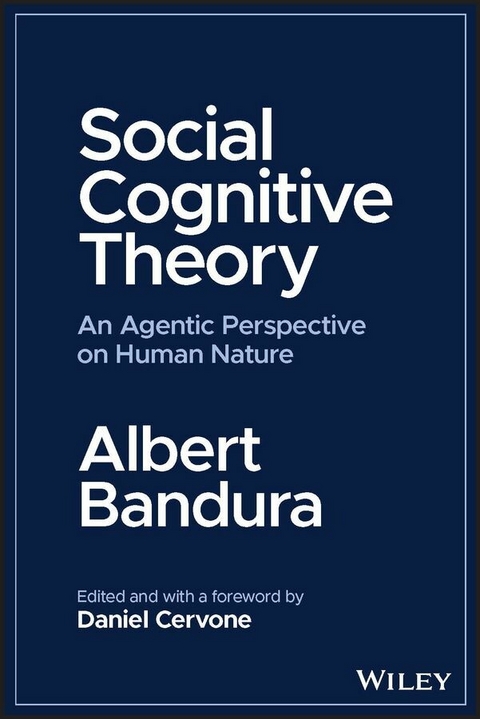
A comprehensive perspective on human nature by one of the undisputed masters of the psychological sciences
The final book by psychology's most eminent modern figure, Dr. Albert Bandura, is the definitive concise presentation of his theoretical views. In Social Cognitive Theory: An Agentic Perspective on Human Nature, Bandura explains how his half-century of research and theory on the determinants of thought and action highlight people's capacity for agency: the ability to exert control over one's actions and the courses of one's development. He further explains how his basic theory and research have been applied, world-wide, for the betterment of the human condition.
Readers will find:
- A thorough introduction to the author's agentic-perspective on human nature
- Dr. Bandura's theoretical analyses of moral behavior and moral disengagement
- Applications of the basic principles of Social Cognitive Theory to personal and social change for human betterment
An essential and groundbreaking resource for educational, health, and personality psychologists, Social Cognitive Theory: An Agentic Perspective on Human Nature will also prove indispensable to social and industrial/organizational psychologists.
ALBERT BANDURA, PhD (deceased), the most highly cited figure in contemporary psychology, was known internationally for his groundbreaking lines of research on observational learning, behavioral change, moral behavior, and self-efficacy, and for his Social Cognitive Theory of human nature.
1
A Psychology of Human Agency
Across historical eras, conceptions of human nature have changed markedly. Theological conceptions predominated in earlier times. Human nature was viewed as preordained by divine design. In the late 19th century, Darwinian principles began to supplant religious doctrines. Human nature was said to result from environmental pressures acting on random gene mutations and reproductive recombinations.
Different as they may be, the theological and the Darwinian frameworks have something in common: They leave little room for human agency. The nature of humans reflects either the purposes of the Divine or the purposeless algorithm that is natural selection.
That purposeless algorithm, however, gave rise to a purposeful species. The abilities to communicate using symbols, to deliberate upon the physical and social worlds, and to plan and intentionally alter the environment in preparation for future events conferred considerable functional advantages. These cognitive capabilities thus became the hallmark of humans.
These human cognitive capabilities are recognized widely. Yet, their implications for understanding causal processes contributing to human nature are often underappreciated. The emergence of language and forethought converted our species into agents: beings who could transcend the dictates of their immediate environment, select and shape the external circumstances they encounter, and thereby guide the course of individual and societal development. Planful cognitive agency augmented aimless environmental selection. Contemporary technological advances have greatly expanded the power of human agency in these coevolutionary processes.
Through cognitive self‐regulation, humans can envision the future and act on it in the present. They can evaluate and modify ongoing current behaviors to best serve not only present needs, but also long‐term aims. These self‐referent cognitive abilities are central to Social Cognitive Theory's agentic perspective on human nature.
On Agency and “Free Will”
Scholarly debates over human agency have a long history. Medieval theologians recognized the dissonance of two ideas: 1) the Creator is omniscient and benevolent, yet 2) created a world that contains evil, including moral evils perpetrated by people who were made in the Creator's image. The doctrine of “free will” provided a way out of this conceptual conundrum. By granting the power of free choice, the Creator enabled people to prove their moral worth in a world of temptations and evils.
The free will position, whose proponents granted humans the power of free choice in the likeness of absolute agency, was debated by philosophers for centuries. A recurrent limitation of these debates is that free will was enigmatic: an autonomous causative force whose origins, exact nature, and independent functioning in the midst of environmental pressures were shrouded in ambiguity. Preoccupation with the metaphysical incompatibility of free will and determinism diverted attention from more fruitful analysis of the capacity of humans to bring their personal influence to bear on events (Nahmias, 2002).
Progress can be made by reframing the issue of free will in terms of the exercise of agency. Agency describes broad capability; to be an “agent” is to be able to influence intentionally one's functioning and life circumstances. This agentic framing invites specification of the psychological mechanisms and causal structures that enable persons to act as agents.
Human agency operates principally through cognitive and other self‐regulatory processes. Their analysis provides insights into the constructive and proactive role that cognition plays in human action, while advancing the understanding of human capabilities beyond earlier debates about an amorphous “free will.”
Nonagentic Approaches in Contemporary Psychology
Psychology has undergone wrenching paradigm shifts during its relatively brief history. Yet, what is surprising is that competing paradigms each have questioned the human capacity for agency. The substantial influence of these paradigms underscores the significance of the agentic perspective on human nature advanced in this volume.
In much of the 20th century, experimental psychology's guiding paradigm was behaviorism. Behaviorists proposed an input‐output model. Stimuli and responses were linked by an intervening but noncausal black box. Investigators harbored the belief that stimuli—in particular, those stimuli that function as response consequences—alter behavior in an automatic, unconscious manner. Skinner's (1971) contention that “a person does not act upon the world, the world acts upon him” (p. 211) epitomized the behavioristic denial of human agency.
This line of theorizing was eventually put out of vogue by psychological models inspired by a new technology: computers. Creative theorists filled the behavioristic black box with symbolic representations, rules, and computational operations. The mind as a symbol manipulator, in the likeness of a linear computer, became the conceptual model for the times.
Cognitive processing theories modeled on serial computer architectures were, in turn, superseded by connectionist models which recognized that mental events occur in parallel. In parallel processing models, interconnected, multilayered, neuronal‐like subsystems work simultaneously. Sensory organs deliver up information to a multitude of sub‐systems acting as the mental machinery that processes the inputs and, through some intermediate integrating system, generates a coherent output automatically and nonconsciously.
These alternative theories differ in what they place in the mediating system. Radical behaviorism posits a noncausal connector; computerized cognitivism posits a linear central processor; and parallel distributed connectionism posits interconnected, neuronal‐like subunits. But the theories share the same bottom‐up causation: input ➔ throughput ➔ output. In each model, environments act on biological machinery that generates outputs automatically and nonconsciously.
These nonagentic conceptions strip humans of a functional consciousness, a self‐identity, and thus an agentic capability. As Harré (1983) emphasized, such conceptions of human nature attribute personal actions to subpersonal parts. In actuality, however, it is conscious, intentional people—not subpersonal parts of people—who plan actions and act on the environment. People create, preserve, transform, and even destroy environments, rather than merely reacting to them as given “inputs.” Nonagentic conceptions overlook the socially embedded interplay between the exercise of personal agency and the nature of the environments that individuals experience. In so doing, they provide a truncated image of human nature.
Agency, Consciousness, and the Brain
Consciousness is the very substance of mental life. Conscious experience makes life not only manageable, but meaningful; a conscious life is a life worth living. Without the capacity for deliberative and reflective conscious activity, humans would be mindless automatons. With it, they are mindful agents.
Consciousness encompasses multiple functions. For example, the function of consciously experiencing an event that is happening to oneself differs from the function of interacting purposefully in an ongoing activity as a planful agent (Korsgaard, 1989a and 1989b). In addition to these nonreflective and reflectively self‐aware components, consciousness also serves a conceptual function; people can consciously deliberate on ideas and experiences, which they do mainly through the medium of language. In this conceptual function, people purposefully access and deliberatively process information in order to construct, select, and ultimately evaluate and regulate courses of action. The human mind is generative, creative, proactive, and reflective, not just reactive.
One must distinguish the psychological functions of conscious thought from the physiological functions that enable people to think consciously. With this distinction in hand, one encounters a formidable explanatory challenge: bridging the gap between a physicalistic account for brain functions and a (nondualistic) cognitivism. How do people activate brain processes to realize given intentions and purposes?
Consciousness is an emergent brain activity with higher‐level control functions, rather than simply an epiphenomenal byproduct of lower‐level processes. Indeed, if the neuronal processes of common activities were automatically reflected in consciousness, conscious experience would be hopelessly cluttered; a mind numbing array of contents would foreclose any functionality of conscious reflection. When one is driving a car, for example, one's consciousness is filled with thoughts of other matters rather than with the ongoing neuronal or biomechanical aspects of driving.
Emergent properties differ in kind from their lower‐level bases. For example, the fluidity and viscosity of water are emergent properties, not simply the combined properties of the individual hydrogen and oxygen components (Bunge, 1977). Through their interactive effects, components are transformed into new phenomena. Van Gulick (2001) made the important distinction between emergent properties and emergent causal powers over events at the lower level.
In the...
| Erscheint lt. Verlag | 28.3.2023 |
|---|---|
| Sprache | englisch |
| Themenwelt | Geisteswissenschaften ► Psychologie ► Allgemeines / Lexika |
| Schlagworte | Determinism • Free Will • human betterment • Human nature • Moral behavior • Moral disengagement • moral engagement • motivated action • psychological agency • Psychological sciences • Psychology • Psychology of Learning • social change |
| ISBN-10 | 1-394-16146-8 / 1394161468 |
| ISBN-13 | 978-1-394-16146-1 / 9781394161461 |
| Informationen gemäß Produktsicherheitsverordnung (GPSR) | |
| Haben Sie eine Frage zum Produkt? |
 EPUB (Adobe DRM)
Kopierschutz: Adobe-DRM
Adobe-DRM ist ein Kopierschutz, der das eBook vor Mißbrauch schützen soll. Dabei wird das eBook bereits beim Download auf Ihre persönliche Adobe-ID autorisiert. Lesen können Sie das eBook dann nur auf den Geräten, welche ebenfalls auf Ihre Adobe-ID registriert sind.
Details zum Adobe-DRM
Dateiformat: EPUB (Electronic Publication)
EPUB ist ein offener Standard für eBooks und eignet sich besonders zur Darstellung von Belletristik und Sachbüchern. Der Fließtext wird dynamisch an die Display- und Schriftgröße angepasst. Auch für mobile Lesegeräte ist EPUB daher gut geeignet.
Systemvoraussetzungen:
PC/Mac: Mit einem PC oder Mac können Sie dieses eBook lesen. Sie benötigen eine
eReader: Dieses eBook kann mit (fast) allen eBook-Readern gelesen werden. Mit dem amazon-Kindle ist es aber nicht kompatibel.
Smartphone/Tablet: Egal ob Apple oder Android, dieses eBook können Sie lesen. Sie benötigen eine
Geräteliste und zusätzliche Hinweise
Buying eBooks from abroad
For tax law reasons we can sell eBooks just within Germany and Switzerland. Regrettably we cannot fulfill eBook-orders from other countries.
aus dem Bereich