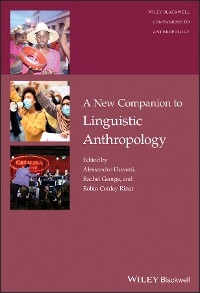
A New Companion to Linguistic Anthropology (eBook)
John Wiley & Sons (Verlag)
978-1-119-78081-6 (ISBN)

Provides an expansive view of the full field of linguistic anthropology, featuring an all-new team of contributing authors representing diverse new perspectives
A New Companion to Linguistic Anthropology provides a timely and authoritative overview of the field of study that explores how language influences society and culture. Bringing together more than 30 original essays by an interdisciplinary panel of renowned scholars and younger researchers, this comprehensive volume covers a uniquely wide range of both classic and contemporary topics as well as cutting-edge research methods and emerging areas of investigation.
Building upon the success of its predecessor, the acclaimed Blackwell Companion to Linguistic Anthropology, this new edition reflects current trends and developments in research and theory. Entirely new chapters discuss topics such as the relationship between language and experiential phenomena, the use of research data to address social justice, racist language and raciolinguistics, postcolonial discourse, and the challenges and opportunities presented by social media, migration, and global neoliberalism. Innovative new research analyzes racialized language in World of Warcraft, the ethics of public health discourse in South Africa, the construction of religious doubt among Orthodox Jewish bloggers, hybrid forms of sociality in videoconferencing, and more.
- Presents fresh discussions of topics such as American Indian speech communities, creolization, language mixing, language socialization, deaf communities, endangered languages, and language of the law
- Addresses recent trends in linguistic anthropological research, including visual documentation, ancient scribes, secrecy, language and racialization, global hip hop, justice and health, and language and experience
- Utilizes ethnographic illustration to explore topics in the field of linguistic anthropology
- Includes a new introduction written by the editors and an up-to-date bibliography with over 2,000 entries
A New Companion to Linguistic Anthropology is a must-have for researchers, scholars, and undergraduate and graduate students in linguistic anthropology, as well as an excellent text for those in related fields such as sociolinguistics, discourse studies, semiotics, sociology of language, communication studies, and language education.
Provides an expansive view of the full field of linguistic anthropology, featuring an all-new team of contributing authors representing diverse new perspectives A New Companion to Linguistic Anthropology provides a timely and authoritative overview of the field of study that explores how language influences society and culture. Bringing together more than 30 original essays by an interdisciplinary panel of renowned scholars and younger researchers, this comprehensive volume covers a uniquely wide range of both classic and contemporary topics as well as cutting-edge research methods and emerging areas of investigation. Building upon the success of its predecessor, the acclaimed Blackwell Companion to Linguistic Anthropology, this new edition reflects current trends and developments in research and theory. Entirely new chapters discuss topics such as the relationship between language and experiential phenomena, the use of research data to address social justice, racist language and raciolinguistics, postcolonial discourse, and the challenges and opportunities presented by social media, migration, and global neoliberalism. Innovative new research analyzes racialized language in World of Warcraft, the ethics of public health discourse in South Africa, the construction of religious doubt among Orthodox Jewish bloggers, hybrid forms of sociality in videoconferencing, and more. Presents fresh discussions of topics such as American Indian speech communities, creolization, language mixing, language socialization, deaf communities, endangered languages, and language of the law Addresses recent trends in linguistic anthropological research, including visual documentation, ancient scribes, secrecy, language and racialization, global hip hop, justice and health, and language and experience Utilizes ethnographic illustration to explore topics in the field of linguistic anthropology Includes a new introduction written by the editors and an up-to-date bibliography with over 2,000 entries A New Companion to Linguistic Anthropologyis a must-have for researchers, scholars, and undergraduate and graduate students in linguistic anthropology, as well as an excellent text for those in related fields such as sociolinguistics, discourse studies, semiotics, sociology of language, communication studies, and language education.
Notes on Contributors
Jocelyn Ahlers is Professor of Linguistics in the Liberal Studies Department at California State University, San Marcos. Her publications include “Unexpected benefits of a documentation project focused on interactional language use,” “Sawmill at Paiute Mountain” (with Laura Grant), and “Native California languages as semiotic resources in the performance of identity.” Her research interests encompass language documentation, revitalization, and reclamation, as well as the role of contemplative pedagogy in supporting student success in social justice-oriented classes.
H. Samy Alim is the David O. Sears Presidential Endowed Chair in the Social Sciences and Professor of Anthropology at UCLA. He is Associate Director of the Ralph J. Bunche Center for African American Studies and serves as Faculty Director of the UCLA Hip Hop Initiative. He has written extensively about language, race, and Hip Hop Culture in Street Conscious Rap (1999, with James G. Spady and Charles G. Lee), Roc the Mic Right: The Language of Hip Hop Culture (2006), Global Linguistic Flows: Hip Hop Cultures, Youth Identities, and the Politics of Language (with Awad Ibrahim and Alastair Pennycook), and Neva Again: Hip Hop Art, Activism, and Education in Post-Apartheid South Africa (with Adam Haupt, Quentin Williams, and Emile Jansen). His most recent book is Freedom Moves: Hip Hop Knowledges, Pedagogies, and Futures (with Jeff Chang and Casey Wong).
Netta Avineri is Language Teacher Education Associate Professor and Intercultural Competence Committee Chair at the Middlebury Institute of International Studies at Monterey. She is also a Critical Service-Learning and Teacher Education Lecturer at California State University, Monterey Bay. She is author of Research Methods for Language Teaching Inquiry, Process, and Synthesis, co-editor of Language and Social Justice in Practice (with Laura R. Graham, Eric J. Johnson, Robin Conley Riner, and Jonathan Rosa), and co-editor of Metalinguistic Communities: Case Studies of Agency, Ideology, and Symbolic Uses of Language (with Jesse Harasta). She is Series Editor for Critical Approaches in Applied Linguistics. Her research interests include language and social justice, interculturality, and heritage language socialization.
Steven P. Black is Associate Professor of Anthropology at Georgia State University. He has conducted research on global health discourses since 2008 with a focus on topics such as ethics and performance, and previously served as the chair of the Committee on Ethics of the American Anthropological Association. He is the author of Speech and Song at the Margins of Global Health: Zulu Tradition, HIV Stigma, and AIDS Activism in South Africa, is coeditor of a special issue of Medical Anthropology titled, “Communicating Care,” and has published pieces at the intersection of linguistic and medical anthropology in edited volumes and in journals including American Anthropologist, Annual Review of Anthropology, Ethos, Journal of Linguistic Anthropology, and Language in Society. He is also the PI on a National Geographic-funded collaborative multimedia ethnography focused on indigenous knowledge, planetary health, and cultural sustainability in Boruca Indigenous Territory, Costa Rica.
Charles L. Briggs is Distinguished Professor of Anthropology at the University of California, Berkeley. His books include Learning How to Ask: A Sociolinguistic Appraisal of the Role of the Interview in Social Science Research, Voices of Modernity: Language Ideologies and the Politics of Inequality (with Richard Bauman), Making Health Public: How News Coverage is Remaking Media, Medicine, and Contemporary Life (with Daniel Hallin), and Unlearning: Rethinking Poetics, Pandemics, and the Politics of Knowledge. His work bridges linguistic, medical, and media anthropology and Latin American Social Medicine. He has conducted ethnographic research primarily in Latin America, especially Venezuela, and the United States, including among Latinx populations. His current work includes a large ethnographic study of knowledge production, care, and narratives in the COVID-19 pandemic and a book project that seeks to decolonize perspectives in linguistic and medical anthropology by focusing on health/communicative inequity and justice.
Erica A. Cartmill is Associate Professor of Anthropology and Psychology at the University of California, Los Angeles. She studies the evolution of language and cognition through research with human children and great apes. Her work highlights gesture and multimodal communication across species, as well as the role of early development in learning about the minds of others. Her collaborative studies span many species, from parrots to cetaceans. She has published in a wide range of journals, including the Annual Review of Anthropology; PNAS; Phil Trans B; Current Biology; Biology Letters; Language, Interaction and Acquisition; Developmental Psychology; Cognition; and Animal Cognition. She aims to connect ethological, anthropological, and psychological theory, and to promote interdisciplinary perspectives in scholarship. She co-directs the Diverse Intelligences Summer Institute, which brings together scholars interested in the study of mind, cognition, and intelligence for several weeks of interdisciplinary exploration.
Jillian R. Cavanaugh is Professor of Anthropology at Brooklyn College CUNY and the Anthropology Program at the Graduate Center CUNY. Her publications include Living Memory: The Social Aesthetics of Language in a Northern Italian Town and Language and Materiality: Ethnographic and Theoretical Perspectives (co-edited with Shalini Shankar). Her research interests include language and food, linguistic labor, language ideologies, language materiality, and language and gender.
Asta Cekaite is Professor of Child Studies, Thematic Research Unit, Linköping University, Sweden. Her research involves an interdisciplinary approach to language, culture, and social interaction. Specific foci include social perspectives on bilingualism, embodiment, touch, emotion, and moral socialization. Empirical fields cover adult-child and children’s peer group interactions in educational settings, and family in various cultural contexts. With M. Goodwin she has co-authored Embodied Family Choreography: Practices of Control, Care and Mundane Creativity. She has co-edited (with L. Mondada) Touch in Social Interaction: Touch, Language and Body.
Christina P. Davis is Associate Professor of Anthropology in the Department of Sociology and Anthropology at Western Illinois University. She is the author of The Struggle for a Multilingual Future: Youth and Education in Sri Lanka and co-editor (with Chaise LaDousa) of Language, Education, and Identity: Medium in South Asia. She is the author of a number of articles including “Speaking Conflict: Ideological Barriers to Bilingual Policy Implementation in Civil War Sri Lanka,” “Trilingual Blunders: Signboards, Social Media, and Transnational Sri Lankan Tamil Publics,” “Memes, Emojis, and Text: The Semiotics of Differentiation in Sri Lankan Tamil Social Media Groups,” and “South Asian Language Practices: Mother Tongue, Medium, and Media” (with Chaise LaDousa). Her research interests concern language and digital media practices, language policy, multilingual education, and ethnic conflict, with a geographical focus on Sri Lanka and India.
Jenny L. Davis is a citizen of the Chickasaw Nation and Associate Professor of Anthropology and American Indian Studies at the University of Illinois, Urbana-Champaign where she is the director of the American Indian Studies Program. Her research areas include Indigenous language revitalization; language, gender, and sexuality; creative writing; and research methods and ethics (Indigenous, collaborative, and speculative). She is the author of Trickster Academy and Talking Indian: Identity and Language Revitalization in the Chickasaw Renaissance and co-editor of Queer Excursions: Retheorizing Binaries in Language, Gender, and Sexuality (with Lal Zimman and Joshua Raclaw).
Erin Debenport is Associate Professor of Anthropology at the University of California, Los Angeles and Associate Director of the UCLA American Indian Studies Center. Her published work focuses on secrecy, revelation, and literacy, and she contributes to ongoing language reclamation projects with several Pueblo Nations. She is the author of Fixing the Books: Secrecy, Literacy, and Perfectibility, and has published articles in The Journal of Linguistic Anthropology, American Anthropologist, The Oxford Handbook of Language and Sexuality, Language and Communication, and The Annual Review of Anthropology.
Alessandro Duranti is Distinguished Research Professor of Anthropology at the University of California, Los Angeles. He has published extensively on political discourse in Samoa and in the US, improvisation in language and music, intentionality, and agency. His books include The Samoan Fono: A Sociolinguistic Study; From Grammar to Politics: Linguistic Anthropology in a Western Samoan Village; Linguistic Anthropology; and The Anthropology of Intentions: Language in a World of Others. His most recent book project is the edited volume Rethinking Politeness with Henri Bergson.
Patrick Eisenlohr is Professor of Anthropology,...
| Erscheint lt. Verlag | 21.3.2023 |
|---|---|
| Reihe/Serie | Blackwell Companions to Anthropology |
| Blackwell Companions to Anthropology | Wiley Blackwell Companions to Anthropology |
| Sprache | englisch |
| Themenwelt | Geisteswissenschaften ► Archäologie |
| Geschichte ► Allgemeine Geschichte ► Vor- und Frühgeschichte | |
| Geisteswissenschaften ► Sprach- / Literaturwissenschaft ► Sprachwissenschaft | |
| Schlagworte | Anthropologie • Anthropology • anthropology language • Linguistic Anthropology • linguistic anthropology essays • linguistic anthropology intro • linguistic anthropology overview • linguistic anthropology reference • linguistic anthropology research • linguistic anthropology textbook • Linguistics • Linguistische Anthropologie • Sociolinguistics • Sociology • Sociology of Language • Soziolinguistik • Soziologie • Sprachsoziologie • Sprachwissenschaften |
| ISBN-10 | 1-119-78081-0 / 1119780810 |
| ISBN-13 | 978-1-119-78081-6 / 9781119780816 |
| Informationen gemäß Produktsicherheitsverordnung (GPSR) | |
| Haben Sie eine Frage zum Produkt? |
 EPUB (Adobe DRM)
Kopierschutz: Adobe-DRM
Adobe-DRM ist ein Kopierschutz, der das eBook vor Mißbrauch schützen soll. Dabei wird das eBook bereits beim Download auf Ihre persönliche Adobe-ID autorisiert. Lesen können Sie das eBook dann nur auf den Geräten, welche ebenfalls auf Ihre Adobe-ID registriert sind.
Details zum Adobe-DRM
Dateiformat: EPUB (Electronic Publication)
EPUB ist ein offener Standard für eBooks und eignet sich besonders zur Darstellung von Belletristik und Sachbüchern. Der Fließtext wird dynamisch an die Display- und Schriftgröße angepasst. Auch für mobile Lesegeräte ist EPUB daher gut geeignet.
Systemvoraussetzungen:
PC/Mac: Mit einem PC oder Mac können Sie dieses eBook lesen. Sie benötigen eine
eReader: Dieses eBook kann mit (fast) allen eBook-Readern gelesen werden. Mit dem amazon-Kindle ist es aber nicht kompatibel.
Smartphone/Tablet: Egal ob Apple oder Android, dieses eBook können Sie lesen. Sie benötigen eine
Geräteliste und zusätzliche Hinweise
Buying eBooks from abroad
For tax law reasons we can sell eBooks just within Germany and Switzerland. Regrettably we cannot fulfill eBook-orders from other countries.
aus dem Bereich