


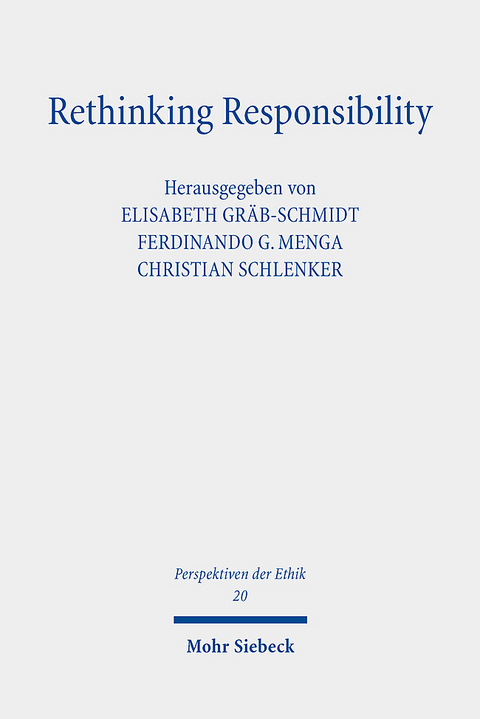
Rethinking Responsibility
Seiten

Verantwortung neu zu denken, bedeutet, einen etablierten Begriff angesichts der vielfältigen Infragestellung seiner Begründungsdimensionen aufrechtzuerhalten. Ausgehend von gegenwärtigen technischen Neuerungen werden in diesem Sammelband die zugrunde liegenden anthropologischen Voraussetzungen hinterfragt. Dabei markiert die Intergenerationale Verantwortung eine Zielperspektive.
This volume examines the concept of responsibility amidst current societal challenges that require its rethinking. Assigning responsibility to an agent proves problematic when technological or social structures have become too complex. Concepts of responsibility which retrospectively name a responsible party often fail due to this complexity, diffusing responsibility to a minimum that can no longer be perceived. The contributions explore the foundations of responsibility in order to engage constructively with contemporary issues. The first part approaches conceptual challenges through examples concerning artificial intelligence, while the second discusses the anthropological presuppositions of responsibility and connects them with the broader continental philosophical tradition. The third part deals with concepts of how intergenerational responsibility can be included both conceptually and legally.
This volume examines the concept of responsibility amidst current societal challenges that require its rethinking. Assigning responsibility to an agent proves problematic when technological or social structures have become too complex. Concepts of responsibility which retrospectively name a responsible party often fail due to this complexity, diffusing responsibility to a minimum that can no longer be perceived. The contributions explore the foundations of responsibility in order to engage constructively with contemporary issues. The first part approaches conceptual challenges through examples concerning artificial intelligence, while the second discusses the anthropological presuppositions of responsibility and connects them with the broader continental philosophical tradition. The third part deals with concepts of how intergenerational responsibility can be included both conceptually and legally.
Geboren 1956; Professorin für Systematische Theologie und Ethik an der Evangelisch-Theologischen Fakultät der Universität Tübingen.
Geboren 1974; Dr. Phil., Dr. iur. et pol. rer. und habilitiert nach dem italienischen Hochschulsystem als "associate professor" in den Bereichen: Moral-, Rechts-, politische und theoretische Philosophie; zur Zeit Post-Doc Forscher am Institut für Ethik, Ev.-Theologische Fakultät, Universität Tübingen.
Geboren 1991; 2011-18 Studium der Ev. Theologie, Mathematik und griechischen Philologie an der Universität Tübingen und der Tufts University, Medford MA; 2018-24 Wissenschaftlicher Mitarbeiter am Institut für Ethik an der Ev.-Theol. Fakultät der Universität Tübingen.
| Erscheinungsdatum | 21.10.2023 |
|---|---|
| Reihe/Serie | Perspektiven der Ethik |
| Verlagsort | Tübingen |
| Sprache | englisch |
| Maße | 156 x 232 mm |
| Gewicht | 388 g |
| Themenwelt | Geisteswissenschaften ► Philosophie ► Allgemeines / Lexika |
| Geisteswissenschaften ► Philosophie ► Ethik | |
| Geisteswissenschaften ► Religion / Theologie | |
| Schlagworte | Ethik • Politische Philosophie • Systematische Theologie |
| ISBN-10 | 3-16-161597-2 / 3161615972 |
| ISBN-13 | 978-3-16-161597-9 / 9783161615979 |
| Zustand | Neuware |
| Informationen gemäß Produktsicherheitsverordnung (GPSR) | |
| Haben Sie eine Frage zum Produkt? |
Mehr entdecken
aus dem Bereich



aus dem Bereich
die letzten Jahre der Philosophie und der Beginn einer neuen …
Buch | Hardcover (2024)
Klett-Cotta (Verlag)
CHF 39,20


