


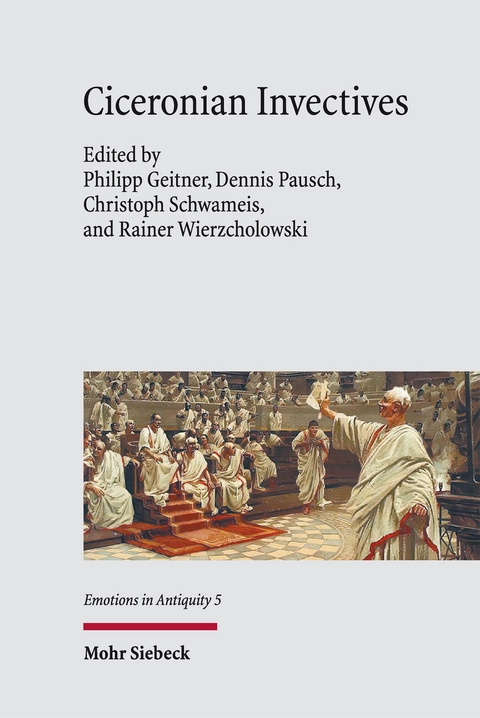
Ciceronian Invectives
Emotions, Configurations, and Reactions
Seiten
2025
Mohr Siebeck (Verlag)
978-3-16-161035-6 (ISBN)
Mohr Siebeck (Verlag)
978-3-16-161035-6 (ISBN)
Die politische Kommunikation in der späten römischen Republik ist in hohem Maße durch Verunglimpfungen, Beschimpfungen und ähnliche Phänomene gekennzeichnet. Der vorliegende Band wirft einen neuen Blick darauf, wie sich diese Sprachhandlungen, hier verstanden als Invektiven, in Ciceros Reden widerspiegeln und mit diesen verbunden sind.
Political communication in the late Roman Republic was highly coloured by rhetorical repertoires featuring disparagement, shaming, and other related phenomena. One of the most prolific perpetrators of such verbal conduct - known as invective - was the orator and statesman Marcus Tullius Cicero (106-43 BC). This volume, which gathers the contributions delivered during the conference "Ciceronian Invective. Emotions, Reactions, Performance", held at Dresden's Technische Universität in 2020, takes a fresh look at the practices reflected in and relating to Cicero's tirades. By comprehending invective not only as a mere literary genre, but also as a practice embedded in social and political contexts, the aim is to arrive at a deeper understanding of Ciceronian invective. The emotions that such use of language aroused, its historical and rhetorical configurations, and the reactions of those offended by it or on its receiving end as an audience are all considered.
Political communication in the late Roman Republic was highly coloured by rhetorical repertoires featuring disparagement, shaming, and other related phenomena. One of the most prolific perpetrators of such verbal conduct - known as invective - was the orator and statesman Marcus Tullius Cicero (106-43 BC). This volume, which gathers the contributions delivered during the conference "Ciceronian Invective. Emotions, Reactions, Performance", held at Dresden's Technische Universität in 2020, takes a fresh look at the practices reflected in and relating to Cicero's tirades. By comprehending invective not only as a mere literary genre, but also as a practice embedded in social and political contexts, the aim is to arrive at a deeper understanding of Ciceronian invective. The emotions that such use of language aroused, its historical and rhetorical configurations, and the reactions of those offended by it or on its receiving end as an audience are all considered.
2020 PhD; Postdoc at the Collaborative Research Center 1285 "Invectivity. Constellations and Dynamics of Disparagement".
2004 PhD; Professor of Latin at Technical University Dresden.
2018 PhD; teaches Roman literature and Latin grammar at the University of Vienna.
teaches Latin literature at the University of Wuppertal.
| Erscheinungsdatum | 29.02.2024 |
|---|---|
| Reihe/Serie | Emotions in Antiquity |
| Verlagsort | Tübingen |
| Sprache | englisch |
| Maße | 155 x 232 mm |
| Gewicht | 531 g |
| Themenwelt | Geschichte ► Allgemeine Geschichte ► Vor- und Frühgeschichte |
| Geschichte ► Allgemeine Geschichte ► Altertum / Antike | |
| Geisteswissenschaften ► Religion / Theologie ► Christentum | |
| Schlagworte | Cicero • Vitriol • vituperation |
| ISBN-10 | 3-16-161035-0 / 3161610350 |
| ISBN-13 | 978-3-16-161035-6 / 9783161610356 |
| Zustand | Neuware |
| Informationen gemäß Produktsicherheitsverordnung (GPSR) | |
| Haben Sie eine Frage zum Produkt? |
Mehr entdecken
aus dem Bereich



aus dem Bereich
auf den Spuren der frühen Zivilisationen
Buch | Hardcover (2023)
C.H.Beck (Verlag)
CHF 27,95
Konzepte – Methoden – Theorien
Buch | Softcover (2024)
UTB (Verlag)
CHF 55,85
die archäologische Wahrheit über die Bibel
Buch | Softcover (2023)
C.H.Beck (Verlag)
CHF 25,20


