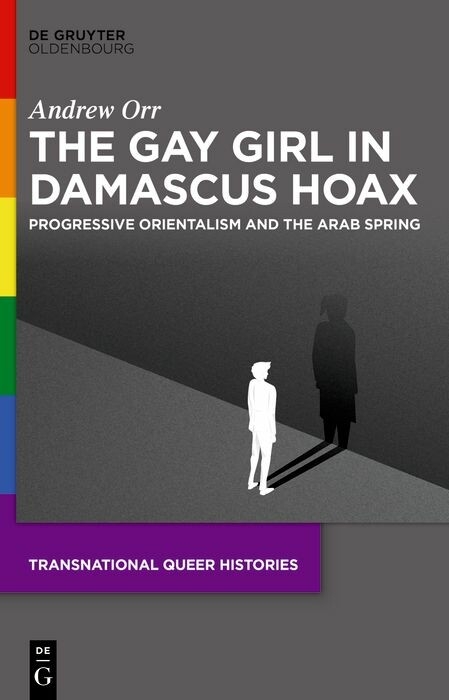
The Gay Girl in Damascus Hoax (eBook)
172 Seiten
De Gruyter (Verlag)
978-3-11-105758-3 (ISBN)
Andrew Orr, Kansas State University, Manhattan KS, USA.
Introduction: Orientalism and the Western Imagination
26 April 2011
Arraf Family Home,
Damascus, Syria
After midnight two armed men confronted Abdallah Arraf in the family’s courtyard. The old man, who had recently moved home from the United States so he could die where he was born, knew they were there to arrest somebody. He was surprised though when they demanded he surrender his daughter Amina.
Amina, however, was not surprised. She had spent the last two months organizing protests and proclaiming her opposition to the regime on her blog, A Gay Girl in Damascus. Not wanting to risk anybody else’s life by trying to hide or escape, she went downstairs to face her fate. When she arrived, the men told her she was under arrest for participating in a Salafist plot. Her father interrupted, claiming it was ridiculous to arrest a woman who “doesn’t even cover any more” for being an Islamist radical. He demanded to know how they could have read her defense of same-sex marriage or her argument that “there should be no religion as religion of the state” and believe she was a religious extremist?
In response one of the men asked Abdallah, “Did she tell you that she likes to sleep with women … That she is one of those faggots who fucks little girls?” Abdallah, who already knew Amina was a lesbian, defiantly responded, “She is my daughter and she is who she is and if you want her, you must take me as well.” Angered, one militiaman grabbed Amina’s breast, and threated that “Maybe if you were with a real man you’d stop this nonsense.” Abdallah contemptuously asked, “Did the jackal sleep with the monkey before you were born?” After demanding and getting their names, he knew he had a chance because although they were Alawis, he knew their families. He recited details from their family’ histories and explained that nothing they said would shake his love for his daughter, “she has done many things that, if I had been her, I would not have done. But she has never once stopped being my daughter and I will never once let you do any harm to her.” He ordered them to leave and “tell the rest of your gang to leave her alone” because she was not their enemy. Instead of backing Assad’s dictatorship out of fear, they should support Amina and democrats like her who “are the ones saying alawi, sunni, arabi, kurdi, duruzi, christian, everyone is the same and will be equal in the new Syria; they are the ones who, if the revolution comes, will be saving Your mother and your sisters.”
Faced with Abdallah’s outrage, the men apologized for disturbing the house and left. On her blog, Amina described how “everyone in the house was awake now and had been watching from balconies and doorways and windows all around the courtyard … and everyone was cheering …” She gushed that “MY DAD had just defeated them! Not with weapons but with words” and that “My father is a hero; I always knew that … but now I am sure.” Reason and acceptance had triumphed over violence and prejudice.1
Later that day Amina posted the story, which she called “My Father, the Hero” to A Gay Girl in Damascus and it spread across the world. Aided by Western journalists and activists who posted links to the blog, hundreds of thousands of people read the story. There was just one problem. Amina Arraf, the “gay girl of Damascus” was none of those things; she did not even exist. Amina and all the stories on A Gay Girl in Damascus were created by Thomas “Tom” MacMaster, a middle-aged male heterosexual American activist and graduate student who had recently moved not to Syria, but to Scotland.
The Arab Spring and A Gay Girl in Damascus
In late 2010 and early 2011 protestors filled the streets of many Arab countries. The protests soon became known in the West as the Arab Spring. In January 2011, protests in Tunisia convinced President Zine El Abidine Ben Ali to accept the end of his twenty-three-year reign and flee the country. Ben Ali’s fall inspired people in other Middle Eastern countries to take to the streets. In January and February 2011 protests spread to Libya, Egypt, Bahrain, and Yemen. Protests in Egypt, and the threatened loss of American economic and military support, led the Egyptian Army to force President Hosni Mubarak to step down. The protest movements quickly acquired a checkered record. Tunisia democratized, but within two years the Egyptian Army reimposed a government resembling Mubarak’s regime. The results were even worse in Libya and Yemen where the unravelling of the old regimes led to long and bloody civil wars. At first it seemed that Syrian dictator Bashar al-Assad would escape unscathed. Emulating Jordan’s King Abdullah II, Assad promised reforms to head off protests. However, in February 2011 small protests slowly spread across Syria.
The Arab Spring captivated European and American observers. Western journalists, policy experts, activists, and academics debated what was happening, what it meant, and how it would shape the region’s future. It reminded many Westerners of the 1989 protests in Eastern Europe, but the development of the internet and social media meant that they could follow Arab activists directly on social media and had online forums where they could easily share and discuss news from the Middle East. Thomas “Tom” MacMaster was one Westerner inspired by the Arab Spring.
In early 2011, MacMaster was forty-years old and had recently moved from Atlanta to Scotland to begin graduate school in medieval history at the University of Edinburgh. MacMaster had been fascinated by the Middle East since he was a child. He had studied Arabic and visited the Middle East as a peace activist and student. After graduation he lived in Atlanta and campaigned for Palestinian rights and against the United States’ wars in Afghanistan and Iraq. MacMaster felt validated by the Arab Spring. He saw the protests as proof of his belief that public opinion in the region was committed to a pluralist, democratic, and anti-capitalist agenda despite neoconservative claims that the dominant strain of Middle Eastern Islam was oppressive and dangerous. But MacMaster feared that Islamophobic and imperialist voices would trick Western public opinion into opposing the reform movements as he believed they had fooled Americans into supporting the invasion of Iraq in 2003.
In 2002 and 2003 MacMaster protested the Iraq War and spoke out against it in online forums. Frustrated with other users challenging his positions with what he viewed as ill-informed opinions he convinced himself that they would more readily accept his views on the Middle East and Islam if he were an Arab Muslim woman. Sometime in late 2002 or 2003, he created email accounts under the name “Amina Arraf” and began using them to post about controversial issues. Over the 2000s, MacMaster expanded the character, adding social media accounts on MySpace, dating sites, and Facebook. He even tried to blog as Amina briefly in 2007. The Arab Spring captivated MacMaster and on 19 February 2011, A Gay Girl in Damascus, a new blog MacMaster created in Amina’s name, went live. Although MacMaster’s previous attempt at blogging fell flat, A Gay Girl in Damascus quickly established an audience and caught American and British journalists’ attention.
The revelation that the Syrian American “gay girl of Damascus” was a heterosexual white American man in Scotland led activists and journalists to ask how the hoax had succeeded. Most accounts focused on the inherent difficulty of proving identity in digital spaces and MacMaster’s exploitation of people’s assumptions that other people who had interacted with Amina online must have known that she was real. Although true, this ignored uncomfortable questions about why Western journalists, activists, and educated readers believed the stories MacMaster told as Amina instead of recognizing them as obvious fantasies.
Studying the Hoax, the Impostor, and the Audience
This project asks why MacMaster’s sophisticated audience believed him. It explains the hoax’s success by framing it as a political intervention and deploys historical methods of textual analysis and contextualization to study the hoax and MacMaster’s audience’s reactions. Understanding why so many people believed that Amina existed and accepted what MacMaster wrote in A Gay Girl in Damascus requires integrating Orientalism, progressive politics, and critical theory while paying close attention to who MacMaster was speaking to. All three factors functioned on conscious and unconscious levels to shape how MacMaster performed Amina and how his audience reacted to the performance.
Because MacMaster used Amina as a proxy for his own progressive politics, he rooted the character in American progressivism. When he then projected his persona into the Middle East and made her a lesbian woman, he relied on Orientalist tropes to sustain the illusion. Part of the reason MacMaster made Amina a lesbian Arab woman was because of his own attachment to liberating academic theory which emphasized the importance of listening to and challenging the Othering of marginalized people, including women, sexual minorities, and people of color. MacMaster’s generally well-educated and progressive readers shared his theoretical deference to marginalized people, general social and political...
| Erscheint lt. Verlag | 3.4.2023 |
|---|---|
| Reihe/Serie | ISSN |
| ISSN | |
| Transnational Queer Histories | Transnational Queer Histories |
| Sprache | englisch |
| Themenwelt | Geisteswissenschaften ► Geschichte |
| Schlagworte | arab spring • Hoax • Orientalism • Progressive |
| ISBN-10 | 3-11-105758-5 / 3111057585 |
| ISBN-13 | 978-3-11-105758-3 / 9783111057583 |
| Informationen gemäß Produktsicherheitsverordnung (GPSR) | |
| Haben Sie eine Frage zum Produkt? |
 EPUB (Wasserzeichen)
Größe: 1,5 MB
DRM: Digitales Wasserzeichen
Dieses eBook enthält ein digitales Wasserzeichen und ist damit für Sie personalisiert. Bei einer missbräuchlichen Weitergabe des eBooks an Dritte ist eine Rückverfolgung an die Quelle möglich.
Dateiformat: EPUB (Electronic Publication)
EPUB ist ein offener Standard für eBooks und eignet sich besonders zur Darstellung von Belletristik und Sachbüchern. Der Fließtext wird dynamisch an die Display- und Schriftgröße angepasst. Auch für mobile Lesegeräte ist EPUB daher gut geeignet.
Systemvoraussetzungen:
PC/Mac: Mit einem PC oder Mac können Sie dieses eBook lesen. Sie benötigen dafür die kostenlose Software Adobe Digital Editions.
eReader: Dieses eBook kann mit (fast) allen eBook-Readern gelesen werden. Mit dem amazon-Kindle ist es aber nicht kompatibel.
Smartphone/Tablet: Egal ob Apple oder Android, dieses eBook können Sie lesen. Sie benötigen dafür eine kostenlose App.
Geräteliste und zusätzliche Hinweise
Buying eBooks from abroad
For tax law reasons we can sell eBooks just within Germany and Switzerland. Regrettably we cannot fulfill eBook-orders from other countries.
aus dem Bereich