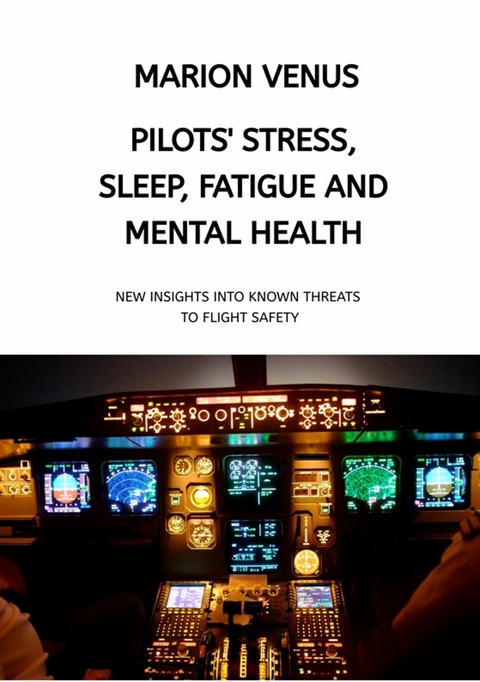
Professional airline Pilots' Stress, Sleep Problems, Fatigue and Mental Health in Terms of Depression, Anxiety, Common Mental Disorders, and Wellbeing in Times of Economic Pressure and Covid19 (eBook)
296 Seiten
tredition (Verlag)
978-3-347-72212-5 (ISBN)
Mental health professional for Pilot peer support, pilot peer, crisis intervention for aircrews (critical incidents CISM, physical, mental health issues) for more than 10 years, Emergency Psychologist, Mental Health Professional for Critical Incident Stress Management, CISM for the Mayday Foundation (Lufthansa) Private Pilot EASA PPL(A) Aviation psychologist & human factors specialist Clinical and health psychologist (approved by the Austrian Federal Ministry of Health) psychological diagnostics, counseling Organization and conduction of workshops, training courses, lectures Safety Specialist, Safety and Health and Quality Manager according to ISO 19011:2002 Peer Reviewer für Elsevier's Transportation Research Interdisciplinary Perspectives, European Review of Applied Psychology
Mental health professional for Pilot peer support, pilot peer, crisis intervention for aircrews (critical incidents CISM, physical, mental health issues) for more than 10 years, Emergency Psychologist, Mental Health Professional for Critical Incident Stress Management, CISM for the Mayday Foundation (Lufthansa) Private Pilot EASA PPL(A) Aviation psychologist & human factors specialist Clinical and health psychologist (approved by the Austrian Federal Ministry of Health) psychological diagnostics, counseling Organization and conduction of workshops, training courses, lectures Safety Specialist, Safety and Health and Quality Manager according to ISO 19011:2002 Peer Reviewer für Elsevier's Transportation Research Interdisciplinary Perspectives, European Review of Applied Psychology
1 Introduction
Airline pilots spend most of their duty and flight hours in their ‘front office’ several kilometers above the ground, in a hostile environment with outside temperatures of about minus 55 Degrees Celsius and not enough oxygen to stay conscious for more than a minute in case of rapid decompression. On the flight deck, pilots operate complex, cutting edge, interacting automated systems in the high-risk high-reliability system aviation. The technical aspects of flight safety have steadily improved over the last decades, although technical failures still lead to fatal crashes, e.g., the malfunction of the MCAS system of the newly released Boeing 737-Max of Lion Air (KNKT, 2019) and Ethiopian Airlines (AIB et al., 2020), or iced pitot tubes (BEA, 2012). Nevertheless, a new threat to flight safety has been discovered. Increasing duty and flight hours and competitive, but still legal rosters have resulted in high levels of pilot fatigue. High levels of on-duty sleepiness and fatigue can affect pilots’ performance and decision-making, and threaten flight safety (Bandeira et al., 2018; Bendak & Rashid, 2020; Bourgeois-Bougrine, 2020; Goode, 2003; Hartzler, 2014). This PhD refers to professional pilots, in contrast to private or glider pilots, and also differs distinctly between sleepiness and fatigue (Shahid et al., 2010).
Fatigue related, unintentional microsleep events1 on the flight deck represent a significant threat to flight safety, due to loss of safety essential situational awareness (Coombes et al., 2020; Kharoufah et al., 2018; Rosa et al., 2020). Although pilot unions have been warning about rising levels of pilot fatigue for many years, regulators have not reacted. According to recent research (Aljurf et al., 2018; Coombes et al., 2020; Williamson & Friswell, 2017), microsleep events in the cockpit are fairly frequent, although flight time limitations (FTL, examples Table 1) and fatigue risk management (FRM) should prevent microsleep and excessive fatigue.
In addition to higher propensity to fall asleep, fatigued pilots tend to make more errors of omission and commission, their judgement, decision making ability and short term memory degrades, their mood deteriorates, pilots’ irritability is higher, and pilots’ flying skills degrade (Coombes et al., 2020; Hartzler, 2014). Microsleep events in the cockpit are reported by 45% of the pilots (Aljurf et al., 2018; Williamson & Friswell, 2017). Per 1000 flight hours, pilots reported 7.3 cases of involuntary sleep of one pilot on the flight deck (Coombes et al., 2020), two thirds of the investigated pilots reported fatigue-related errors during active flight duty. These facts suggest that FTL and FRM (FRM) are less effective than expected (Bourgeois-Bougrine, 2020; Coombes et al., 2020; Demerouti et al., 2019; Efthymiou et al., 2021).
Table 1: Examples of basic flight time limitations (FTL) rules of the European Aviation Safety Agency (EASA), Civil Aviation Safety Authority (CASA) and the US Federal Aviation Administration (FAA). These FTL were in force during the time of data collection from June 2018 until March 2019 (Venus & grosse Holtforth, 2021a)Klicken oder tippen Sie hier, um Text einzugeben.
| Flight Time Limitations in effect until March 2019 |
|
|
| EASA FTL: ORO.FTL.210 | CASA FTL 48.1 | FAA Part 121 |
|
| Max. duty hours | 13 duty hours | 14 duty hours | 14 duty hours |
| Duty period or duty hours*/pilot (multi pilot operation) | Max. duty hours/month | 190 duty hours | 200 duty hours |
|
|
| Commander’s Discretion (Extension of max. duty hours) | max. 13 duty hours plus max. 2 duty hours | max. 14 duty hours plus max. 1 duty hour | max. 14 duty hours plus max. 2 duty hours |
| Augmented Crews§ | depending on time of day | FDP > 9 to 13 duty hours | FDP > 8 to 14 duty hours | FDP > 9 to 14 duty hours |
| Flight hours†/pilot (multi pilot operation) | In any 28 consecutive days | 100 flight hours | 100 flight hours | 100 flight hours |
|
| In any calendar year | 900 flight hours |
| 1000 flight hours |
|
| In any 12 consec. Months | 1000 flight hours | 1000 flight hours |
|
| Minimum rest‡ | Before flight duty | 10 hours (exceptions) | 10 hours (exceptions) | 10 hours |
Note.
All definitions from EASA FTL (2014, pp.-22):
*) “Duty period [duty hours] means a period which starts when a crew member is required by an operator to report for or to commence a duty and ends when that person is free of all duties, including post-flight duty;”
§) “augmented flight crew means a flight crew which comprises more than the minimum number required to operate the aircraft, allowing each flight crew member to leave the assigned post, for the purpose of in-flight rest, and to be replaced by another appropriately qualified flight crew member;”
†) “Flight time [flight hours] means the time between an aircraft first moving from its parking place for the purpose of taking off until it comes to rest on the designated parking position and all engines or propellers are shut down;”
‡) “Rest period means a continuous, uninterrupted and defined period of time, following duty or prior to duty, during which a crew member is free of all duties, standby and reserve;”
1.1 A short History of Pilots’ Fatigue and Mental Health Research
In the 1980s, pilots reported on average 45.7±30 flight hours/month (M±SD) (Sloan & Cooper, 1986), while present flight time limitations (e.g., CASA FTL, 2013; EASA FTL, 2014) allow up to 100 flight hours and 1000 flight hours per year (examples Table 1, suppl. material). Severe fatigue contributed to several crashes or severe incidents like China Airlines 006 (NTSB, 1987), Korean Air 801 (NTSB, 2000), American Airlines 1420 (NTSB, 2001) and the TransAsia crashes (ASC, 2015, 2016), while fatigue and precarious working conditions contributed to the crash of Colgan Air 3407 (NTSB, 2010). These accidents or crashes caused 380 fatalities; 170 persons were injured. Pilot mental health has only come into media and public focus after the planned aircraft assisted suicide and mass murder crashes (Laukkala et al., 2018) such as the Germanwings crash in 2015 (BEA, 2016), while the previous LAM crash in 2013 (MWT, 2016) remained almost unnoticed, similar to the EgyptAir 990 crash (NTSB, 1999a), which was caused by a previously demoted pilot. The most recent crash of China Eastern in March 20222 is suspected to be the latest intentional aircraft assisted suicide crash of a fully functional, almost new Boeing 737-800. Mulder & de Rooy (2018) concluded, acute mental health problems and a series of negative life events played a substantial role in seventeen commercial aviation accidents and incidents with 576 fatalities.
So far, pilot fatigue and mental health were treated as separate issues. While pilot mental health has only become a relevant research topic in the recent years (Aljurf et al., 2018; Cahill et al., 2021; Cullen et al., 2020; Mulder & de Rooy, 2018; O’Hagan et al., 2016, 2017, 2019; Widyahening, 2007; AC. Wu et al., 2016), NASA started fatigue research in the 1990’s (Bourgeois-Bougrine et al., 2003; Caldwell, 2005; Graeber & Dinges, 1994; Petrie & Dawson, 1997; Petrilli et al., 2006; Powell et al., 2010; Roach, Petrilli, et al., 2012).
In the following section, the research topics pilot mental health and pilot fatigue are examined in more detail, possible weaknesses of the traditional research approach are pointed out.
1.2 Pilot Mental Health or the Pilots’ Human Side
Until the Germanwings crash, pilot mental health was not on the radar of most aviation psychologists or human factors specialists. Pilots were seen as extensions of cutting-edge technology in the cockpit, rational achievers recruited from the top two percent of the general population. Pilots have always been expected to perform at their best in every situation, from the middle of the night in a tropical thunderstorm to the wind shears on final approach at London City Airport. The intentional suicide-murder crashes mentioned above have produced a new research topic: Pilots’ mental health.
So far, only a few crashes have been caused by a pilot in the cockpit, killing everyone on board (BEA, 2016; MWT, 2016; NTSB, 1999a), the Western China accident report (crash in March 2022) is not available yet. In these cases, the commander or co-pilot had a known history of a) persistent suicidality, and/or b)...
| Erscheint lt. Verlag | 30.8.2022 |
|---|---|
| Reihe/Serie | Aviation Psychology & Human Factors | Aviation Psychology & Human Factors |
| Verlagsort | Ahrensburg |
| Sprache | englisch |
| Themenwelt | Schulbuch / Wörterbuch ► Lexikon / Chroniken |
| Geisteswissenschaften ► Geschichte | |
| Technik | |
| Wirtschaft ► Betriebswirtschaft / Management ► Planung / Organisation | |
| Wirtschaft ► Betriebswirtschaft / Management ► Wirtschaftsinformatik | |
| Schlagworte | Airline Pilot • Anxiety • common mental disorders • Depression • fatigue • Fatigue Management • flight safety • irregular shiftwork • Mental Health • Stress • Wellbeing |
| ISBN-10 | 3-347-72212-4 / 3347722124 |
| ISBN-13 | 978-3-347-72212-5 / 9783347722125 |
| Informationen gemäß Produktsicherheitsverordnung (GPSR) | |
| Haben Sie eine Frage zum Produkt? |
 EPUB (Wasserzeichen)
DRM: Digitales Wasserzeichen
Dieses eBook enthält ein digitales Wasserzeichen und ist damit für Sie personalisiert. Bei einer missbräuchlichen Weitergabe des eBooks an Dritte ist eine Rückverfolgung an die Quelle möglich.
Dateiformat: EPUB (Electronic Publication)
EPUB ist ein offener Standard für eBooks und eignet sich besonders zur Darstellung von Belletristik und Sachbüchern. Der Fließtext wird dynamisch an die Display- und Schriftgröße angepasst. Auch für mobile Lesegeräte ist EPUB daher gut geeignet.
Systemvoraussetzungen:
PC/Mac: Mit einem PC oder Mac können Sie dieses eBook lesen. Sie benötigen dafür die kostenlose Software Adobe Digital Editions.
eReader: Dieses eBook kann mit (fast) allen eBook-Readern gelesen werden. Mit dem amazon-Kindle ist es aber nicht kompatibel.
Smartphone/Tablet: Egal ob Apple oder Android, dieses eBook können Sie lesen. Sie benötigen dafür eine kostenlose App.
Geräteliste und zusätzliche Hinweise
Buying eBooks from abroad
For tax law reasons we can sell eBooks just within Germany and Switzerland. Regrettably we cannot fulfill eBook-orders from other countries.
aus dem Bereich