


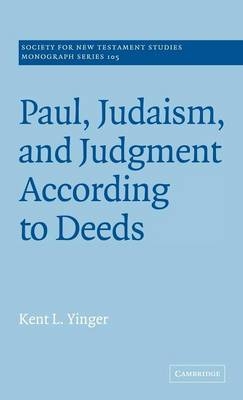
Paul, Judaism, and Judgment According to Deeds
Seiten
1999
Cambridge University Press (Verlag)
978-0-521-63243-0 (ISBN)
Cambridge University Press (Verlag)
978-0-521-63243-0 (ISBN)
This 1999 book explores the thought of Paul and Judaism on the subject of divine judgment according to works. How can Paul say we will be saved by grace through faith, and also that we will be judged according to our deeds? This book explains the apparent contradiction.
Why does 'judgment according to deeds' produce no discernible theological tension for Paul, the apostle of justification by faith? For students of his writings, paradox, incoherence, or eschatological tension come more readily to mind. Paul felt no such theological tension because there was none - neither within his own soteriology, nor in that of the Judaism from which he learned to speak of 'judgment according to deeds'. For both, salvation is wholly by God's grace and the saved will be repaid (i.e. saved or condemned) in accordance with what they have done. Thus, Paul can promise eternal life to those who 'do good', while threatening wrath upon the disobedient (Rom 2:6-11), and without undermining justification by faith. This thorough 1999 examination of second temple and pauline texts interacts with discussions of 'covenantal nomism', justification, and the 'new perspective' on Paul to explore the Jewishness of the apostle's theology.
Why does 'judgment according to deeds' produce no discernible theological tension for Paul, the apostle of justification by faith? For students of his writings, paradox, incoherence, or eschatological tension come more readily to mind. Paul felt no such theological tension because there was none - neither within his own soteriology, nor in that of the Judaism from which he learned to speak of 'judgment according to deeds'. For both, salvation is wholly by God's grace and the saved will be repaid (i.e. saved or condemned) in accordance with what they have done. Thus, Paul can promise eternal life to those who 'do good', while threatening wrath upon the disobedient (Rom 2:6-11), and without undermining justification by faith. This thorough 1999 examination of second temple and pauline texts interacts with discussions of 'covenantal nomism', justification, and the 'new perspective' on Paul to explore the Jewishness of the apostle's theology.
Preface; List of abbreviations; Introduction; Part I. Judgment According to Deeds in Jewish Literature: 1. The use of the motif in the Jewish scriptures; 2. The use of the motif in the Old Testament pseudepigrapha; 3. The use of the motif in the Qumran literature; Part II. Judgment According to Deeds in Paul's Letters: 4. Judgment according to deeds in Paul's letter to the Romans; 5. Judgment according to deeds in 1 Corinthians; 6. Judgment according to deeds in 2 Corinthians and Colossians; 7. Paul and a Jewish motif: conclusions; Appendices; Bibliography; Subject index; Index of passages.
| Erscheint lt. Verlag | 22.4.1999 |
|---|---|
| Reihe/Serie | Society for New Testament Studies Monograph Series |
| Zusatzinfo | 1 Tables, unspecified |
| Verlagsort | Cambridge |
| Sprache | englisch |
| Maße | 140 x 216 mm |
| Gewicht | 570 g |
| Themenwelt | Religion / Theologie ► Christentum ► Bibelausgaben / Bibelkommentare |
| Geisteswissenschaften ► Religion / Theologie ► Judentum | |
| ISBN-10 | 0-521-63243-9 / 0521632439 |
| ISBN-13 | 978-0-521-63243-0 / 9780521632430 |
| Zustand | Neuware |
| Informationen gemäß Produktsicherheitsverordnung (GPSR) | |
| Haben Sie eine Frage zum Produkt? |
Mehr entdecken
aus dem Bereich


aus dem Bereich
Buch | Softcover (2021)
De Gruyter (Verlag)
CHF 44,90


