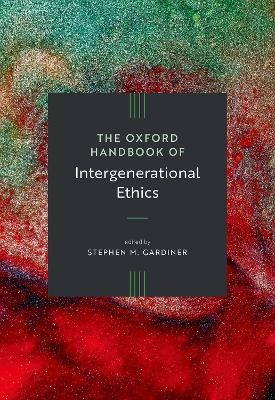
The Oxford Handbook of Intergenerational Ethics
Oxford University Press Inc (Verlag)
978-0-19-088193-1 (ISBN)
The philosopher John Rawls once said that "the question of justice between generations...subjects any ethical theory to severe if not impossible tests." This volume aims to illuminate those tests, indicate the progress made in resolving them, and take some steps of its own. It focuses on the increasing relevance of intergenerational ethics to key challenges of the 21st century, such as climate change, rapid technological change, the expanding human population, and threats of extinction. It features philosophers and political theorists of international standing, providing a cutting-edge perspective on these issues.
Part A considers how intergenerational ethics should be understood from the point of view of leading contemporary moral and political theories, as well as approaches grounded in diverse cultural traditions. Topics include consequentialism, deontology, the ethics of care, contractualism, communitarianism, indigenous perspectives on ancestry, capabilities, republicanism, Buen Vivir, nonanthropocentrism, Confucianism, Maori philosophy, and African intergenerational ethics. Part B reflects on key concepts that structure public and academic discussions of intergenerational issues, such as sustainability, natural heritage, well-being, basic needs, meaning, and the threat of intergenerational tyranny. Part C addresses central issues that arise in intergenerational ethics. These range from key philosophical problems to how to understand political ideals to questions about the limits of appropriate concern. Chapters focus on areas such as: just savings principles, discounting in economics, duties to the past, the nonidentity problem, the repugnant conclusion, discursive justice, shaping intergenerational institutions, and whether to make threatening human extinction an international crime. Part D concludes by sampling topics that have a special importance in intergenerational affairs, such as pensions, inheritance, reparations, intergenerational debt, nuclear weapons, human population size, species conservation, and genetic enhancement of humans.
Stephen M. Gardiner is Professor of Philosophy and Ben Rabinowitz Professor of the Human Dimensions of the Environment at the University of Washington, Seattle, where he is also Director of the Program on Ethics. He is the author of A Perfect Moral Storm: The Ethical Tragedy of Climate Change (2011), and co-author of Debating Climate Ethics (2016). His edited books include The Ethics of "Geoengineering" the Global Climate (2020), The Oxford Handbook of Environmental Ethics (2016), Climate Ethics: Essential Readings (2010) and Virtue Ethics: Old and New (2005). His latest book, Dialogues on Climate Justice (co-authored with Arthur Obst), tells the story of Hope, a fictional protagonist whose life is shaped by a series of conversations about ethics and justice in a climate-challenged world.
INTRODUCTION
The Intergenerational Turn in Ethics: Modest Extension, Major Transformation, or Jealous Virtues?
Stephen M. Gardiner
PART A. THEORIES AND TRADITIONS
1. Consequentialism as an Intergenerational Ethic
Tim Mulgan
2. A Deontological Approach to Future Consequences
Molly Gardner
3. For a Care-based Intergenerational Ethic
Ruth Makoff and Rupert Read
4. Contractualism, Interpersonal and Intergenerational
Rahul Kumar
5. Intergenerational Cooperation and the Social Contract
Joseph Heath
6. Constructivist Contractualism and Future Generations
Gustaf Arrhenius and Emil Andersson
7. Intergenerational Justice and Equality
Clark Wolf
8. Global Intergenerational Justice: A Cosmopolitan Perspective
Simon Caney
9. The Community, The Nation, and Obligations to Future Generations
Avner de-Shalit
10. Hume, Republicanism, and Relations to Posterity
John O'Neill and John Salter
11. Capabilities, Future Generations, and Climate Justice
Breena Holland
12. Long-Term Non-anthropocentric Ethics
John Nolt
13. Ancestry and Crisis: Intergenerational Ethics and Ecocentrism
Kyle Whyte
14. Confucianism and Intergenerational Ethics
Marion Hourdequin and David B. Wong
15. Kaitiakitanga: Toward an Intergenerational Philosophy
Krushil Wahene
16. Intergenerational Justice: An African Perspective
Ernest-Marie Mbonda and Thierry Ngosso
17. Buen Vivir: A Latin American Contribution to Intra- and Intergenerational Ethics
Graciela Vidiella and Facundo Garcia Valverde
PART B. KEY CONCEPTS
18. The Centrality of the Tyranny of the Contemporary to Intergenerational Ethics
Stephen M. Gardiner
19. Intergenerational Metaphors
Axel Gosseries
20. Well-being and Intergenerational Ethics
Andrew Moore
21. Basic Needs and Sufficiency: the Foundations of Intergenerational Justice
Lucas H. Meyer & Thomas Polzer
22. Natural Resources, Sustainability and Intergenerational Ethics
Chris Armstrong
23. The Intergenerational Value of Natural Heritage
Angela Karlhoff
24. Irreversible Loss
Kai Spiekermann
25. Meaning and Value Across the Generations
Samuel Scheffler
26. A World They Don't Deserve: Moral failure and deep adaptation
Allen Thompson
PART C. CENTRAL ISSUES
27. Discounting and Intergenerational Ethics
Marc Fleurbaey and Stéphane Zuber
28. The Sustainabilitarian Approach: Utilitarianism, the Discounting of Future Welfare Levels, and Sustainability
John E. Roemer
29. Justice between Coexisting Generations
Juliana Uhuru Bidadanure
30. The Just Savings Principle
Eric Brandstedt
31. The Family and Intergenerational Justice: A Liberal Egalitarian Perspective
Colin M. Macleod
32. Do We Have Moral Duties to Past People?
Geoffrey Scarre
33. Parfit and the Non-Identity Problem
David Boonin
34. The Repugnant Conclusion: an Overview
Gustaf Arrhenius & Emil Andersson
35. Risk, Responsibility, and Procreative Asymmetries
Rivka Weinberg
36. Human Rights & Intergenerational Ethics
Marcus Duwell
37. Discursive Justice in and with Future Generations
Michael Blake
38. Intergenerational Ethics and Individual Duties: A Cooperative Promotional Approach
Elizabeth Cripps
39. Political Institutions & Intergenerational Ethics: Disenfranchising the Future?
Anja Karnein
40. Postericide and Intergenerational Ethics
Catriona McKinnon
PART D: SPECIAL TOPICS
41. Universal State Pension Schemes and the Duties of Retirees
Elizabeth Finneron-Burns
42. On "Dynastic" Inequality
Dan Halliday & Miranda Stewart
43. Intergenerational Justice and Debt
Patrick Taylor Smith
44. Reparation as Intergenerational Justice
Janna Thompson
45. Should We Deploy Nuclear Energy? How Intergenerational Ethics Could Help to Escape the Dichotomy
Behnam Taebi
46. Nuclear Deterrence - Another Perfect Storm
Matthew Rendall
47. The Challenge of Population
Sarah Conly
48. Species Conservation, Biotechnology, and Intergenerational Ethics
Ron Sandler
49. Moral Bioenhancement and Future Generations: Selecting Martyrdom?
Julian Savulescu and Hilary Bowman-Smart
| Erscheinungsdatum | 15.02.2023 |
|---|---|
| Reihe/Serie | Oxford Handbooks |
| Verlagsort | New York |
| Sprache | englisch |
| Maße | 191 x 239 mm |
| Gewicht | 1633 g |
| Themenwelt | Geisteswissenschaften ► Philosophie ► Ethik |
| Sozialwissenschaften ► Pädagogik | |
| Sozialwissenschaften ► Soziologie | |
| ISBN-10 | 0-19-088193-3 / 0190881933 |
| ISBN-13 | 978-0-19-088193-1 / 9780190881931 |
| Zustand | Neuware |
| Informationen gemäß Produktsicherheitsverordnung (GPSR) | |
| Haben Sie eine Frage zum Produkt? |
aus dem Bereich