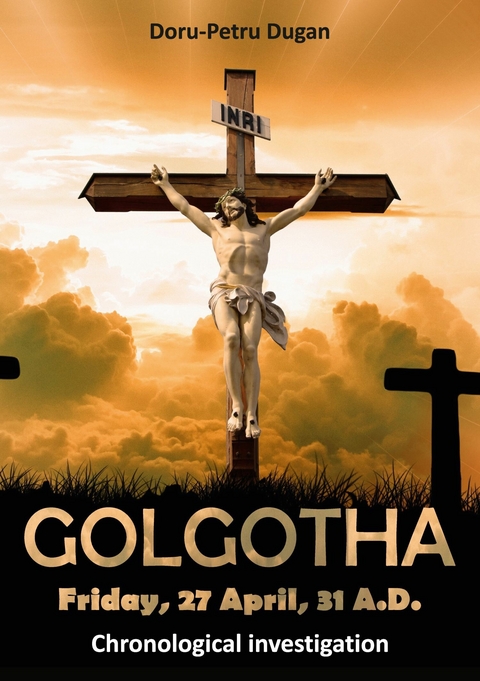
GOLGOTHA - Friday, 27 April, 31 A.D. (eBook)
484 Seiten
tredition (Verlag)
978-3-347-78609-7 (ISBN)

Preface
The essence of man’s personal relationship with God is sublimely revealed by the so – called ´´Gospel in miniature´´, a Johannine verse, that sums up the whole salvific theology: “ For God so loved the world, that he gave his only-begotten Son, that whosoever believes on him may not perish, but have life eternal ” (Jn. 3:16). The sacrifice on Golgotha represents the key event in the economy of salvation; the mystery of human kind’s redemption—i.e., the release through the paying of a price—was attained with the sacrifice of Jesus, the Son of God and the Son of Man, “ who himself bore our sins in his body on the tree, in order that, being dead to sins, we may live to righteousness: (…). ” (1 Pt.2:24). For this reason, the ‘Cross’ has become a symbol of love, expiation, and God’s spirit of sacrifice towards the fallen world. The death of Jesus, “ (…) the Lamb of God, who takes away the sin of the world. ” (Jn.1:29), has obvious connotations with the dogma of the Paschal sacrifice,“(…). For also our passover, Christ, has been sacrificed;” (1 Co.5:7), on a day of Passover, at the biblical ninth hour, when the ritual of sacrifice began in the Temple. But the Crucifixion of the Nazarene — although recorded in the Greek Scriptures, the Babylonian Talmud, the works of the Church Fathers and even by a number of lay writers of Antiquity, having been a historic event that took place in Roman Judaea, where records of the populace were kept — has never been correctly dated. Fortunately, the predetermined divine plan and foreknowledge of God, who knows all things and all events that will happen over time, provided a numerological prophetic schema for the rigorous determination of the date in which this tragedy would take place. This is the so-called ‘Seventy Weeks’ prophecy, given in chapter 9 (verses 24-27) of the ´´Book of Daniel´´, one of the strangest, most enigmatic and consequently most fascinating works of the Old Testament. Although the subject of this chronological forecast is of great interest to both Judaism and Christianism, all previous theological studies have failed to solve the famous equation correctly, because the esoteric language of prophecy and its computational algorithm were inaccessible to the uninitiated. The solution proposed in the present monograph, whereby I claim finally to have solved the problem in question, derives from the scheme of the historical – Messianic interpretation of Daniel’s prophecy. Its originality resides in a new way of treating the chronologies of the following three topics:
1) The reign of Artaxerxes I, King of Persia (1st regnal year: {4? / 8? August 465 B.C. ÷ 19 September 465 B.C.} / 7th regnal year: {23 September 460 B.C. ÷ 11 October 459 B.C.} / 20th regnal year: {1 October 447 B.C. ÷ 19 September 446 B.C.}, according to the circumstantial chronology of Ezra and Nehemiah).
2) The Messianic Prophecy of Daniel 9:25-26a / The Oracle of the ´´Sixty-nine Weeks´´ (Starting date: 7 / 8 April 446 B.C. / in the 20th regnal year of Artaxerxes I; Duration, structured in 7 + 62 = 69 ‘weeks’: 483 prophetic years / 360-day years = 476 Julian calendar years / 365.25-day years; Ending date: 26 / 27 April 31 A.D. / in the 18th regnal year of Tiberius).
3) The Events of ´´Passion Week´´ (the Triumphal Entry into Jerusalem: Saturday, 21 April, 31 A.D.; the Last Supper, which was not a traditional Passover Seder: Tuesday evening, 24 April, 31 A.D.; the Arrest: Tuesday night / Wednesday, 24 / 25 April, 31 A.D.; the Jewish Trial: Wednesday, 25 April, 31 A.D.; the Roman Trials I + II and Condemnation: Thursday, 26 April, 31 A.D.; the Crucifixion and Death: Friday, 27 April, 31 A.D. / Delayed Passover; the Resurrection: Saturday night / Sunday, 28 April, 31 A.D.).
All the scriptural verses, cited as doctrinal arguments, are taken from the Bible translated by J.N.Darby (a 19th century Anglo-Irish evangelist, who was a promoter of classical dispensationalism): ´´ The Darby Bible´´ (acronym DBY). This version of the Holy Scriptures has considerable prestige because: 1) it is a literal translation, which even in the late-nineteenth century rendered the divine name YHWH as Jehovah, as opposed to the traditional practice of substituting for this sacred Tetragrammaton (Gr. “four letters”) the word LORD; Nevertheless, since the personal Name of Almighty God, expressed by the Hebrew tetragrammaton YHWH (Jehovah) # 3068, is still not familiar to many readers, it will be systematically combined with its usual translation, written in capital letters , i.e., the LORD and 2) it enjoys international recognition, since it was already published in the 19th and 20th centuries in widely circulated languages such as English (The Holy Bible containing the Old and New Testaments / The Darby Bible), French (La Sainte Bible qui comprend l’Ancien et le Nouveau Testament / La Bible Darby) and German ( Die Heilige Schrift / Elberfelder Bibel). As such, despite its age and a number of linguistic inadvertencies, DBY is regarded even today as one of the most accurate translations of the Bible, which warrants its selection as the reference text for the commentaries that follow. Obviously, however, rigorous research also demands textual comparisons, since none of the biblical editions can be said to enjoy the privilege of perfection. In this respect, the documentation has been extended to the following classical versions and modern translations: Biblia / Bibel (Die Luther-Bibel & Die Dietenberger-Bibel / Die Eck-Bibel); La Bible (La Bible d’Olivétan & La Bible de l’Épée & La Bible de Genève); La Sainte Bible (La Bible de Sacy & La Bible d’Ostervald & La Bible Martin); The Holy Bible (The King James Version / KJV or The New King James Version / NKJV & The Webster Bible / WBT & The American Standard Version / ASV & The Rotherham Bible / EBR; The Scofield Reference Bible / SCO & The Knox Bible / KB & Restoration of Original Sacred Name Bible & New International Version Anglicised / NIVUK & Green’s Literal Translation / LITV & The Book of Yahweh: The Holy Scriptures & The God’s Word Translation / GW & The Holman Christian Standard Bible / HCSB & The Divine Name King James Bible / DNKJB & Sacred Name Bible: Sacred Name King James Version & The Christian Standard Bible / CSB & Berean Study Bible / BSB); The Scriptures (ISR); Young’s Literal Translation (YLT); La Bible de Jerusalem (BJ) / The Jerusalem Bible (JB); Biblia (Traducere Literală Nouă / TLN); Biblia (Noua Traducere in Limba Română / NTR); Concordant Version of the Old Testament (CVOT) & Concordant Literal New Testament (CLNT); Word of YHVH Bible: My Name is YaHavah; The Holy Scriptures according to the Masoretic Text (JPS); Complete Jewish Bible (CJB) & The Holy Scriptures: Tree of Life Version (TLV); The Septuagint with Apocrypha Greek-English, La Bible d’Alexandrie – LXX; Septuaginta (Romanian Translation); A New English Translation of the Septuagint (NETS); Holy Bible from the Ancient Eastern Text (The Lamsa Bible - Peshitta / LBP); Aramaic Peshitta New Testament Translation - Messianic Version; Les Evangiles dans la langue de Jesus; The Peshitta Holy Bible Translated (PHBT). Likewise, for the elucidation of certain semantic details, we have drawn upon the main interlinear or polyglot editions: Hebraicorum Bibliorum Veteris Testamenti Latina; Biblia Hebraica & Novum Testamentum Graecorum; The Interlinear NIV Hebrew-English Old Testament; Ancien Testament interlinéare hébreu – français; The Interlinear Hebrew-Greek-English Bible / 4 Vols.; Das Alte Testament Interlinearübersetzung Hebräisch – Deutsch / 5 Vols.; The Messianic Aleph Tav Interlinear Scriptures (MATIS) / 3 Vols.; The Aramaic English Interlinear Peshitta Holy Bible; Kata Biblon Greek Septuagint (interlinear) and Wiki English Translation; Biblia Polyglotta Complutensis / 6 Vols.); Biblia Polyglotta Antwerpiensia / 8 Vols.; Biblia Polyglotta Hamburgensis / 6 Vols.; Bibla Polyglotta Heidelbergensis / 4 Vols.; Novum Testamentum Dni.Nri. Iesu Christi; La Bible de Vence; Biblia Polyglotta Parisiensia / 10 Vols.; Biblia Polyglotta Londinensia / 6 Vols.; Biblia Pentapla / 3 Vols.; Biblia Polyglotta Lipsiensia / 3 Vols.; The English Hexapla; Hexapla Origenis / 2 Vols.; Biblia Hexaglotta / 6 Vols.; Biblia Triglotta / 2 Vols.; Biblia Sacra Vulgatae Editionis (Die Allioli – Bibel) / 3 Vols.; La Sainte Bible Polyglotte; The Holy Bible. Douay - Rheims Version (The Challoner Bible); The Septuagint with Apocrypha: Greek and English; Vetus Testamentum Graecum juxta Septuaginta interpretes (Vetus Testamentum Graece et Latine); Aramaic English New Testament. Unless otherwise stated, all texts in...
| Erscheint lt. Verlag | 21.12.2022 |
|---|---|
| Verlagsort | Ahrensburg |
| Sprache | englisch |
| Themenwelt | Geisteswissenschaften ► Philosophie ► Erkenntnistheorie / Wissenschaftstheorie |
| Geisteswissenschaften ► Religion / Theologie ► Christentum | |
| Schlagworte | biblical chronology • Daniel 9:24-27 • Daniel 9:25-26 • Daniel’s 69-Weeks Oracle • Daniel’s 70-Week Prophecy • Jesus Crucifixion • Messiah • New Testament • Old Testament |
| ISBN-10 | 3-347-78609-2 / 3347786092 |
| ISBN-13 | 978-3-347-78609-7 / 9783347786097 |
| Informationen gemäß Produktsicherheitsverordnung (GPSR) | |
| Haben Sie eine Frage zum Produkt? |
 EPUB (Wasserzeichen)
DRM: Digitales Wasserzeichen
Dieses eBook enthält ein digitales Wasserzeichen und ist damit für Sie personalisiert. Bei einer missbräuchlichen Weitergabe des eBooks an Dritte ist eine Rückverfolgung an die Quelle möglich.
Dateiformat: EPUB (Electronic Publication)
EPUB ist ein offener Standard für eBooks und eignet sich besonders zur Darstellung von Belletristik und Sachbüchern. Der Fließtext wird dynamisch an die Display- und Schriftgröße angepasst. Auch für mobile Lesegeräte ist EPUB daher gut geeignet.
Systemvoraussetzungen:
PC/Mac: Mit einem PC oder Mac können Sie dieses eBook lesen. Sie benötigen dafür die kostenlose Software Adobe Digital Editions.
eReader: Dieses eBook kann mit (fast) allen eBook-Readern gelesen werden. Mit dem amazon-Kindle ist es aber nicht kompatibel.
Smartphone/Tablet: Egal ob Apple oder Android, dieses eBook können Sie lesen. Sie benötigen dafür eine kostenlose App.
Geräteliste und zusätzliche Hinweise
Buying eBooks from abroad
For tax law reasons we can sell eBooks just within Germany and Switzerland. Regrettably we cannot fulfill eBook-orders from other countries.
aus dem Bereich