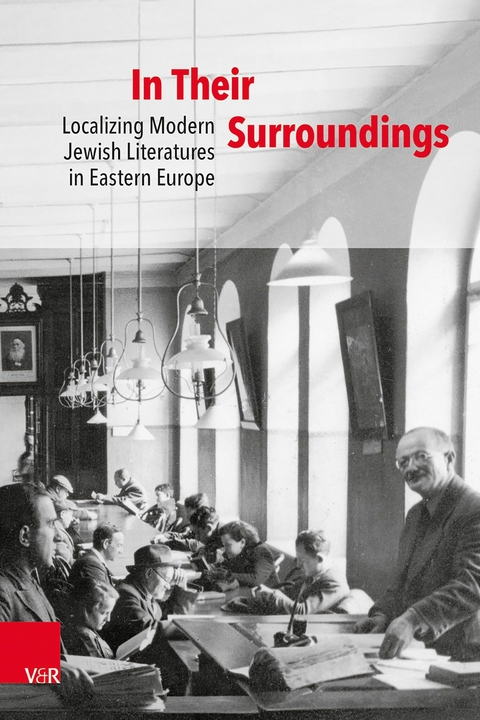
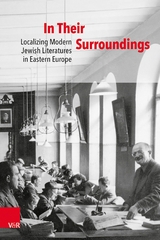
In Their Surroundings (eBook)
278 Seiten
Vandenhoeck und Ruprecht (Verlag)
978-3-647-99337-9 (ISBN)
Efrat Gal-Ed is Professor of Yiddish Studies at the Heinrich Heine University Düsseldorf.
Efrat Gal-Ed is Professor of Yiddish Studies at the Heinrich Heine University Düsseldorf.
Efrat Gal-Ed, Natasha Gordinsky, Sabine Koller, Yfaat Weiss
| ”אין דער אמת‘ן זיינען מיר אינאיינעם מיט אונזער שפּראַך און ליטעראַטור און אונזער גאַנצען גייסטיגען פארמעגען — פּאָליטעריטאָריאַל, ד. ה. מיר שוועבען ניט אין דער לופטען, מיר זיינען ניט | “In truth we are, along with our [Yiddish] language, our literature, and our whole intellectual capacity, polyterritorial, that is, we are not afloat in the air, not uprooted from the ground; on the contrary, we draw nurture from various soils, are under the influence of various climate zones, various surroundings. The effects of these all meet one another, join together, come into conflict or unite with our common national work.” Shmuel Niger, 19221 |
| ”לבחור לשון כמי שבוחר לו טבעת. הזכות הזאת לבחור בלשון כבטבעת קידושין ולברך עליה, הרי את מקודשת.“ | “Choose a language as one chooses a ring. This privilege of choosing a language as one does a wedding ring, chanting: with this ring you are my sacred.” Leah Goldberg, 19462 |
| ”די יודישע ליטעראַטור געהט חלילה נישט צו גרונד. זי איז איינע און איהר נאָמען איז איינער. נור זי קומט צום לעזער אין צוויי געשטאַלטען, און ווי די שאָלען אויפ׳ן וואָגשאָל שאָקלען זיי זיך איינער אַנטקעגען דער אַנדערער. און אַזוי ווי אין דער נאַטור איז קיין זאַך נישט אַבּסאָלוט — בעוועגען זיך די שאָלען אַרויף און אַראָבּ.“ | “The Jewish literature is not deteriorating, heaven forbid. It is one and its name is one. Rather, it appears to the reader in two forms, and like the swaying plates of a scale, up and down against each other. And just like in nature, where there are no absolutes, so the scales sway up and down.” Bal-Makhshoves, 19103 |
When, in 1910, eminent critic Bal-Makhshoves (“Man of Thoughts,” pen name of Isidor Elyashev) coined the image of two plates (two languages) being part of one scale (one literature) in his article Tsvey shprakhen—eyn eyntsige literatur (Two Languages—One Literature), he aptly promoted the unity of a dynamic bilingual Jewish literature. Bal-Makhshoves is a sagacious and reliable voice when tracing the formation of modern Jewish literatures.4 This profound and far-reaching process began in the second half of the nineteenth century in Eastern Europe, primarily in provincial capitals and towns located in the historical region of the Jewish Pale of Settlement in the Russian Empire. The historical, political, and sociocultural constellations of the time had a crucial impact on Jewish literary thinking. Jewish culture in Eastern Europe evolved in close connection with the Central and Eastern European imperial and minority languages specific to the Russian, German, and Austro-Hungarian cultures. The development led, on the one hand, to the participation of Jews in the intellectual and literary achievements in these languages. On the other hand, it generated a flow of aesthetic ideals and political ideologies from the surrounding majority cultures into the Jewish discourses in the Yiddish and Hebrew languages. The “two forms,” i. e. the literatures in Yiddish and Hebrew, in their polylingual environments were decisive for the evolution of Jewish secular culture from the turn of the nineteenth century onward. While literary works were preoccupied with the existential dilemmas of the Jewish people, they nevertheless relied on the philosophical apparatus of Russian and German literatures and thought (Friedrich Schiller, Friedrich Nietzsche, Rainer Maria Rilke, Aleksandr Pushkin, Fëdor Dostoevskiy, Lev Tolstoy, Anton Chekhov, Aleksandr Blok, Anna Akhmatova, and many more). The keen interest of early Hebrew and Yiddish writers in Russian and German cultures made way for the Europeanization of modern Jewish literatures.5 An important dimension of this development was the continuing endeavor of translating German and Russian literary and philosophical writings into Hebrew and Yiddish, thereby preserving their humanistic legacy.
Within a vibrant polylingual and multicultural atmosphere, an eventful history marked by revolutions, the breakdown of empires, the rise (or reappearance) of young nations (partly with an inflated sense of nationalism), and mass migration to the New World, a modern Jewish literary thinking took shape. Numerous processes of cultural transfer played a major role in forging the concept of Europe for Eastern European Jewish intellectuals. In Hebrew literature, Uri Nissan Gnessin, Gershon Shofman, or Yosef Ḥayyim Brenner, among others, modelled their literary writings in imagined and real contact zones where European and Russian modernist trends were inspiring paragons. In Gomel, they avidly read and translated Chekhov, admired Charles Baudelaire, discussed the differences in the poetics of Maksim Gor’kiy and Andrey Belyy, and studied German. Whereas at the same time in other places, be it a Volhynian shtetl, Lithuanian Vilna, or the metropolis of Kyiv, their Yiddish-writing colleagues—Dovid Bergelson, Moyshe Kulbak, Perets Markish, and others—were eager to get hold of journals, almanacs, anthologies, or books of Russian Symbolist poetry, Russian and Ukrainian Futurist verse, or German Expressionism.
This concept of European culture was disseminated in the literary imagination of Jewish writers and expanded with the emergence of modernist movements in Europe. Based mainly in Eastern and Central European metropolises, Jewish literatures offered new aesthetic forms through which to understand, and come to terms with, modernity. Jewish intellectuals became the messengers of “travelling concepts,” be they radical political ideas or literary norms and conventions. Their acculturation to hegemonic cultures was accompanied by the adaptation of narrative models and critical paradigms that brought about fundamental changes in the conceptualization of history, Jewish collectiveness, Jewish spaces, and literature itself. However, the encounter of Jewish intellectuals with hegemonic cultures took place in specific regional contexts and through contacts with other, nonimperial cultures. As a result, Eastern European Jewish literatures faced different and even contradictory tendencies: universalism vs. particularism, Russification/Germanization vs. Jewish nationalism, and localism vs. cosmopolitanism.
While Hebrew and Yiddish literatures evolved employing similar strategies, a dominant dynamic between them was the battle between Hebraists and Yiddishists, pursued with much political and ideological vehemence and resulting in considerable bitterness, particularly on the side of the Yiddishists. Nevertheless, looking across the Hebraist-Yiddishist divide from today’s point of view, it could be argued that the two young literatures shared the same vision of what literature ought to be and achieve, and how it should do that. As polyglot intellectuals, some Jewish authors decided to use a single language, while others wrote in both Hebrew and Yiddish. The emerging literatures in the two Jewish languages thus formed one multilingual system, which was constituted by dynamic interactions and linguistic crossovers that could include Russian, Polish, Ukrainian, German, and other languages.
The dynamic multicultural and polyphonic literary life outlined above was the object of investigation of the research project “In Their Surroundings: Localizing Modern Jewish Literatures in Eastern Europe,” funded by the German-Israeli Foundation for Scientific Research and Development (2017–2019). The project,...
| Erscheint lt. Verlag | 12.12.2022 |
|---|---|
| Zusatzinfo | mit 19 s/w u. 63 farb. Abb. |
| Verlagsort | Göttingen |
| Sprache | englisch |
| Themenwelt | Geschichte ► Allgemeine Geschichte ► 1918 bis 1945 |
| Schlagworte | Deborah Vogel • Jewish Studies • Jiddische und hebräische Literatur • Jüdische Geschichte • Leah Goldberg • Literaturwissenschaft • Moyshe Kulbak • Osteuropäische Geschichte • Yosef Ḥayim Brenner |
| ISBN-10 | 3-647-99337-9 / 3647993379 |
| ISBN-13 | 978-3-647-99337-9 / 9783647993379 |
| Informationen gemäß Produktsicherheitsverordnung (GPSR) | |
| Haben Sie eine Frage zum Produkt? |
 EPUB (Ohne DRM)
Digital Rights Management: ohne DRM
Dieses eBook enthält kein DRM oder Kopierschutz. Eine Weitergabe an Dritte ist jedoch rechtlich nicht zulässig, weil Sie beim Kauf nur die Rechte an der persönlichen Nutzung erwerben.
Dateiformat: EPUB (Electronic Publication)
EPUB ist ein offener Standard für eBooks und eignet sich besonders zur Darstellung von Belletristik und Sachbüchern. Der Fließtext wird dynamisch an die Display- und Schriftgröße angepasst. Auch für mobile Lesegeräte ist EPUB daher gut geeignet.
Systemvoraussetzungen:
PC/Mac: Mit einem PC oder Mac können Sie dieses eBook lesen. Sie benötigen dafür die kostenlose Software Adobe Digital Editions.
eReader: Dieses eBook kann mit (fast) allen eBook-Readern gelesen werden. Mit dem amazon-Kindle ist es aber nicht kompatibel.
Smartphone/Tablet: Egal ob Apple oder Android, dieses eBook können Sie lesen. Sie benötigen dafür eine kostenlose App.
Geräteliste und zusätzliche Hinweise
Buying eBooks from abroad
For tax law reasons we can sell eBooks just within Germany and Switzerland. Regrettably we cannot fulfill eBook-orders from other countries.
aus dem Bereich