


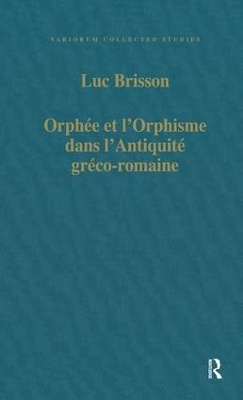
Orphée et l’Orphisme dans l’Antiquité gréco-romaine
Seiten
1995
Variorum (Verlag)
978-0-86078-453-1 (ISBN)
Variorum (Verlag)
978-0-86078-453-1 (ISBN)
The main purpose of this book is to provide a contextualization of the Orphic fragments cited by Medio-Platonists and Neo-Platonists, Proclus, Damascius and Olympiodorus. The author concludes that the "Rhapsodies" were composed from an earlier version known by Aristophanes, Plato and others.
The figure of Orpheus has long exercised a potent influence on religious thought. Yet what we know directly about Orphism comes from a scatter of isolated and often very short fragments quoted in the works of Platonists of the Roman period, notably Proclus, Damascius and Olympiodorus. The author’s concern here is to establish the context in which these passages were cited, and to trace the development of the written tradition, from the texts which contain a critique of the beliefs of the Homeric era to those, whether newly composed or transformed, which show signs of adaptation to later religious and philosophical movements, among them Stoicism and Platonism. In sharp contrast to views held by others, it is argued that it is possible to map out a process of evolution, amongst other criteria by focusing on the role and place of Chronos in the Orphic theogony. The author also asks whether there really ever existed true Orphic sects with a cult with specific rites, and would conclude that the present evidence cannot be held to substantiate this. Orphée a pendant longtemps exercé une puissante influence sur la pensée religieuse. Cependant, ce que nous connaissons directement de l’Orphïsme se réduit à une poignée de fragments isolés et souvent très courts qui se trouvent éparpillés dans les oeuvres de Platoniciens ayant vécu sous l'Empire romain, surtout Proclus, Damascius et Olympiodore. Dans les articles qui composent ce recueil, l'auteur s'est attaché à reconstituer les contextes dans lesquels ces passages sont cités, et à comprendre comment s'est développée la tradition écrite à laquelle ils appartiennent, depuis les textes qui critiquent les croyances véhiculées par Homère et par Hésiode et qui, ayant fait l'objet d'une rédaction ou d'une transformation récente, présentent les signes d'une adaptation à des mouvements religieux ou philosophiques tardifs, le Stoïcisme et le médio-Platonisme entre autres. S'opposant en cela à b
The figure of Orpheus has long exercised a potent influence on religious thought. Yet what we know directly about Orphism comes from a scatter of isolated and often very short fragments quoted in the works of Platonists of the Roman period, notably Proclus, Damascius and Olympiodorus. The author’s concern here is to establish the context in which these passages were cited, and to trace the development of the written tradition, from the texts which contain a critique of the beliefs of the Homeric era to those, whether newly composed or transformed, which show signs of adaptation to later religious and philosophical movements, among them Stoicism and Platonism. In sharp contrast to views held by others, it is argued that it is possible to map out a process of evolution, amongst other criteria by focusing on the role and place of Chronos in the Orphic theogony. The author also asks whether there really ever existed true Orphic sects with a cult with specific rites, and would conclude that the present evidence cannot be held to substantiate this. Orphée a pendant longtemps exercé une puissante influence sur la pensée religieuse. Cependant, ce que nous connaissons directement de l’Orphïsme se réduit à une poignée de fragments isolés et souvent très courts qui se trouvent éparpillés dans les oeuvres de Platoniciens ayant vécu sous l'Empire romain, surtout Proclus, Damascius et Olympiodore. Dans les articles qui composent ce recueil, l'auteur s'est attaché à reconstituer les contextes dans lesquels ces passages sont cités, et à comprendre comment s'est développée la tradition écrite à laquelle ils appartiennent, depuis les textes qui critiquent les croyances véhiculées par Homère et par Hésiode et qui, ayant fait l'objet d'une rédaction ou d'une transformation récente, présentent les signes d'une adaptation à des mouvements religieux ou philosophiques tardifs, le Stoïcisme et le médio-Platonisme entre autres. S'opposant en cela à b
Luc Brisson, CNRS, France
Contents: Avant-propos; Les théogonies Orphiques et le papyrus de Derveni: notes critiques; Usages et fonctions du secret dans le Pythagorisme ancien; La figure de Chronos dans la théogonie orphique et ses antécédents iraniens; Orphée et l’Orphisme à l’époque impériale: témoignages et interprétations philosophiques, de Plutarque à Jamblique; Proclus et l’Orphisme; Damascius et l’Orphisme; Le corps ’dionysiaque’: l’anthropogonie décrite dans le Commentaire sur le Phédon de Platon (1, par. 3-6), attribué à Olympiodore est-elle orphique?; Addenda et corrigenda; Indexes.
| Erscheint lt. Verlag | 9.3.1995 |
|---|---|
| Reihe/Serie | Variorum Collected Studies |
| Sprache | englisch |
| Maße | 150 x 224 mm |
| Gewicht | 453 g |
| Themenwelt | Geschichte ► Allgemeine Geschichte ► Altertum / Antike |
| Geisteswissenschaften ► Religion / Theologie ► Weitere Religionen | |
| Geisteswissenschaften ► Sprach- / Literaturwissenschaft ► Anglistik / Amerikanistik | |
| Geisteswissenschaften ► Sprach- / Literaturwissenschaft ► Literaturwissenschaft | |
| ISBN-10 | 0-86078-453-3 / 0860784533 |
| ISBN-13 | 978-0-86078-453-1 / 9780860784531 |
| Zustand | Neuware |
| Informationen gemäß Produktsicherheitsverordnung (GPSR) | |
| Haben Sie eine Frage zum Produkt? |
Mehr entdecken
aus dem Bereich

aus dem Bereich
ohne den ganzen langweiligen Kram
Buch | Hardcover (2025)
C.H.Beck (Verlag)
CHF 36,40
von den Anfängen bis zum Untergang
Buch | Hardcover (2025)
Alfred Kröner Verlag
CHF 48,95
von den Anfängen bis zur Spätantike
Buch | Softcover (2024)
C.H.Beck (Verlag)
CHF 16,80


