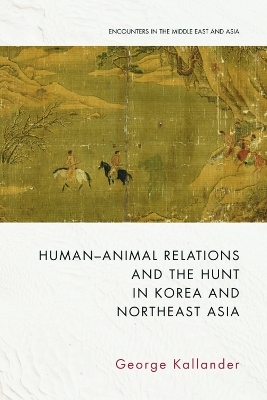
Human-Animal Relations and the Hunt in Korea and Northeast Asia
Edinburgh University Press (Verlag)
978-1-3995-1209-1 (ISBN)
This book focuses on the transitional period in late Koryŏ and early Chosŏn dynasty Korea from the 1270s until 1506, situating the Korean peninsula in relation to the neighbouring Mongol Empire and Ming Dynasty China. During this period, Korean statesmen expanded their influence over people and the environment. Human-animal relations became increasingly significant to politics, national security, and elite identities. Animals, both wild and domestic, were used in ritual sacrifices, submitted as tax tribute, exchanged in regional trade, and most significantly, hunted. Royal proponents of the hunt, as a facet of political and military legitimacy, were contested by a small but vocal group of officials. These vocal elites attempted to circumscribe royal authority by co-opting hunting through Confucian laws and rites, either by regulating the practice to a state ritual at best, or, at worst, considering it a barbaric exercise not befitting of the royal family. While kings defied the narrow Confucian views on governance that elevated book learning over martial skills, these tensions revealed how the meaning of political power and authority were shaped. Attention to animals and hunting depicts how a multiplicity of cultural references—Sinic, Korean, Northeast Asian, and steppeland—existed in tension with each other and served as a battleground for defining politics, society, and ritual. Kallander argues that rather than mere resources, animals were a site over which power struggles were waged.
George Kallander is Professor of History at Syracuse University, where he is also Director of the East Asia Program at the Moynihan Institute. He is author of The Diary of 1636: The Second Manchu Invasion of Korea (Columbia University Press, 2020) and Salvation through Dissent: Tonghak Heterodoxy and Early Modern Korea (University of Hawai’i Press, 2013). Kallander has received fellowships from the Institute for Advanced Study (Princeton), the Academy of Korean Studies, and Columbia University.
List of Illustrations List of Kings
Introduction: Why Animals and the Hunt?
Wild Beasts on a Premodern Peninsula
Koryŏ and the Empire of the Hunt
Growth, Transformation and Challenge in the Late-14th and Early 15th Centuries
Confucian Beasts: Human–Animal Relations in Early Chosŏn
Stalking the Forests: The Military on the Chase in the Mid-15th Century
Challenges to the Royal Military Kangmu Hunt
Public Animals, Private Hunts and Royal Authority in the 15th Century
Release the Falcons: A King in a Confucian Court
Taming Wild Animals and Beastly Monarchs
Conclusion: Legacies of the Hunt in Politics, Society and Empire
Bibliography Index
| Erscheinungsdatum | 02.05.2023 |
|---|---|
| Reihe/Serie | Encounters in the Middle East and Asia |
| Zusatzinfo | 6 black and white illustrations, 3 black and white maps |
| Verlagsort | Edinburgh |
| Sprache | englisch |
| Maße | 156 x 234 mm |
| Themenwelt | Geschichte ► Allgemeine Geschichte ► Mittelalter |
| Geschichte ► Allgemeine Geschichte ► Neuzeit (bis 1918) | |
| Geisteswissenschaften ► Geschichte ► Regional- / Ländergeschichte | |
| Geschichte ► Teilgebiete der Geschichte ► Kulturgeschichte | |
| ISBN-10 | 1-3995-1209-9 / 1399512099 |
| ISBN-13 | 978-1-3995-1209-1 / 9781399512091 |
| Zustand | Neuware |
| Informationen gemäß Produktsicherheitsverordnung (GPSR) | |
| Haben Sie eine Frage zum Produkt? |
aus dem Bereich