


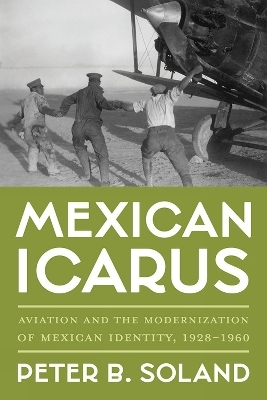
Mexican Icarus
Aviation and the Modernization of Mexican Identity, 1928-1960
Seiten
2024
University of Pittsburgh Press (Verlag)
978-0-8229-4760-8 (ISBN)
University of Pittsburgh Press (Verlag)
978-0-8229-4760-8 (ISBN)
The development of aviation in Mexico reflected more than a pragmatic response to the material challenges brought on by the 1910 Revolution. At the same time, the archetype of the aviator camouflaged problematic aspects of the government’s unification and development plans that displaced and exploited poor and Indigenous communities.
The development of aviation in Mexico reflected more than a pragmatic response to the material challenges brought on by the 1910 Revolution. It was also an effective symbol for promoting the aspirations of the new elite who attained prominence during the war and who fixated on technology as a measure of national progress. The politicians, industrialists, and cultural influencers in the media who made up this group molded the aviator into an avatar of modern citizenship. The figure of the pilot as a model citizen proved an adept vessel for disseminating the values championed by the official party of the Revolution and validating the technological determinism that underpinned its philosophy of development. At the same time, the archetype of the aviator camouflaged problematic aspects of the government’s unification and development plans that displaced and exploited poor and Indigenous communities.
The development of aviation in Mexico reflected more than a pragmatic response to the material challenges brought on by the 1910 Revolution. It was also an effective symbol for promoting the aspirations of the new elite who attained prominence during the war and who fixated on technology as a measure of national progress. The politicians, industrialists, and cultural influencers in the media who made up this group molded the aviator into an avatar of modern citizenship. The figure of the pilot as a model citizen proved an adept vessel for disseminating the values championed by the official party of the Revolution and validating the technological determinism that underpinned its philosophy of development. At the same time, the archetype of the aviator camouflaged problematic aspects of the government’s unification and development plans that displaced and exploited poor and Indigenous communities.
Peter B. Soland is assistant professor of history specializing in Latin America at the University of Houston–Downtown.
| Erscheinungsdatum | 25.05.2023 |
|---|---|
| Verlagsort | Pittsburgh PA |
| Sprache | englisch |
| Maße | 152 x 229 mm |
| Themenwelt | Geisteswissenschaften ► Geschichte ► Allgemeine Geschichte |
| ISBN-10 | 0-8229-4760-9 / 0822947609 |
| ISBN-13 | 978-0-8229-4760-8 / 9780822947608 |
| Zustand | Neuware |
| Informationen gemäß Produktsicherheitsverordnung (GPSR) | |
| Haben Sie eine Frage zum Produkt? |
Mehr entdecken
aus dem Bereich



aus dem Bereich
eine Reise um die Welt zu außergewöhnlichen Persönlichkeiten, …
Buch | Softcover (2023)
Piper (Verlag)
CHF 25,20
Eine wahre Geschichte von Schiffbruch, Mord und Meuterei
Buch | Hardcover (2024)
C.Bertelsmann (Verlag)
CHF 34,95


