


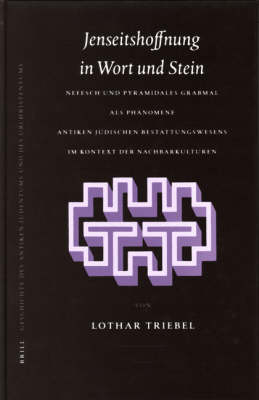
Jenseitshoffnung in Wort und Stein
Nefesch und pyramidales Grabmal als Phänomene antiken jüdischen Bestattungswesens im Kontext der Nachbarkulturen
Seiten
2004
Brill (Verlag)
978-90-04-12924-5 (ISBN)
Brill (Verlag)
978-90-04-12924-5 (ISBN)
- Titel ist leider vergriffen;
keine Neuauflage - Artikel merken
This monograph discusses "Nefesh" as a term in the ancient semitic cultures of burial, especially Judaism. It secondly deals with the pyramid as a distinct feature of burial sites in Ancient Israel and links its use to the hope for postmortal existence.
This monograph deals with two phenomena of ancient (hellenistic and roman times) Jewish burial customs: The use of the term “nefesh” for denoting a tomb-monument etc. and the use of the pyramid as a distinct feature of tomb architecture and of decoration of burial sites. Every instance of Jewish use of either the term or the pyramid will be analysed, as well as a couple of instances from neighbouring cultures and languages (especially Nabatea and Palmyra). The widespread opinion that “nefesh” denotes specifically a pyramid is to be falsified. Palestinian Jewish burial customs turn out to be deeply embedded into their semitic environment. Finally the hypothesis is advanced that the pyramid often symbolizes a concept of afterlife. About 50 plates with ca. 200 photos and drawings accompany the text.
This monograph deals with two phenomena of ancient (hellenistic and roman times) Jewish burial customs: The use of the term “nefesh” for denoting a tomb-monument etc. and the use of the pyramid as a distinct feature of tomb architecture and of decoration of burial sites. Every instance of Jewish use of either the term or the pyramid will be analysed, as well as a couple of instances from neighbouring cultures and languages (especially Nabatea and Palmyra). The widespread opinion that “nefesh” denotes specifically a pyramid is to be falsified. Palestinian Jewish burial customs turn out to be deeply embedded into their semitic environment. Finally the hypothesis is advanced that the pyramid often symbolizes a concept of afterlife. About 50 plates with ca. 200 photos and drawings accompany the text.
Lothar Triebel, Ph.D. (2002) in Jewish Studies, Free University of Berlin, taught at Humboldt-University of Berlin until 2002 and serves currently as a protestant pastor in Mainz.
| Reihe/Serie | Arbeiten zur Geschichte des antiken Judentums und des Urchristentums ; 56 |
|---|---|
| Verlagsort | Leiden |
| Sprache | deutsch; Greek, Ancient (to 1453); Hebrew |
| Gewicht | 913 g |
| Themenwelt | Geisteswissenschaften ► Religion / Theologie ► Judentum |
| ISBN-10 | 90-04-12924-3 / 9004129243 |
| ISBN-13 | 978-90-04-12924-5 / 9789004129245 |
| Zustand | Neuware |
| Informationen gemäß Produktsicherheitsverordnung (GPSR) | |
| Haben Sie eine Frage zum Produkt? |
Mehr entdecken
aus dem Bereich


aus dem Bereich


