


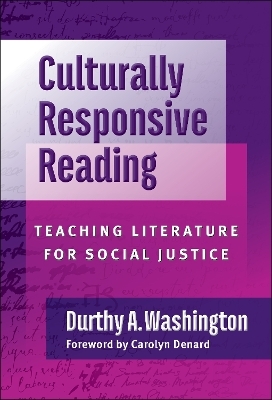
Culturally Responsive Reading
Teachers' College Press (Verlag)
978-0-8077-6829-7 (ISBN)
- Titel z.Zt. nicht lieferbar
- Versandkostenfrei
- Auch auf Rechnung
- Artikel merken
Help students to explore the intertextuality of literature and to think more deeply and compassionately about the world. This book shows high school teachers and college instructors how to foreground a work's cultural context, recognizing that every culture has its own narrative tradition of oral and written classics that inform its literature. The author introduces readers to the LIST Paradigm, a guided approach to culturally responsive reading that encourages readers to access and analyze a text by asking significant questions designed to foster close, critical reading. By combining aspects of both literary analysis (exploring the elements of fiction such as plot, setting, and character) and literary criticism (exploring works from multiple perspectives such as historical, psychological, and archetypal), the LIST Paradigm helps educators "unlock" literature with four keys to culture: Language, Identity, Space, and Time. In Culturally Responsive Reading, Washington exposes cultural myths, reveals racist and culturally biased language, dismantles stereotypes, and prevents the egregious misreading of works written by people of color.
Book Features:
Describes a unique approach to culturally responsive reading, including specific teaching strategies and rich classroom examples.
Explores numerous texts by writers of color that are rarely included as required reading in literature courses.
Provides examples and illustrations of innovative ways to incorporate multicultural texts into an introductory literature course.
Incorporates epigraphs and questions that highlight each component of the LIST approach.
Includes a critical essay that guides teachers through the process of teaching a complex postmodern novel (Junot Díaz's The Brief Wondrous Life of Oscar Wao).
Durthy A. Washington is a writer, seminar leader, former English professor, and founder of LitUnlocked©, which offers workshops and seminars dedicated to the art of mindful culturally responsive reading.
Contents (Tentative)
Foreword
Acknowledgments
Preface: "Why Are We Reading This?"
The Tar Baby Incident
The LIST Paradigm: A Guided Approach to Teaching Literature
Creating the LIST Paradigm
Introduction: "Culturally Responsive Reading: What It Is and Why It Matters"
"Moving Out Beyond Yourself": Coping With Culture Shock
Defining "American Literature": Reading Western "Classics"
Exploring Postcolonial Literature: Telling Our Own Stories
Achieving Agency: Rejecting "The White Criterion"
Misreading Multicultural Texts
Challenging Censorship
PART I: The LIST Paradigm: A Guide to Culturally Responsive Reading
1. Culture in the Classroom: Introducing the LIST Paradigm
Teaching at the Academy
Exploring Cultural Myths
Exploring Definitions of "Culture"
Teaching Values
Introducing the LIST Paradigm
Literary Analysis
Literary Criticism
List Paradigm Exercises
Teaching Through the Lens of Culture
2. Telling Our Stories: Exploring the Power of Narrative
Defining "Story"
Bibliotherapy
Mindful Reading
Types of Stories
3. Readers, Reading, and the Reading Process
Why We Read
What We Read
How We Read
4. "Interrogating the Text": Asking Significant Questions
Conflicting Views on Reading Literature
Engaging Questions From Other Disciplines
Who Is "Qualified" to Speak?
Questions for Writers
Questions for Students
Exploring "Subversive" Texts
PART II: Exploring the LIST Paradigm: Four "Keys to Culture"
Chapter 5: Language: "How Does the Author Contextualize Linguistic Signs and Symbols?"
Language as Resistance
Language in Postcolonial Studies
Reading Ousamne Sembène's Niiwam
Language Creation: Code-Switching and Code-Meshing
Language Validation: Standard English and Vernacular
Language Use: "The Transforming Power of Language"
Significant Questions—General
Significant Questions—Music
6. Identity: "Who Are These People and What Do They Want?"
Identity Politics (Race, Racism, and Colorism)
Literary Archetypes
Cultural Stereotypes
Significant Questions
7. Space: "How Do Characters Negotiate the Text's Physical, Psychological, and Cultural Landscapes?"
Physical Space
Domestic Space ("Home")
Racialized Space
Counterspaces (Third Space Theory)
Psychological Space
The Subaltern
Cultural Landscapes: The Slave Ships
Narrative Space
Significant Questions
8. Time: "How Does an Author Manipulate Time"
Exploring Time in Contemporary Fiction
Cultural Perceptions of Time
Historiography
Historicity
Time in A Lesson Before Dying
Significant Questions
PART III: Exploring the LIST Paradigm: Unlocking the Text
9. Cultural Contexts for The Brief Wondrous Life of Oscar Wao
Reading Oscar Wao
Language in Oscar Wao
History: The Parsley Massacre
Major Influences
Author Background
10. Exploring the LIST Paradigm© : Reading The Brief Wondrous Life of Oscar Wao
Introducing the Novel
Narrative Structure
Language: "How Does the Author Contextualize Linguistic Signs and Symbols?"
Identity: "Who Are These People and What Do They Want"
Space: "How Do Characters Negotiate the Text's Physical, Psychological, and Cultural Landscapes?"
Time: "How Does the Author Manipulate Time?"
Coda
Appendix A.1: Exploring the LIST Paradigm: A Reader's Guide
Appendix A.2: LIST Worksheet
Appendix B: Defining Elements of Morrison's Fiction
Appendix C: Notes on Narrative Structure
Appendix D: Suggestions for Pairing Texts
References
Index
About the Author
| Erscheinungsdatum | 03.04.2023 |
|---|---|
| Verlagsort | New York |
| Sprache | englisch |
| Maße | 152 x 229 mm |
| Gewicht | 272 g |
| Themenwelt | Geisteswissenschaften ► Sprach- / Literaturwissenschaft ► Sprachwissenschaft |
| Sozialwissenschaften ► Pädagogik ► Erwachsenenbildung | |
| ISBN-10 | 0-8077-6829-4 / 0807768294 |
| ISBN-13 | 978-0-8077-6829-7 / 9780807768297 |
| Zustand | Neuware |
| Informationen gemäß Produktsicherheitsverordnung (GPSR) | |
| Haben Sie eine Frage zum Produkt? |
aus dem Bereich


