


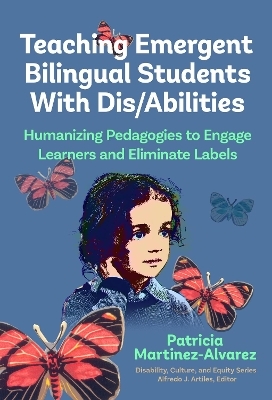
Teaching Emergent Bilingual Students with Dis/Abilities
Teachers' College Press (Verlag)
978-0-8077-6810-5 (ISBN)
Book Features:
Combines the fields of bilingual education and disability studies so that bilingual students with disabilities can be understood and taught from a strengths-based perspective.
Includes activity invitations to help teachers create high-quality learning spaces.
Provides sample work from diverse elementary school–aged children, as well as children's responses to the learning activity.
Proposes curriculum to expand what identity and agency look like in schools embracing more humanistic pedagogies.
Patricia Martínez-Álvarez is an associate professor and director of the Bilingual/Bicultural Education program at Teachers College, Columbia University.
Contents
Preface ix
List of Abbreviations xv
Acknowledgments xvii
1. Tensions Surrounding the Education of Bilingual Children With a Disability 1
Cultural Historical Tensions in Teaching and Learning With Bilingual Children 3
Issues of Disability Identification Disproportionality and Consequences of Labels 4
Lack of Teacher Preparation Programs for Inclusive Education in Bilingual Contexts 6
Lack of Inclusive Approaches for Bilingual Education 8
Bilingual Education: A Space Inclusive of Children With a Disability 10
2. Assumptions and Theories in the Varied Ways of Knowing Project 13
Assumptions Grounding the Varied Ways of Knowing Project 15
Theoretical Ideas Guiding the Project: A Hybrid Afterschool Program Space 15
The Varied Ways of Knowing Project 22
3. Documenting the Varied Ways of Knowing Project 25
The Role of the Institution of Higher Education 26
The Varied Ways of Knowing School Context 26
Varied Ways of Knowing Project: Children and Teacher Candidates 27
Documenting Learning With Bilingual Children With and Without a Disability 28
Exploring the Work of the Children and the Teacher Candidates 29
Reflecting on Roles When Working in Bilingual Contexts 30
Relevant Questions and Organization of the Chapters 31
4. The Issue of Ableism in Bilingual and Bicultural Education 35
Metaphors Driving Bilingual Teachers to Enact Ableist Practices 37
The Learning Identities of Bilingual Children With a Disability 40
Conclusion 51
5. Teaching Children With Multiple Labels: Manifestations of Assimilation and Turning Points 53
Parallel Processes of Assimilation: Being Bilingual and Having a Disability 53
Assimilationist Processes Impacting Children of Immigrant Background 54
Assimilationist Processes Impacting Children Labeled With a Disability 55
Interrupting Processes of Assimilation 57
Children's Experience: Expansive Views Crossing Identities and Cultures 58
A Contrasting Experience: Susana's Agency and Learning Identity 68
A Turning Point: "(Susana) Is a Very Strong Girl for Sharing That With All of Us" 73
Conclusion 76
6. Humanistic Perspectives in Inclusive Bilingual Education 79
The Significance of Humanistic Perspectives With Bilingual Children With a Disability 79
The Capas y Escudos (Capes and Shields) Project 85
Playful Spaces as Tools for Humanizing Pedagogies 85
Conclusion 96
7. Exploring Disability With Bilingual Children 98
Identity and Disability 99
Bilingual and Bicultural Identity 100
Multiple Identities and Bilingual Children With a Disability 101
Teaching About Disability and the Disability Rights Movement 103
Learning and Disability Identity Through a CHAT and DSE Lens 104
Exploring the Disability Civil Rights Movement and the Rights of People With a Disability 106
Agency and Collective Learning While Exploring Disability 106
Conclusion 122
8. Science Learning With Bilingual Children: Learning In-Between Boundaries in a Hybrid Space 126
Science Education and Emergent Bilinguals 127
Science Education and Children With a Disability 129
Exploring Science With Bilingual Children With and Without a Disability 130
The Relevant Contexts for Science and Landforms Unit 131
Learning at the Boundary of Knowledges, Disciplines, and Formal/Less Formal Spaces 132
Conclusion 145
9. Artifact-Mediated Science Content Learning in Inclusive Bilingual Contexts 148
The Importance of Mediators When Teaching Children With a Disability 150
The Importance of Mediators When Teaching Bilingual Children 152
Mediating Science Content Learning With Bilingual Children With a Disability 153
The Earthquakes, Plate Tectonics, and the Ring of Fire Unit 154
Artifacts and the Way They Mediate Learning in Inclusive Bilingual Contexts 155
Children's Volitional Actions: Re-mediating Using Artifacts and Various Knowledges 156
Language as an Artifact: Tensions Addressing Content Learning and Language Learning 166
Conclusion 172
10. The Varied Ways of Knowing Project: Teaching Bilingual Students With a Disability 175
Ableist Practices in Bilingual Education and Implications 177
Historical Assimilationist Practices and Implications for Bilingual Education 179
Humanistic Perspectives for Inclusive Bilingual Education 180
Learning About Disability With Bilingual Children 185
A Hybrid Space for Science Learning In-Between Boundaries 186
Conclusion 189
Epilogue 191
References 193
Index 213
About the Author 222
| Erscheinungsdatum | 02.03.2023 |
|---|---|
| Reihe/Serie | Disability, Culture, and Equity Series |
| Verlagsort | New York |
| Sprache | englisch |
| Maße | 160 x 223 mm |
| Gewicht | 272 g |
| Themenwelt | Geisteswissenschaften ► Sprach- / Literaturwissenschaft ► Sprachwissenschaft |
| Sozialwissenschaften ► Pädagogik ► Didaktik | |
| Sozialwissenschaften ► Pädagogik ► Sonder-, Heil- und Förderpädagogik | |
| ISBN-10 | 0-8077-6810-3 / 0807768103 |
| ISBN-13 | 978-0-8077-6810-5 / 9780807768105 |
| Zustand | Neuware |
| Informationen gemäß Produktsicherheitsverordnung (GPSR) | |
| Haben Sie eine Frage zum Produkt? |
aus dem Bereich


