


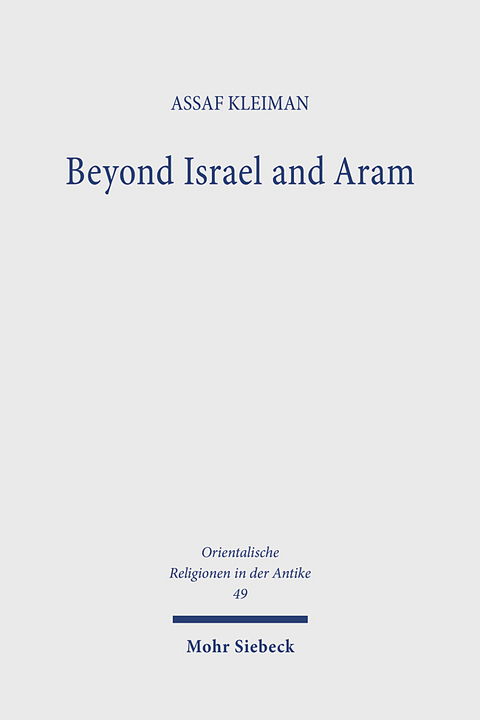
Beyond Israel and Aram
The Archaeology and History of Iron Age Communities in the Central Levant. Research on Israel and Aram in Biblical Times VI
Seiten
Assaf Kleiman erörtert die Archäologie und Geschichte lokaler Gemeinschaften in der zentralen Levante, die im Schatten von Israel und Aram-Damaskus blühten. Die Studie bietet einen neuen und spannenden Blick auf die politischen Beziehungen und den kulturellen Austausch zwischen der einheimischen Bevölkerung und den Eliten, die vom 10. bis 8. Jahrhundert v. Chr. über sie herrschten.
In this study, Assaf Kleiman discusses the settlement history and material culture of complex communities that flourished in the shadow of Israel and Aram-Damascus. A detailed examination of the finds from the Lebanese Beqaa, through the Sea of Galilee, to the Irbid Plateau, offers an exceptional portrayal of the developments experienced by these communities, before and after the emergence of the territorial kingdoms; these advances include the rise and fall of local polities, the adoption and rejection of certain cultural traits, and even the background for the dissemination of writing. The study provides, therefore, a new and exciting way to look at the political relations and cultural exchange between the indigenous communities and the elites that ruled over them. Rather than interpreting the local populations simply as "Israelites" or "Aramaeans," the archaeological record reveals their diversity and highlights the discrete historical trajectories they followed from the 12th to 8th centuries BCE.
In this study, Assaf Kleiman discusses the settlement history and material culture of complex communities that flourished in the shadow of Israel and Aram-Damascus. A detailed examination of the finds from the Lebanese Beqaa, through the Sea of Galilee, to the Irbid Plateau, offers an exceptional portrayal of the developments experienced by these communities, before and after the emergence of the territorial kingdoms; these advances include the rise and fall of local polities, the adoption and rejection of certain cultural traits, and even the background for the dissemination of writing. The study provides, therefore, a new and exciting way to look at the political relations and cultural exchange between the indigenous communities and the elites that ruled over them. Rather than interpreting the local populations simply as "Israelites" or "Aramaeans," the archaeological record reveals their diversity and highlights the discrete historical trajectories they followed from the 12th to 8th centuries BCE.
Born 1985; 2019 PhD; 2019-22 post-doctoral fellow of the Minerva Stiftung at Leipzig University; since 2022 Senior Lecturer at the Department of Archaeology, Ben-Gurion University of the Negev, Israel.
| Erscheinungsdatum | 31.10.2022 |
|---|---|
| Reihe/Serie | Orientalische Religionen in der Antike |
| Verlagsort | Tübingen |
| Sprache | englisch |
| Maße | 179 x 251 mm |
| Gewicht | 378 g |
| Themenwelt | Geisteswissenschaften ► Religion / Theologie ► Christentum |
| Schlagworte | Ancient Israel • Aramaeans • Archaeology of the Levant • biblical history • Hazael |
| ISBN-10 | 3-16-161543-3 / 3161615433 |
| ISBN-13 | 978-3-16-161543-6 / 9783161615436 |
| Zustand | Neuware |
| Informationen gemäß Produktsicherheitsverordnung (GPSR) | |
| Haben Sie eine Frage zum Produkt? |
Mehr entdecken
aus dem Bereich



aus dem Bereich
und was sie über die Kirche verraten
Buch | Hardcover (2024)
C.H.Beck (Verlag)
CHF 39,90
Jesusüberlieferungen außerhalb der Bibel
Buch | Softcover (2024)
C.H.Beck (Verlag)
CHF 15,90


