


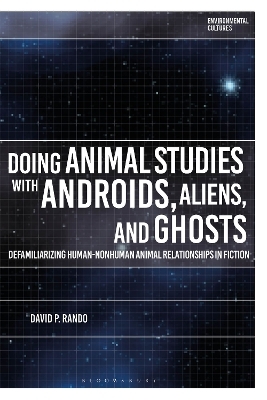
Doing Animal Studies with Androids, Aliens, and Ghosts
Defamiliarizing Human-Nonhuman Animal Relationships in Fiction
Seiten
2023
Bloomsbury Academic (Verlag)
978-1-350-35612-2 (ISBN)
Bloomsbury Academic (Verlag)
978-1-350-35612-2 (ISBN)
Through readings of texts featuring creatures such as androids, aliens and ghosts, this book explores the boundaries of humanness and helps the reader to see nonhuman animals afresh and reimagining the terms of our relationships with them.
Exploring what can be learnt when literary critics in the field of animal studies temporarily direct attention away from representations of nonhuman animals in literature and towards liminal figures like androids, aliens and ghosts, this book examines the boundaries of humanness. Simultaneously, it encourages the reader both to see nonhuman animals afresh and to reimagine the terms of our relationships with them.
Examining imaginative texts by writers such as Octavia Butler, Philip K. Dick, Kazuo Ishiguro, Jeanette Winterson and J. M. Coetzee, this book looks at depictions of androids that redefine traditional humanist qualities such as hope and uniqueness. It examines alien visions that unmask the racist and heteronormative roots of speciesism. And it unpacks examples of ghosts and spirits who offer posthumous visions of having-been-human that decenter anthropocentrism. In doing so, it leaves open the potential for better relationships and futures with nonhuman animals.
Exploring what can be learnt when literary critics in the field of animal studies temporarily direct attention away from representations of nonhuman animals in literature and towards liminal figures like androids, aliens and ghosts, this book examines the boundaries of humanness. Simultaneously, it encourages the reader both to see nonhuman animals afresh and to reimagine the terms of our relationships with them.
Examining imaginative texts by writers such as Octavia Butler, Philip K. Dick, Kazuo Ishiguro, Jeanette Winterson and J. M. Coetzee, this book looks at depictions of androids that redefine traditional humanist qualities such as hope and uniqueness. It examines alien visions that unmask the racist and heteronormative roots of speciesism. And it unpacks examples of ghosts and spirits who offer posthumous visions of having-been-human that decenter anthropocentrism. In doing so, it leaves open the potential for better relationships and futures with nonhuman animals.
David P. Rando is a Professor in the Department of English at Trinity University, USA.
Introduction: Android as Device
Chapter 1. Nonhuman Hope
Chapter 2. The Artificial Gaze
Chapter 3. Familiar Aliens
Chapter 4. Posthumous Humanity
Conclusion: Uniqueness, or, Doing Animal Studies One Alien at a Time
Coda: To the Wild Robots of the Future
Bibliography
| Erscheinungsdatum | 20.04.2023 |
|---|---|
| Reihe/Serie | Environmental Cultures |
| Verlagsort | London |
| Sprache | englisch |
| Maße | 154 x 236 mm |
| Gewicht | 480 g |
| Themenwelt | Geisteswissenschaften ► Sprach- / Literaturwissenschaft ► Anglistik / Amerikanistik |
| Geisteswissenschaften ► Sprach- / Literaturwissenschaft ► Literaturwissenschaft | |
| ISBN-10 | 1-350-35612-3 / 1350356123 |
| ISBN-13 | 978-1-350-35612-2 / 9781350356122 |
| Zustand | Neuware |
| Informationen gemäß Produktsicherheitsverordnung (GPSR) | |
| Haben Sie eine Frage zum Produkt? |
Mehr entdecken
aus dem Bereich

aus dem Bereich
Poetik eines sozialen Urteils
Buch | Hardcover (2023)
De Gruyter (Verlag)
CHF 83,90


