


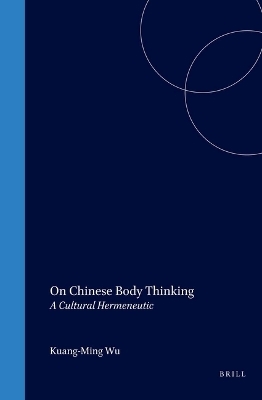
On Chinese Body Thinking
A Cultural Hermeneutic
Seiten
1997
Brill (Verlag)
978-90-04-10150-0 (ISBN)
Brill (Verlag)
978-90-04-10150-0 (ISBN)
- Titel ist leider vergriffen;
keine Neuauflage - Artikel merken
This book uses Western philosophical tradition to make a case for a form of thinking properly associated with ancient China. It argues that Chinese thinking is concrete rather than formal and abstract, and this is gathered in a variety of ways under the metaphor “body thinking”.
This book uses Western philosophical tradition to make a case for a form of thinking properly associated with ancient China. The book's thesis is that Chinese thinking is concrete rather than formal and abstract, and this is gathered in a variety of ways under the symbol “body thinking”. The root of the metaphor is that the human body has a kind of intelligence in its most basic functions. When hungry the body gets food and eats, when tired it sleeps, when amused it laughs. In free people these things happen instinctively but not automatically.
The metaphor of body thinking is extended far beyond bodily functions in the ordinary sense to personal and communal life, to social functions and to cultivation of the arts of civilization. As the metaphor is extended, the way to stay concrete in thinking with subtlety becomes a kind of ironic play, a natural adeptness at saying things with silences. Play and indirection are the roads around formalism and abstraction. Western formal thinking, it is argued, can be sharpened by Chinese body thinking to exhibit spontaneity and to produce healthy human thought in a community of cultural variety.
This book uses Western philosophical tradition to make a case for a form of thinking properly associated with ancient China. The book's thesis is that Chinese thinking is concrete rather than formal and abstract, and this is gathered in a variety of ways under the symbol “body thinking”. The root of the metaphor is that the human body has a kind of intelligence in its most basic functions. When hungry the body gets food and eats, when tired it sleeps, when amused it laughs. In free people these things happen instinctively but not automatically.
The metaphor of body thinking is extended far beyond bodily functions in the ordinary sense to personal and communal life, to social functions and to cultivation of the arts of civilization. As the metaphor is extended, the way to stay concrete in thinking with subtlety becomes a kind of ironic play, a natural adeptness at saying things with silences. Play and indirection are the roads around formalism and abstraction. Western formal thinking, it is argued, can be sharpened by Chinese body thinking to exhibit spontaneity and to produce healthy human thought in a community of cultural variety.
Kuang-ming Wu, Ph.D. (1965, Philosophy), Yale University, is Professor of History, National Chung-cheng University, Taiwan; Rosebush University Professor Emeritus, University of Wisconsin, USA. He has published extensively on the philosophy of Chuang Tzu and distinctness of Chinese thinking.
| Erscheint lt. Verlag | 1.2.1997 |
|---|---|
| Reihe/Serie | Philosophy of History and Culture ; 12 |
| Verlagsort | Leiden |
| Sprache | englisch |
| Gewicht | 1071 g |
| Einbandart | Leinen |
| Themenwelt | Geisteswissenschaften ► Philosophie ► Erkenntnistheorie / Wissenschaftstheorie |
| Geisteswissenschaften ► Philosophie ► Geschichte der Philosophie | |
| Geisteswissenschaften ► Philosophie ► Philosophie der Neuzeit | |
| ISBN-10 | 90-04-10150-0 / 9004101500 |
| ISBN-13 | 978-90-04-10150-0 / 9789004101500 |
| Zustand | Neuware |
| Informationen gemäß Produktsicherheitsverordnung (GPSR) | |
| Haben Sie eine Frage zum Produkt? |
Mehr entdecken
aus dem Bereich

aus dem Bereich
Buch | Softcover (2023)
Reclam, Philipp (Verlag)
CHF 9,80
die Evolution des Geistes
Buch | Softcover (2025)
Suhrkamp (Verlag)
CHF 41,95


