


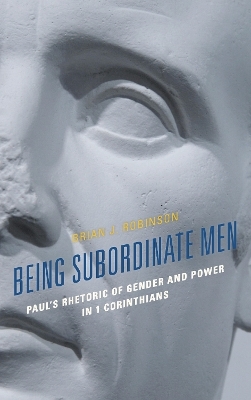
Being Subordinate Men
Paul's Rhetoric of Gender and Power in 1 Corinthians
Seiten
2022
Lexington Books/Fortress Academic (Verlag)
978-1-9787-0335-3 (ISBN)
Lexington Books/Fortress Academic (Verlag)
978-1-9787-0335-3 (ISBN)
Being Subordinate Men offers a gender critical examination of Paul’s use of gender and power in the argument of 1 Corinthians, showing that the apostle consistently undermines first-century Roman norms of masculinity.
Being Subordinate Men offers a gender critical examination of Paul’s use of gender and power in the argument of 1 Corinthians. By elevating femininity and misperforming masculinity, Paul consistently undermines first century Roman norms of masculinity. Such norms of masculinity would have allowed some of the higher status men among the Corinthian believers to occupy positions of power that would give them control over lower status members of the community. Instead of supporting such a patriarchal model, Paul articulates a form of masculinity that would require these higher status men to abandon their positions of power and occupy positions that would put them on equal status with women and men whose bodies and identities forced them to the margins of society. Such a move subverts forms of toxic, or hegemonic, masculinity that give a select few men power over the bodies of others. Instead of a toxic masculinity, Paul commands the men in his audience to embody a failed, or subordinate, masculinity. This failed masculinity not only imitates Paul’s own subordinate masculinity, seen in his embrace of feminine imagery and his failure to live up to first century Roman norms of masculinity, but also supports Paul’s main reason for writing 1 Corinthians by confronting the factionalism that threatens to destroy the believing community. Paul’s vision for the believing community is one of equality that centers itself in imitation of the crucified body of Jesus, a body that demonstrates that equality, not domination, is the path to the kingdom of God.
Being Subordinate Men offers a gender critical examination of Paul’s use of gender and power in the argument of 1 Corinthians. By elevating femininity and misperforming masculinity, Paul consistently undermines first century Roman norms of masculinity. Such norms of masculinity would have allowed some of the higher status men among the Corinthian believers to occupy positions of power that would give them control over lower status members of the community. Instead of supporting such a patriarchal model, Paul articulates a form of masculinity that would require these higher status men to abandon their positions of power and occupy positions that would put them on equal status with women and men whose bodies and identities forced them to the margins of society. Such a move subverts forms of toxic, or hegemonic, masculinity that give a select few men power over the bodies of others. Instead of a toxic masculinity, Paul commands the men in his audience to embody a failed, or subordinate, masculinity. This failed masculinity not only imitates Paul’s own subordinate masculinity, seen in his embrace of feminine imagery and his failure to live up to first century Roman norms of masculinity, but also supports Paul’s main reason for writing 1 Corinthians by confronting the factionalism that threatens to destroy the believing community. Paul’s vision for the believing community is one of equality that centers itself in imitation of the crucified body of Jesus, a body that demonstrates that equality, not domination, is the path to the kingdom of God.
Brian J. Robinson teaches classes on religious studies and hellenistic Jewish and early Christianity literature at Azusa Pacific University and California Lutheran University.
Chapter 1: Uncovering Paul’s Body
Chapter 2: The Body, Masculinity, and Power
Chapter 3: Reconstructing Masculinities
Chapter 4: Paul’s Subordinate Masculinity in 1 Corinthians
Chapter 5: Manifestations of Subordinate Masculinity in Paul’s Paraenesis
Chapter 6: Summary and an Interpretive Exploration of Paul’s Veils
| Erscheinungsdatum | 26.08.2022 |
|---|---|
| Sprache | englisch |
| Maße | 154 x 230 mm |
| Gewicht | 413 g |
| Themenwelt | Geschichte ► Allgemeine Geschichte ► Vor- und Frühgeschichte |
| Geschichte ► Allgemeine Geschichte ► Altertum / Antike | |
| Religion / Theologie ► Christentum ► Kirchengeschichte | |
| ISBN-10 | 1-9787-0335-X / 197870335X |
| ISBN-13 | 978-1-9787-0335-3 / 9781978703353 |
| Zustand | Neuware |
| Informationen gemäß Produktsicherheitsverordnung (GPSR) | |
| Haben Sie eine Frage zum Produkt? |
Mehr entdecken
aus dem Bereich



aus dem Bereich
Konzepte – Methoden – Theorien
Buch | Softcover (2024)
UTB (Verlag)
CHF 55,85
auf den Spuren der frühen Zivilisationen
Buch | Hardcover (2023)
C.H.Beck (Verlag)
CHF 27,95


