


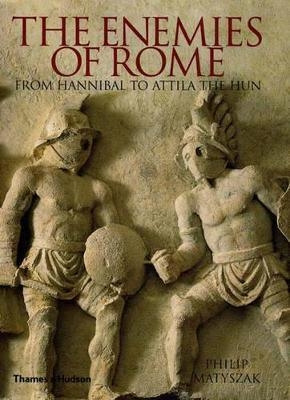
The Enemies of Rome
From Hannibal to Attila the Hun
Seiten
2004
Thames & Hudson Ltd (Verlag)
978-0-500-25124-9 (ISBN)
Thames & Hudson Ltd (Verlag)
978-0-500-25124-9 (ISBN)
- Titel ist leider vergriffen;
keine Neuauflage - Artikel merken
Zu diesem Artikel existiert eine Nachauflage
An assessment of the rise and fall of the Roman empire, told from the perspectives of the civilizations that were vanquished by Rome, argues that such groups as the Celts, Hebrews, and Phoenicians were civilizations in their own right in spite of beliefs about Roman superiority and examines the impa
Until recently, it was assumed that Rome carried the torch of civilization into the barbarian darkness, bringing law, architecture and literature to conquered peoples. An alternative view now suggests that many of Rome's enemies - the Celts and Dacians, for example - were developing civilizations in their own right before premature obliteration at the Roman sword. Indeed, as Philip Matyszak argues, had Rome not crushed rival powers so completely, the drop into the Dark Ages might not have occurred: at Rome's collapse, no other powerful civilizations remained to absorb the impact. This book looks at the growth and eventual demise of Rome from the viewpoint of the vanquished peoples. They varied from the highly cultivated Greeks and Egyptians, to wild and rebellious Britons and Germans, to the Asiatic empires of the Persians and Parthians. Their leaders were driven by ambition, vindictive hatred, fear, political calculation, or simply naked greed. Some fought to preserve their heritage and ancient way of life, some for personal survival, and others from a warrior's love of battle.
Until recently, it was assumed that Rome carried the torch of civilization into the barbarian darkness, bringing law, architecture and literature to conquered peoples. An alternative view now suggests that many of Rome's enemies - the Celts and Dacians, for example - were developing civilizations in their own right before premature obliteration at the Roman sword. Indeed, as Philip Matyszak argues, had Rome not crushed rival powers so completely, the drop into the Dark Ages might not have occurred: at Rome's collapse, no other powerful civilizations remained to absorb the impact. This book looks at the growth and eventual demise of Rome from the viewpoint of the vanquished peoples. They varied from the highly cultivated Greeks and Egyptians, to wild and rebellious Britons and Germans, to the Asiatic empires of the Persians and Parthians. Their leaders were driven by ambition, vindictive hatred, fear, political calculation, or simply naked greed. Some fought to preserve their heritage and ancient way of life, some for personal survival, and others from a warrior's love of battle.
Philip Matyszak has a doctorate in Roman history from St John's College, Oxford, and is the author of Chronicle of the Roman Republic.
Part I: 1. Hannibal; 2. Philip V; 3. Viriathus; 4. Jugurtha; Part II: 5. Mithridates; 6. Spartacus; 7. Vercingetorix; 8. Orodes; 9. Cleopatra; 10. Arminius; Part III: 11. Boudicca; 12. Josephus; 13. Decebalus Part IV: 14. Shapur; 15. Zenobia; 16. Alaric; 17. Attila; Epilogue; Index
| Zusatzinfo | 36 b/w pls, 34 b/w illus, maps |
|---|---|
| Verlagsort | London |
| Sprache | englisch |
| Maße | 165 x 238 mm |
| Gewicht | 772 g |
| Themenwelt | Geschichte ► Allgemeine Geschichte ► Vor- und Frühgeschichte |
| Geisteswissenschaften ► Geschichte ► Regional- / Ländergeschichte | |
| ISBN-10 | 0-500-25124-X / 050025124X |
| ISBN-13 | 978-0-500-25124-9 / 9780500251249 |
| Zustand | Neuware |
| Informationen gemäß Produktsicherheitsverordnung (GPSR) | |
| Haben Sie eine Frage zum Produkt? |
Mehr entdecken
aus dem Bereich

aus dem Bereich
auf den Spuren der frühen Zivilisationen
Buch | Hardcover (2023)
C.H.Beck (Verlag)
CHF 27,95
Konzepte – Methoden – Theorien
Buch | Softcover (2024)
UTB (Verlag)
CHF 55,85


