
A Clinician's Guide to Think Good-Feel Good
John Wiley & Sons Inc (Verlag)
978-0-470-02508-6 (ISBN)
- Titel erscheint in neuer Auflage
- Artikel merken
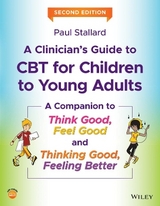
This is a companion guide to Think Good Feel Good: A Cognitive Behaviour Therapy Workbook for Children and Young People. Designed for clinicians using the original workbook in their work with children, the book builds upon the workbook materials by offering guidance on all aspects of the therapeutic process and a range of case studies highlighting therapy in action. Topics covered include parent involvement, key cognitive distortions in children, formulations, challenging thoughts, guided discovery and the use of imagery. Also included is a chapter focusing on possible problems in therapy and strategies for overcoming them.
To supplement the workbook, the clinician's guide offers further materials and handouts for use in therapy, including psycho-educational materials for children and parents on common problems, such as depression, OCD, PTSD/Trauma and Anxiety
Dr Paul Stallard graduated as a clinical psychologist from Birmingham University in 1980. He worked with children and young people in the West Midlands before moving to the Department of Child and Family Psychiatry, Bath, in 1988. He has a part-time appointment at the University of Bath as Professor of Child and Family Mental Health, and has received a number of research grants exploring the effects of trauma and chronic illness on children. He has published over 70 peer-reviewed papers and his current research interests include the use of cognitive behaviour therapy with children, post-traumatic stress disorder and the psychological effects of chronic illness.
About the author viii
Acknowledgements ix
On-line resources x
1 Overview 1
Engagement and readiness to change 2
Formulations 3
The Socratic process and inductive reasoning 4
Involving parents in child-focused CBT 5
The process of child-focused CBT 5
Adapting CBT for children 6
Core components of CBT programmes for internalising problems 7
2 Engagement and readiness to change 9
Engaging with children 9
The Stages of Change 10
Motivational interviewing 15
When would CBT not be indicated? 22
‘The Scales of Change’ 25
3 Formulations 27
Key aspects of a formulation 28
Mini-formulations 29
General cognitive formulations 30
Onset formulations 32
Complex formulations 39
Problem-specific formulations 41
Common problems 44
‘The Negative Trap’ 47
‘The 4-part Negative Trap’ 48
‘Onset Formulation Template’ 49
4 The Socratic process and inductive reasoning 51
Facilitating self-discovery 51
The structure of the Socratic process 52
Inductive reasoning 53
The Socratic process 57
The Socratic process and collaborative empiricism 60
What makes a good Socratic question? 61
How does it work? 62
Common problems 64
‘The Chain of Events’ 67
5 Involving parents in child-focused CBT 69
The importance of involving parents 69
Clinical benefits of parental involvement 72
Model of change 73
The role of parents in child-focused CBT 73
Parental involvement 75
Common components of parent-focused interventions 80
Two final thoughts 83
‘What is Cognitive Behaviour Therapy (CBT)?’ 85
‘What Parents Need to Know about Cognitive Behaviour Therapy (CBT)’ 87
6 The process of child-focused CBT 91
The therapeutic process of child-focused CBT 91
PRECISE in practice 100
7 Adapting CBT for children 105
The cognitive capacity debate 105
Adapting CBT for use with children 107
Visualisation 112
‘The Thought Tracker Quiz: What are the thinking errors?’ 121
‘Responsibility Pies’ 122
‘When I Feel Worried’ 123
‘When I Feel Angry’ 124
‘When I Feel Sad’ 125
‘Sharing our Thoughts’ 126
8 Core components of CBT programmes for internalizing problems 129
What is the balance between cognitive and behavioural strategies? 129
Do we need to directly focus upon dysfunctional cognitions and processes? 131
What cognitions or cognitive processes might be important? 131
Does cognitive change result in problem improvement? 132
Is CBT effective? 132
What are the effective components of CBT interventions? 133
Where is it best to start? 133
How many treatment sessions are needed? 134
What about home-based assignments? 135
What are the core components of standardised CBT programmes? 135
Psychoeducational materials 145
‘Beating Anxiety’ 146
‘Fighting Back Depression’ 152
‘Controlling Worries and Habits’ 158
‘Coping with Trauma’ 165
References 171
Index 179
| Erscheint lt. Verlag | 9.9.2005 |
|---|---|
| Verlagsort | New York |
| Sprache | englisch |
| Maße | 216 x 277 mm |
| Gewicht | 499 g |
| Themenwelt | Geisteswissenschaften ► Psychologie ► Klinische Psychologie |
| Medizin / Pharmazie ► Medizinische Fachgebiete ► Pädiatrie | |
| Medizin / Pharmazie ► Medizinische Fachgebiete ► Psychiatrie / Psychotherapie | |
| ISBN-10 | 0-470-02508-5 / 0470025085 |
| ISBN-13 | 978-0-470-02508-6 / 9780470025086 |
| Zustand | Neuware |
| Informationen gemäß Produktsicherheitsverordnung (GPSR) | |
| Haben Sie eine Frage zum Produkt? |
aus dem Bereich