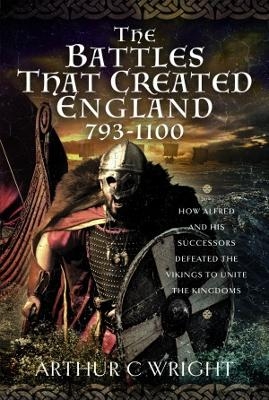
The Battles That Created England 793-1100
Frontline Books (Verlag)
978-1-3990-8798-8 (ISBN)
In popular imagination the warfare of the Early Middle Ages is often obscure, unstructured, and unimaginative, lost between two military machines, the Romans' and the Normans', which saw the country invaded and partitioned. In point of fact, we have a considerable amount of information at our fingertips and the picture that should emerge is one of English ability in the face of sometimes overwhelming pressures on society, and a resilience that eventually drew the older kingdoms together in new external responses which united the English' in a common sense of purpose.
This is the story of how the Saxon kingdoms, which had maintained their independence for generations, were compelled to unite their forces to resist the external threat of the Viking incursions. The kingdoms of East Anglia, Mercia, Northumbria, Kent, Essex, Sussex, and Wessex were gradually welded into one as Wessex grew in strength to become the dominant Saxon kingdom.
From the weak thelred to the strong Alfred, rightly deserving the epithet Great', to the strong, but equally unfortunate, Harold, this era witnessed brutal hand-to-hand battles in congested melees, which are normally portrayed as unsophisticated but deadly brawls. In reality, the warriors of the era were experienced fighters often displaying sophisticated strategies and deploying complex tactics.
Our principal source, replete with reasonably reliable reportage, are the Anglo-Saxon Chronicles, comprehensive in collation though subject to oral distortion and mythological excursions. The narrative of these does not appear to flow continuously, leaving too much to imagination but, by creating a complementary matrix of landscapes, topography and communications it is possible to provide convincing scenery into which we can fit other archaeological and philological evidence to show how the English nation was formed in the bloody slaughter of battle.
Born in North Staffordshire, ARTHUR WRIGHT has spent most of his life in Essex and for thirty years he was a museum curator, ultimately responsible for four museums. A military historian by training, the scope of his professional responsibilities encouraged him to focus on social history. Two of the museum buildings being medieval, he was drawn into this period and then developed a forty-year obsession with the Domesday Book, finding that there was no mathematically demonstrable solution to its cryptic statistics in any published work. Wrestling with the logic and arithmetic he deduced it was possible to decode its contents, eventually publishing his research. He is also a living history' educator and craftsman with a wide range of manual and traditional skills.
| Erscheinungsdatum | 30.01.2023 |
|---|---|
| Zusatzinfo | 16 |
| Verlagsort | Barnsley |
| Sprache | englisch |
| Maße | 156 x 234 mm |
| Themenwelt | Geschichte ► Teilgebiete der Geschichte ► Kulturgeschichte |
| Geschichte ► Teilgebiete der Geschichte ► Militärgeschichte | |
| ISBN-10 | 1-3990-8798-3 / 1399087983 |
| ISBN-13 | 978-1-3990-8798-8 / 9781399087988 |
| Zustand | Neuware |
| Informationen gemäß Produktsicherheitsverordnung (GPSR) | |
| Haben Sie eine Frage zum Produkt? |
aus dem Bereich