


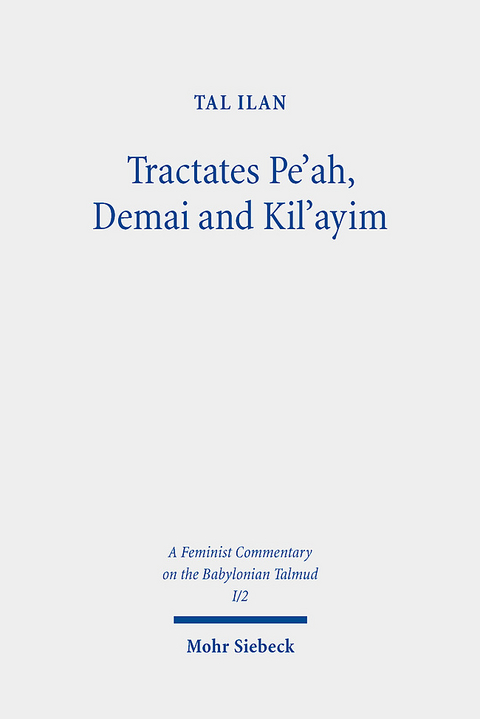
Tractates Pe'ah, Demai and Kil'ayim
Volume I/2. Text, Translation, and Commentary
Seiten
Tal Ilan legt im vorliegenden Band einen feministischen Kommentar zu den ersten drei Mischnatraktaten des Seder Sera'im (Saaten) vor, zu denen es keinen babylonischen Kommentar gibt. Das erste Traktat, Pe'ah, handelt von den Wohltaten. Demai, das zweite Traktakt, handelt vom zweifelhaften Zehnten. Das dritte Traktat, Kil'ajim, handelt von verbotenen Mischungen.
In this volume, Tal Ilan presents a feminist commentary on the first three mishnaic tractates of Seder Zera'im (Seeds) that have no Babylonian commentary. The first one, Pe'ah, is about charity. The commentary shows that, even though women in antiquity were poorer than men, and the Bible was aware of this, this tractate actually ignores them completely. Demai, the second tractate, is about doubtful tithing. Because it devotes much space to a sectarian organization known as the havurah , it is interesting to discover that this sect included women among its members. The third tractate, kil'ayim, is about forbidden mixtures - mixed breeding among animals, mixed weaving of two sorts of thread; the sowing of mixed crops in a field, or working the land with two different animals hitched together. The tractate is full of gendered metaphors that are discussed in detail.
In this volume, Tal Ilan presents a feminist commentary on the first three mishnaic tractates of Seder Zera'im (Seeds) that have no Babylonian commentary. The first one, Pe'ah, is about charity. The commentary shows that, even though women in antiquity were poorer than men, and the Bible was aware of this, this tractate actually ignores them completely. Demai, the second tractate, is about doubtful tithing. Because it devotes much space to a sectarian organization known as the havurah , it is interesting to discover that this sect included women among its members. The third tractate, kil'ayim, is about forbidden mixtures - mixed breeding among animals, mixed weaving of two sorts of thread; the sowing of mixed crops in a field, or working the land with two different animals hitched together. The tractate is full of gendered metaphors that are discussed in detail.
Born 1956; professor emerita of Jewish studies at the Freie Universität Berlin.
| Erscheinungsdatum | 30.09.2022 |
|---|---|
| Reihe/Serie | A Feminist Commentary on the Babylonian Talmud |
| Verlagsort | Tübingen |
| Sprache | englisch |
| Maße | 164 x 242 mm |
| Gewicht | 378 g |
| Themenwelt | Geisteswissenschaften ► Religion / Theologie ► Judentum |
| Geisteswissenschaften ► Sprach- / Literaturwissenschaft ► Literaturwissenschaft | |
| Schlagworte | Gender • Greco-Roman Antiquity • Jewish Studies • rabbinic literature |
| ISBN-10 | 3-16-161533-6 / 3161615336 |
| ISBN-13 | 978-3-16-161533-7 / 9783161615337 |
| Zustand | Neuware |
| Informationen gemäß Produktsicherheitsverordnung (GPSR) | |
| Haben Sie eine Frage zum Produkt? |
Mehr entdecken
aus dem Bereich
aus dem Bereich


