


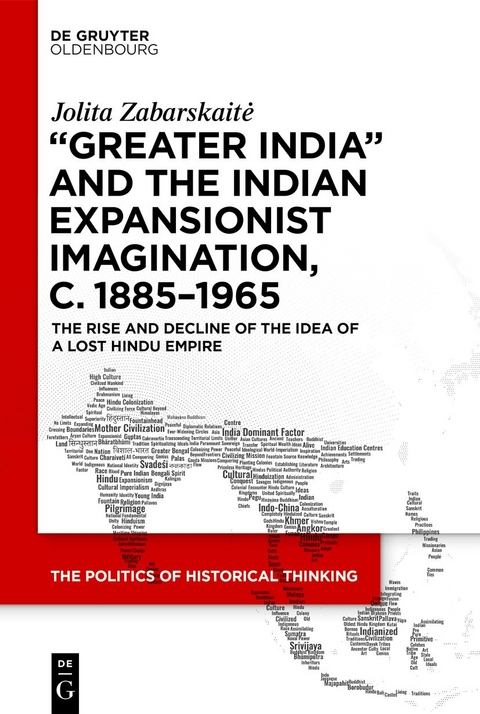
‘Greater India’ and the Indian Expansionist Imagination, c. 1885–1965
The Rise and Decline of the Idea of a Lost Hindu Empire
Seiten
2022
De Gruyter Oldenbourg (Verlag)
978-3-11-099715-6 (ISBN)
De Gruyter Oldenbourg (Verlag)
978-3-11-099715-6 (ISBN)
This series seeks to focus on the politics inherent in historical thinking, professional and non-professional, promoted by states, political organisations, ‘nationalities’ or interest groups, and to explore the links between political (re-)education, historiography and mobilisation or identity formation.
This book is the first systematic study of the genealogy, discursive structures, and political implications of the concept of ‘Greater India’, implying a Hindu colonization of Southeast Asia, and used by extension to argue for a past Indian greatness as a colonial power, reproducible in the present and future. From the 1880s to the 1960s, protagonists of the Greater India theme attempted to make a case for the importance of an expansionist Indian civilisation in civilizing Southeast Asia. The argument was extended to include Central Asia, Africa, North and South America, and other regions where Indian migrants were to be found. The advocates of this Indocentric and Hindu revivalist approach, with Hindu and Indian often taken to be synonymous, were involved in a quintessentially parochial project, despite its apparently international dimensions: to justify an Indian expansionist imagination that viewed India’s past as a colonizer and civilizer of other lands as a model for the restoration of that past greatness in the future. Zabarskaite shows that the crucial ideologues and elements used for the formation of the construct of Greater India can be traced to the svadeśī movement of the turn of the century, and that Greater India moved easily between the domains of the scholarly and the popular as it sought to establish itself as a form of nationalist self-assertion.
This book is the first systematic study of the genealogy, discursive structures, and political implications of the concept of ‘Greater India’, implying a Hindu colonization of Southeast Asia, and used by extension to argue for a past Indian greatness as a colonial power, reproducible in the present and future. From the 1880s to the 1960s, protagonists of the Greater India theme attempted to make a case for the importance of an expansionist Indian civilisation in civilizing Southeast Asia. The argument was extended to include Central Asia, Africa, North and South America, and other regions where Indian migrants were to be found. The advocates of this Indocentric and Hindu revivalist approach, with Hindu and Indian often taken to be synonymous, were involved in a quintessentially parochial project, despite its apparently international dimensions: to justify an Indian expansionist imagination that viewed India’s past as a colonizer and civilizer of other lands as a model for the restoration of that past greatness in the future. Zabarskaite shows that the crucial ideologues and elements used for the formation of the construct of Greater India can be traced to the svadeśī movement of the turn of the century, and that Greater India moved easily between the domains of the scholarly and the popular as it sought to establish itself as a form of nationalist self-assertion.
lt;p>Jolita Zabarskaite, Heidelberg University.
"This carefully researched monograph derives additional value from the precise and systematic way it shows how ostensibly sound scholarship can succumb to sectarian thinking, uncritical adoration, personal prejudices, or exclusivist agendas, variously interpreted to suit the political hour." - Ana Jelnikar, Anthropological Notebooks, Issue 1/2024, pp. S10-S13
"Zabarskait 's incisive, pioneering account leads to a re-conceptualisation of a space that is but one of many contact zones in her larger theme [Greater India]." - Bipasha Bhattacharyya, Zeitschrift für Indologie und Südasienstudien, Issue 40/2023, pp. 155-169
| Erscheinungsdatum | 26.10.2022 |
|---|---|
| Reihe/Serie | The Politics of Historical Thinking ; 4 |
| Verlagsort | Berlin/München/Boston |
| Sprache | englisch |
| Maße | 155 x 230 mm |
| Gewicht | 746 g |
| Themenwelt | Sachbuch/Ratgeber ► Natur / Technik |
| Geisteswissenschaften ► Geschichte | |
| Schlagworte | Colonialism • Greater India • India • Indien • Kolonialismus • South East Asia • Südostasien |
| ISBN-10 | 3-11-099715-0 / 3110997150 |
| ISBN-13 | 978-3-11-099715-6 / 9783110997156 |
| Zustand | Neuware |
| Informationen gemäß Produktsicherheitsverordnung (GPSR) | |
| Haben Sie eine Frage zum Produkt? |
Mehr entdecken
aus dem Bereich



aus dem Bereich
wenn Mensch und Maschine eins werden
Buch | Hardcover (2024)
Piper (Verlag)
CHF 33,55


