


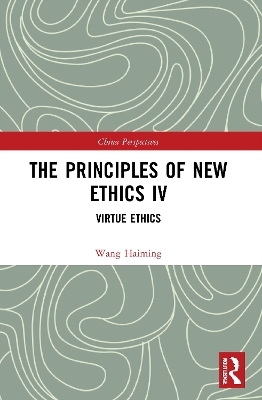
The Principles of New Ethics IV
Virtue Ethics
Seiten
2022
Routledge (Verlag)
978-0-367-69291-9 (ISBN)
Routledge (Verlag)
978-0-367-69291-9 (ISBN)
This volume analyzes the relationship between people’s sense of reputation, the political and economic status of a nation, and the observation of virtue ethics. The author argues that reputation, democracy, a market economy, freedom of speech, and liberalism can benefit the observation of virtue ethics.
From Descartes to Spinoza, Western philosophers have attempted to propose an axiomatic systemization of ethics. However, without consensus on the contents and objects of ethics, the system remains incomplete. This four-volume set presents a model that highlights a Chinese philosopher’s insights into ethics after a 22-year study. Three essential components of ethics are examined: meta-ethics, normative ethics, and virtue ethics.
In this volume, the author analyzes the relationship between people’s sense of reputation, the political and economic status of a nation, and the observation of virtue ethics, and he argues that reputation can encourage people to conform to virtue ethics. In addition, a nation’s political and economic status is closely connected to people’s virtue ethics. That is, people will have higher virtue ethics when constitutional democracy, a market economy without government control, freedom of speech, and the moral system of liberalism and egalitarianism are established in a nation.
This title is an essential read for students and scholars of ethics and philosophy in general.
From Descartes to Spinoza, Western philosophers have attempted to propose an axiomatic systemization of ethics. However, without consensus on the contents and objects of ethics, the system remains incomplete. This four-volume set presents a model that highlights a Chinese philosopher’s insights into ethics after a 22-year study. Three essential components of ethics are examined: meta-ethics, normative ethics, and virtue ethics.
In this volume, the author analyzes the relationship between people’s sense of reputation, the political and economic status of a nation, and the observation of virtue ethics, and he argues that reputation can encourage people to conform to virtue ethics. In addition, a nation’s political and economic status is closely connected to people’s virtue ethics. That is, people will have higher virtue ethics when constitutional democracy, a market economy without government control, freedom of speech, and the moral system of liberalism and egalitarianism are established in a nation.
This title is an essential read for students and scholars of ethics and philosophy in general.
Wang Haiming is a professor at the Department of Philosophy at Peking University, China, and a specially appointed professor at Sanya University, China, mainly studying ethics and political philosophy. He has written ten academic monographs, including Stateology; A Theory of Justice; and The Economic Characteristics of China.
1 Conscience and Reputation: Ways of Realizing Excellent Morality
2 Moral Character: The Realization of Excellent Morality
| Erscheinungsdatum | 13.07.2022 |
|---|---|
| Reihe/Serie | China Perspectives |
| Verlagsort | London |
| Sprache | englisch |
| Maße | 156 x 234 mm |
| Gewicht | 299 g |
| Themenwelt | Geisteswissenschaften ► Philosophie ► Ethik |
| ISBN-10 | 0-367-69291-0 / 0367692910 |
| ISBN-13 | 978-0-367-69291-9 / 9780367692919 |
| Zustand | Neuware |
| Informationen gemäß Produktsicherheitsverordnung (GPSR) | |
| Haben Sie eine Frage zum Produkt? |
Mehr entdecken
aus dem Bereich



aus dem Bereich
Buch | Hardcover (2025)
Suhrkamp (Verlag)
CHF 32,15


