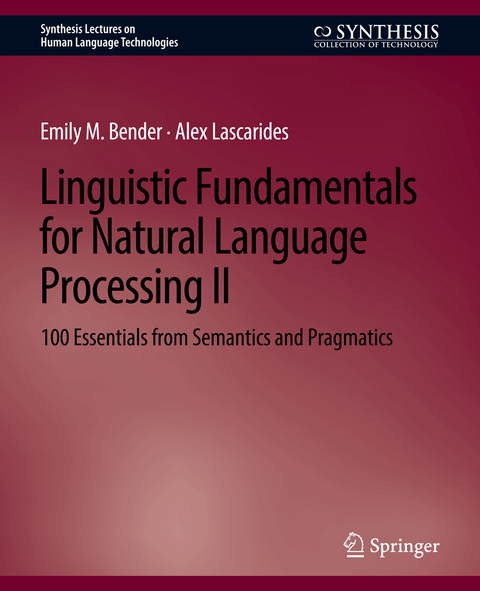
Linguistic Fundamentals for Natural Language Processing II
Springer International Publishing (Verlag)
978-3-031-01044-6 (ISBN)
Emily M. Bender is a Professor in the Department of Linguistics and Adjunct Professor in the School of Computer Science & Engineering at the University of Washington. Her primary research interests lie in multilingual grammar engineering, the incorporation of linguistic knowledge in NLP, computational semantics, and ethics in NLP. She is the PI of the Grammar Matrix project, which is developed in the context of the DELPH-IN Consortium (Deep Linguistic Processing with HPSG Initiative). More generally, she is interested in the intersection of linguistics and computational linguistics, from both directions: bringing computational methodologies to linguistic science and linguistic science to natural language processing. Her Ph.D. in Linguistics is from Stanford University. She has authored or co-authored papers in Transactions of the ACL, Linguistic Issues in Language Technology, the Journal of Research on Language and Computation, English Language and Linguistics, the Encyclopedia of Language and Linguistics, and Linguistic Typology, and the proceedings of conferences such as ACL, COLING, EMNLP, IJCNLP and IWCS, and associated workshops. She is the author of a previous volume of this series, Linguistic Fundamentals for Natural Language Processing: 100 Essentials from Morphology and Syntax, Synthesis Lectures on Human Language Technologies #20.Alex Lascarides is Personal Chair in Semantics at the School of Informatics, University of Edinburgh. Her research is in formal and computational semantics and pragmatics, focusing mainly on the interaction between discourse coherence and discourse interpretation. Together with her colleague Nicholas Asher, she developed the semantic framework Segmented Discourse Representation Theory (SDRT). She has published work on many semantic phenomena, including tense and aspect, presuppositions, lexical semantics, indirect speech acts, the semantics of questions and requests, strategic conversation, agreement and denial, negotiation and persuasion, human-robot interaction, symbol grounding, intonation, and embodied conversation, including the meaning spontaneous hand gestures. More recently, her research has focused on non-linguistic phenomena in Artificial Intelligence, particularly on learning optimal strategies in complex games, and algorithms for adapting graphical representations of sequential decision problems when during the learning process the learner discovers unforeseen factors that are critical to success. Her Ph.D. in Cognitive Science is from the University of Edinburgh. She has co-authored a book on SDRT (published by Cambridge University Press), a textbook on cognition and communication (published by MIT Press), journal papers on formal semantics (Linguistics and Philosophy, Journal of Semantics, Semantics and Pragmatics), philosophy (Synthese, Review of Philosophy and Psychology, Journal of Logic, Language and Information), computational linguistics (Computational Linguistics, Natural Language Engineering) and artificial intelligence (Journal of Artificial Intelligence Research), and papers at conferences such as ACL, COLING, EMNLP, IWCS, SEMDIAL, AAMAS, CoRL, UAI, ICML and Intellysis.
Acknowledgments.- Introduction.- What is Meaning?.- Lexical Semantics: Overview.- Lexical Semantics: Senses.- Semantic Roles.- Collocations and Other Multiword Expressions.- Compositional Semantics.- Compositional Semantics beyond Predicate-Argument Structure.- Beyond Sentences.- Reference Resolution.- Presupposition.- Information Status and Information Structure.- Implicature and Dialogue.- Resources.- Bibliography.- Authors' Biographies.- General Index.- Index of Languages.
| Erscheinungsdatum | 06.06.2022 |
|---|---|
| Reihe/Serie | Synthesis Lectures on Human Language Technologies |
| Zusatzinfo | XVII, 250 p. |
| Verlagsort | Cham |
| Sprache | englisch |
| Maße | 191 x 235 mm |
| Gewicht | 518 g |
| Themenwelt | Geisteswissenschaften ► Sprach- / Literaturwissenschaft ► Sprachwissenschaft |
| Informatik ► Theorie / Studium ► Künstliche Intelligenz / Robotik | |
| ISBN-10 | 3-031-01044-2 / 3031010442 |
| ISBN-13 | 978-3-031-01044-6 / 9783031010446 |
| Zustand | Neuware |
| Informationen gemäß Produktsicherheitsverordnung (GPSR) | |
| Haben Sie eine Frage zum Produkt? |
aus dem Bereich