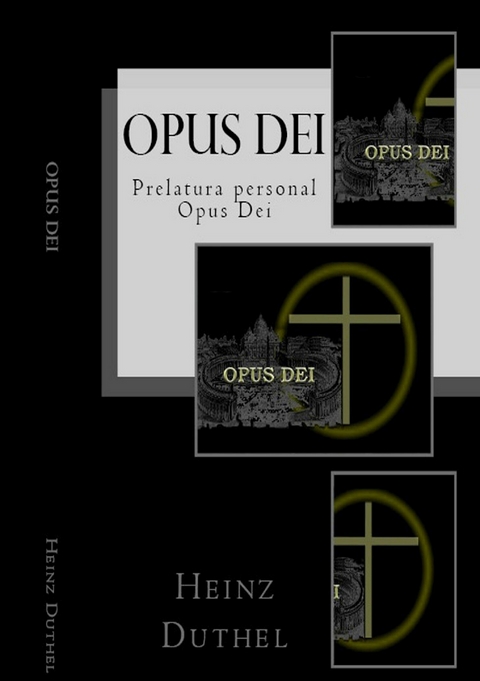
Opus Dei - Opus Dei personal prelature (eBook)
707 Seiten
neobooks Self-Publishing (Verlag)
978-3-7541-9260-3 (ISBN)
https://meinbuch.store
https://meinbuch.store
756, the history of the Papal States begins.
1860, the army of the King of Italy Victor Emmanuel II conquers the Papal States, leaving the Holy See in possession only of Rome and its coastal region, during the papacy of Pius IX.
In 1870, Victor Emmanuel takes Rome largely thanks to the Franco-Prussian War and proclaims it the new capital of his kingdom.
1917, Benedict XV proposes a peace plan for the First World War that is totally ignored by the international community.
1929, the Lateran Treaty is signed by Pietro Gasparri, representing the Holy See, and Benito Mussolini, Italian Prime Minister, on February 11 during the pontificate of Pius XI. With this pact, the dispute with Italy that had existed since 1870 was terminated.
1939, the Second World War breaks out; the Holy See declares itself neutral.
1965, Paul VI closes the Second Vatican Council.
1981, John Paul II suffers an attack in St. Peter's Square in the Vatican.
2005, Pope John Paul II dies and Benedict XVI is elected as pope.
dad
Catholic Church
Vatican City
Catholicism
Vatican Library
Annex: Ambassadors of Spain to the Holy See
Vatican City (vatican_va) on Twitter
The Holy thirst
secular institute
In the Catholic Church, a secular Institute is an association for lay people who profess the three obligatory evangelical counsels (chastity, poverty and obedience) by virtue of a sacred bond, by virtue of which they give their lives to the following of Christ and to the apostolate of the Church. Church, committing herself to the sanctification of the world by working from within it (can. 710), following a specific constitution for her institute. Together with the religious Institutes, they are the two categories that make up the state of life consecrated by the profession of the evangelical counsels in the Catholic Church. Secular Institutes bring together men or women (separately). The appellation secular underlines that those who profess this state of consecrated life do not change the condition they have in the century and that they continue to live and act in the midst of the people of God without leaving their own social environment (can. 711; can. 713 § 2 ) according to their own secular way of life.
These secular Institutes can be clerical or lay, male or female.
History
Secular Institutes, although they have historical precedents since the end of the s. XVI, obtained legal recognition and were framed among the states of consecrated life approved by the Church in the twentieth century, on February 2, 1947, with the Apostolic Constitution Provida Mater Ecclesia. The first Secular Institute was Opus Dei, at the beginning of its legal itinerary that ended in 1982 with the figure of personal prelature.
Secular Institutes in the 1983 Code
The Code of Canon Law promulgated by John Paul II in 1983 in the Second Book, which deals with the people of God, contains a complete chapter on secular Institutes (Chapter 8): canons 710 to 730 inclusive.
life rules
The nature of secular institutes allows their members to live with their families, in a group (without being a community) or alone, since secular consecrated persons do not cease to be lay people.
The apostolate of secular institutes includes the whole way of life of the members in their trades, professions or in the service of others. On some occasions, they help in parish or diocesan activities.
They regularly meet with other members of the local, regional and national association, to share days of recollection and retreat, they also often meet to socialize as well as at national and international conferences. There are true and strong bonds of communion between the members of an institute.
Secular institutes, in the humility of their means but in the confidence that comes from their vocation, propose to realize the model of relationship between the Church and the world.
One cannot fail to see the coincidence between the charism of the secular institutes and what has been one of the most important and clearest lines of the council: the presence of the Church in the world. These institutes, by virtue of their charism of consecrated secularity, appear as instruments to embody this spirit and transmit it to the whole Church.
If they remain faithful to their own vocation, the secular institutes will become "the experimental laboratory in which the Church verifies the concrete modalities of its relations with the world. (Paul VI; 3-25-76)
List of approved secular institutes
Salesian Family: Volunteers of Don Bosco - VDB (1917) and Volunteers with Don Bosco - CDB (1994).
Secular Institute Faithful Servants of Jesus
Santa Maria Family: Santa Maria Crusades and Santa Maria Crusaders
Secular Institute of Jesus Crucified and Mary Immaculate. (Lasallian Spirituality)
Secular Institute Brotherhood of Evangelical Workers
Disciples of the Lord Secular Institute (1944)
Secular Institute of Schoenstatt Sisters of Mary (1926)
Secular Institute of the Schoenstatt Fathers (1965)
Pius X Secular Institute (1959)
Religious orders
religious congregations
apostolic life society
Catechesis: laity who follow Jesus Christ from the Evangelical Councils
Documentation on Secular Institutes
Secular institutes in Spain
National Conference of Secular Institutes of Chile
Servi Trinitatis Secular Institute
National Conference of Secular Institutes of Chile
Volunteers With Don Bosco (CDB)
personal prelature
A personal prelature is an institution of the Catholic Church made up of priests and deacons, headed by a prelate (who in turn may be a priest or a bishop). There may also be lay people who collaborate with the apostolic works of the personal prelature.
There is another figure in the Catholic Church also called prelature, the "Territorial Prelature". This is a quasi-diocese, it is governed by the common law of the Church (not by statutes) and has its own people made up mainly of lay people, to whom the prelate and his presbytery provide ordinary pastoral care.
There is currently only one personal prelature: the Prelature of the Holy Cross and Opus Dei, erected by Pope John Paul II in 1982.
Legal regime
Personal prelatures are regulated by points 294 to 297 of the Code of Canon Law, belonging to the first part (Of the Christian faithful) of Book II (Of the People of God):
294 In order to promote a suitable distribution of presbyters or to carry out special pastoral or missionary works in favor of various regions or diverse social groups, the Apostolic See, having heard the Episcopal Conferences concerned, may erect personal prelatures consisting of presbyters. and deacons of the secular clergy.
295 § 1. The personal prelature is governed by the statutes issued by the Apostolic See and its government is entrusted to a Prelate as his own Ordinary, who has the power to erect a national or international seminary as well as to incardinate the students and promote them to orders by way of service to the prelature. § 2. The Prelate must take care of the spiritual formation of those ordained with the aforementioned title, as well as their appropriate support.
296 Through agreements established with the prelature, the laity can dedicate themselves to the apostolic works of the personal prelature; but the mode of this organic cooperation and the main duties and rights attached to it must be adequately determined in the statutes.
297 The statutes will determine the relations of the personal prelature with the local Ordinaries of those particular Churches in which the prelature exercises or wishes to exercise its pastoral or missionary works, with the prior consent of the diocesan Bishop.
Nature of personal prelatures
There are fundamentally two opinions: the one that considers that a personal prelature, being a clerical entity (that is, formed by clerics), in relation to the lay people who collaborate with its apostolic works, has to be an entity of an associative nature; and those who affirm that a personal prelature is an ecclesiastical circumscription (such as dioceses, military ordenates, etc.).
In the words of Antonio Viana, a well-known canonist of Opus Dei:
"One of the issues most studied by contemporary canonical science is the nature of personal prelatures. [...] In a synthetic way it can be remembered that for some personal prelatures are associative-based entities oriented to the formation, incardination and distribution of clergy for the service of the dioceses, while others consider them institutions belonging to the hierarchical organization of the Church with the typical configuration of the quasi-diocesan pastoral circumscriptions. The first support the exclusively clerical composition of the personal prelatures; on the other hand, the second opinion mentions the clerus-populus relationship as the personal substratum of these prelatures." (Ius Canonicum, 79 (2000), pp. 289-306.)
The opinions of two authors in favor of the associative thesis are included below: Joseph Ratzinger (then cardinal, 1981) and Giancarlo Ghirlanda (Jesuit canonist, 2000); and those of two others in favor of belonging to the hierarchical structure of the Church: Bishop Javier Echevarría (prelate of Opus Dei, 2005) and Jorge Miras (canonist of Opus Dei, 1999).
Cardinal Ratzinger
In the preparatory work of the CDC in 1983, the then Cardinal (who was later elected Pope under the name of Benedict XVI) argued that
"the personal Prelature... is not a particular Church...
| Erscheint lt. Verlag | 26.5.2022 |
|---|---|
| Verlagsort | Berlin |
| Sprache | deutsch |
| Themenwelt | Geisteswissenschaften ► Sprach- / Literaturwissenschaft |
| Schlagworte | Alvaro • Echevarría • Javier • John-Paul-II • Maria-del-Carmen-Tapia • Miguel-Fisac • Paquita-Domínguez • Portillo • Tomás-Alvira • Toni-Zweifel |
| ISBN-10 | 3-7541-9260-4 / 3754192604 |
| ISBN-13 | 978-3-7541-9260-3 / 9783754192603 |
| Informationen gemäß Produktsicherheitsverordnung (GPSR) | |
| Haben Sie eine Frage zum Produkt? |
 EPUB (Wasserzeichen)
E-Book Endkundennutzungsbedinungen des Verlages
DRM: Digitales Wasserzeichen
Dieses eBook enthält ein digitales Wasserzeichen und ist damit für Sie personalisiert. Bei einer missbräuchlichen Weitergabe des eBooks an Dritte ist eine Rückverfolgung an die Quelle möglich.
Dateiformat: EPUB (Electronic Publication)
EPUB ist ein offener Standard für eBooks und eignet sich besonders zur Darstellung von Belletristik und Sachbüchern. Der Fließtext wird dynamisch an die Display- und Schriftgröße angepasst. Auch für mobile Lesegeräte ist EPUB daher gut geeignet.
Systemvoraussetzungen:
PC/Mac: Mit einem PC oder Mac können Sie dieses eBook lesen. Sie benötigen dafür die kostenlose Software Adobe Digital Editions.
eReader: Dieses eBook kann mit (fast) allen eBook-Readern gelesen werden. Mit dem amazon-Kindle ist es aber nicht kompatibel.
Smartphone/Tablet: Egal ob Apple oder Android, dieses eBook können Sie lesen. Sie benötigen dafür eine kostenlose App.
Geräteliste und zusätzliche Hinweise
Buying eBooks from abroad
For tax law reasons we can sell eBooks just within Germany and Switzerland. Regrettably we cannot fulfill eBook-orders from other countries.
aus dem Bereich