


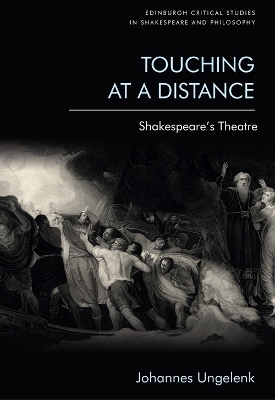
Touching at a Distance
Shakespeare's Theatre
Seiten
2023
Edinburgh University Press (Verlag)
978-1-4744-9782-4 (ISBN)
Edinburgh University Press (Verlag)
978-1-4744-9782-4 (ISBN)
Studies the capacity of Shakespeare’s plays to touch and think about touch
Theatre has a remarkable capacity: it touches from a distance. The audience is affected, despite their physical separation from the stage. The spectators are moved, even though the fictional world presented to them will never come into direct touch with their real lives. Shakespeare is clearly one of the master practitioners of theatrical touch. As the study shows, his exceptional dramaturgic talent is intrinsically connected with being one of the great thinkers of touch. His plays fathom the complexity and power of a fascinating notion – touch as a productive proximity that is characterised by unbridgeable distance – which philosophers like Friedrich Nietzsche, Maurice Blanchot, Jacques Derrida, Luce Irigaray and Jean-Luc Nancy have written about, centuries later.
By playing with touch and its metatheatrical implications, Shakespeare raises questions that make his theatrical art point towards modernity: how are communities to form when traditional institutions begin to crumble? What happens to selfhood when time speeds up, when oneness and timeless truth can no longer serve as reliable foundations? What is the role and the capacity of language in a world that has lost its seemingly unshakeable belief and trust in meaning? How are we to conceive of the unthinkable extremes of human existence – birth and death – when the religious orthodoxy slowly ceases to give satisfactory explanations? Shakespeare’s theatre not only prompts these questions, but provides us with answers. They are all related to touch, and they are all theatrical at their core: they are argued and performed by the striking experience of theatre’s capacities to touch – at a distance.
This publication was supported by funds from the Publication Fund for Open Access Monographs of the Federal State of Brandenburg, Germany.
Theatre has a remarkable capacity: it touches from a distance. The audience is affected, despite their physical separation from the stage. The spectators are moved, even though the fictional world presented to them will never come into direct touch with their real lives. Shakespeare is clearly one of the master practitioners of theatrical touch. As the study shows, his exceptional dramaturgic talent is intrinsically connected with being one of the great thinkers of touch. His plays fathom the complexity and power of a fascinating notion – touch as a productive proximity that is characterised by unbridgeable distance – which philosophers like Friedrich Nietzsche, Maurice Blanchot, Jacques Derrida, Luce Irigaray and Jean-Luc Nancy have written about, centuries later.
By playing with touch and its metatheatrical implications, Shakespeare raises questions that make his theatrical art point towards modernity: how are communities to form when traditional institutions begin to crumble? What happens to selfhood when time speeds up, when oneness and timeless truth can no longer serve as reliable foundations? What is the role and the capacity of language in a world that has lost its seemingly unshakeable belief and trust in meaning? How are we to conceive of the unthinkable extremes of human existence – birth and death – when the religious orthodoxy slowly ceases to give satisfactory explanations? Shakespeare’s theatre not only prompts these questions, but provides us with answers. They are all related to touch, and they are all theatrical at their core: they are argued and performed by the striking experience of theatre’s capacities to touch – at a distance.
This publication was supported by funds from the Publication Fund for Open Access Monographs of the Federal State of Brandenburg, Germany.
Johannes Ungelenk is Junior Professor for Literary Theory and Comparative Literature, in the Department for Arts and Media at University of Potsdam, Germany. He is the author of Literature and Weather: Shakespeare – Goethe – Zola (De Gruyter, 2018), Sexes of Winds and Packs: Rethinking Feminism with Deleuze and Guattari (Marta Press, 2014) and Narcissus and Echo: A Political Reading of George Eliot’s Daniel Deronda (wvt, 2012).
Introduction: Theatrical Contagions
1. Theatre’s Offence: Hamlet and The Tempest
2. Touching the Depth of the Surface: Richard III
3. Caressing with Words: Much Ado About Nothing
4. Touching Fractions: Troilus and Cressida
Coda: A Philology of Touch
| Erscheinungsdatum | 30.01.2023 |
|---|---|
| Reihe/Serie | Edinburgh Critical Studies in Shakespeare and Philosophy |
| Zusatzinfo | 1 black and white illustration |
| Verlagsort | Edinburgh |
| Sprache | englisch |
| Maße | 156 x 234 mm |
| Themenwelt | Geisteswissenschaften ► Sprach- / Literaturwissenschaft ► Anglistik / Amerikanistik |
| Geisteswissenschaften ► Sprach- / Literaturwissenschaft ► Literaturgeschichte | |
| Geisteswissenschaften ► Sprach- / Literaturwissenschaft ► Literaturwissenschaft | |
| ISBN-10 | 1-4744-9782-9 / 1474497829 |
| ISBN-13 | 978-1-4744-9782-4 / 9781474497824 |
| Zustand | Neuware |
| Informationen gemäß Produktsicherheitsverordnung (GPSR) | |
| Haben Sie eine Frage zum Produkt? |
Mehr entdecken
aus dem Bereich


aus dem Bereich
Poetik eines sozialen Urteils
Buch | Hardcover (2023)
De Gruyter (Verlag)
CHF 83,90


