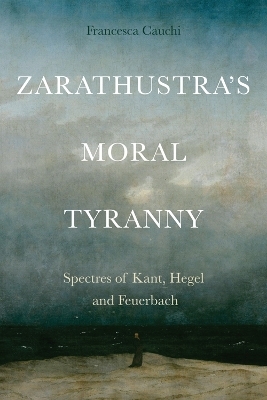
Zarathustra's Moral Tyranny
Edinburgh University Press (Verlag)
978-1-3995-0431-7 (ISBN)
By way of a sustained interrogation of Zarathustra’s doctrine of self-overcoming, Francesca Cauchi lays bare the asceticism underlying the prescriptive injunctions set forth in the first two parts of Thus Spoke Zarathustra. These injunctions fall under three heads: self-legislation, self-denial and self-sacrifice, which are shown to bear striking affinities with concepts first formulated by Kant, Hegel and Feuerbach. In Cauchi’s new reading, the Kantian rational will, the Hegelian ‘labour of the negative’ and Feuerbach’s indivisible trinity of love, sacrifice and suffering are seen to resurface in Zarathustra as the agents of a ferocious and self-eviscerating doctrine of self-overcoming that exhibits all the attributes of a moral tyranny.
Francesca Cauchi is an Associate Professor National Sun Yat-sen University in Kaohsiung, Taiwan. She is the author of Zarathustra contra Zarathustra: The Tragic Buffoon (Ashgate, 1998), reissued under the Routledge imprint in September 2018. She has published many articles in peer-review journals including Philological Quarterly, Journal of European Studies and Oxford German Studies.
Introduction
The naturalist-normative problem
The morality problem
Max Stirner and the ‘tyranny of mind’
Kant, Hegel, and Feuerbach
1. Nietzsche’s Ascetic Morality
Pitting a ‘morality of reason’ against the Christian morality of feeling
Nietzsche’s self-eviscerating ‘morality of sacrifice’
Do ‘free-spirited moralists’ have the right to inflict their cruelty on others?
Austerity and artifice
2. The Kantian Rational Will and the Tyranny of Self-Overcoming
Autonomy and universality
Creator-destroyers and hammer-wielding legislators
Shattering the Christian table of values
Erkenntniss and the hard labour of reorienting the affects
Reverence and martyrdom: willing the Übermensch
3. Hegel’s ‘Labour of the Negative’ and the Lacerations of Self-Negation
Affirmative negation and Deleuzian derision
Spirit’s ‘labour of the negative’
Practical freedom and the planting of thought into the passions
Spirit’s vicious cycle of bitter deaths and interminable resurrections
4. The Bitter Cup of Pure Love: Feuerbach and Zarathustra
Reclaiming the ’divine’ powers of human greatness
Love as a human absolute
Christ’s Passion and Zarathustra’s sacrificial love
An excursus on self-love and the I and thou of compassion
Conclusion
Zarathustra’s violent rhetoric of truth incorporation
Zarathustra’s moral tyranny
Bibliography
Index
| Erscheinungsdatum | 30.11.2022 |
|---|---|
| Verlagsort | Edinburgh |
| Sprache | englisch |
| Maße | 138 x 216 mm |
| Themenwelt | Geisteswissenschaften ► Philosophie ► Ethik |
| ISBN-10 | 1-3995-0431-2 / 1399504312 |
| ISBN-13 | 978-1-3995-0431-7 / 9781399504317 |
| Zustand | Neuware |
| Informationen gemäß Produktsicherheitsverordnung (GPSR) | |
| Haben Sie eine Frage zum Produkt? |
aus dem Bereich