


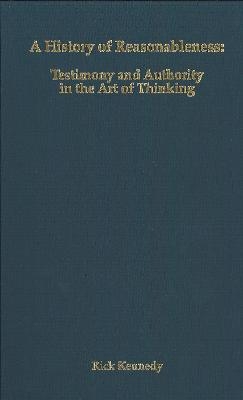
A History of Reasonableness
Testimony and Authority in the Art of Thinking
Seiten
2004
University of Rochester Press (Verlag)
978-1-58046-152-8 (ISBN)
University of Rochester Press (Verlag)
978-1-58046-152-8 (ISBN)
- Titel ist leider vergriffen;
keine Neuauflage - Artikel merken
A defense of the social operation of thinking, with an emphasis on testimony and authority.
This book describes a lost tradition that can be called reasonableness. The tradition began with Aristotle, was recommended to Western education by Augustine, flourished in the schools of the Renaissance through the nineteenth century, then got lost in the academic and philosophic shuffles of the twentieth century. Representative of the tradition is John Locke's story of a King of Siam who rejected reports of the existence of ice. The King would have hadto risk too much trust in another man whom he did not know too well -- a Dutch ambassador -- in order to believe that elephants could walk on cold water. John Locke presented the story to encourage his readers to think about theresponsibilities and risks entailed in what he called 'the gentle and fair ways of information.'
The art of thinking is largely social. Popular textbook writers such as Quintilian, Boethius, Philipp Melanchthon, John of St.Thomas, Antoine Arnauld, Thomas Reid, Isaac Watts, Richard Whately, William Hamilton, L. Susan Stebbings, and Max Black taught strategies of belief, trust, assent, and even submission as part of reasonableness. For over two thousand years testimony and authority were at the center of lively discussions about teaching the art of thinking. In the twentieth century the tradition faltered largely due to Immanuel Kant's insistence that there should be no distinction between handling testimony and personal experience. This book recounts the history of a lively educational tradition and hopes to encourage its revival.
Rick Kennedy, whose previous books and articles have beenabout Colonial American logic, mathematics, and science, is Professor of History at Point Loma Nazarene University.
This book describes a lost tradition that can be called reasonableness. The tradition began with Aristotle, was recommended to Western education by Augustine, flourished in the schools of the Renaissance through the nineteenth century, then got lost in the academic and philosophic shuffles of the twentieth century. Representative of the tradition is John Locke's story of a King of Siam who rejected reports of the existence of ice. The King would have hadto risk too much trust in another man whom he did not know too well -- a Dutch ambassador -- in order to believe that elephants could walk on cold water. John Locke presented the story to encourage his readers to think about theresponsibilities and risks entailed in what he called 'the gentle and fair ways of information.'
The art of thinking is largely social. Popular textbook writers such as Quintilian, Boethius, Philipp Melanchthon, John of St.Thomas, Antoine Arnauld, Thomas Reid, Isaac Watts, Richard Whately, William Hamilton, L. Susan Stebbings, and Max Black taught strategies of belief, trust, assent, and even submission as part of reasonableness. For over two thousand years testimony and authority were at the center of lively discussions about teaching the art of thinking. In the twentieth century the tradition faltered largely due to Immanuel Kant's insistence that there should be no distinction between handling testimony and personal experience. This book recounts the history of a lively educational tradition and hopes to encourage its revival.
Rick Kennedy, whose previous books and articles have beenabout Colonial American logic, mathematics, and science, is Professor of History at Point Loma Nazarene University.
Rick Kennedy, whose previous books and articles have been about Colonial American logic, mathematics, and science, is professor of history at Point Loma Nazarene University
The Classical Tradition of Testimony in Topics
Three Medieval Traditions: Augustine, Boethius, and Cassiodoras
Two Renaissance Traditions: Ciceronian and Augustinian
The Long Influence of The Port-Royal Logic
Appreciating Aristotle: Thomists, Scots, and Oxford Noetics
Testimony Experience: The Rise of Critical Thinking
| Erscheint lt. Verlag | 26.9.2004 |
|---|---|
| Reihe/Serie | Rochester Studies in Philosophy |
| Verlagsort | Rochester |
| Sprache | englisch |
| Maße | 152 x 229 mm |
| Gewicht | 524 g |
| Themenwelt | Geisteswissenschaften ► Philosophie |
| ISBN-10 | 1-58046-152-2 / 1580461522 |
| ISBN-13 | 978-1-58046-152-8 / 9781580461528 |
| Zustand | Neuware |
| Informationen gemäß Produktsicherheitsverordnung (GPSR) | |
| Haben Sie eine Frage zum Produkt? |
Mehr entdecken
aus dem Bereich


aus dem Bereich
wie Tiere den Tod verstehen
Buch | Hardcover (2025)
Insel Verlag
CHF 42,90
Band 8: Ästhetik (1961/62)
Buch | Hardcover (2025)
Suhrkamp (Verlag)
CHF 109,15


