


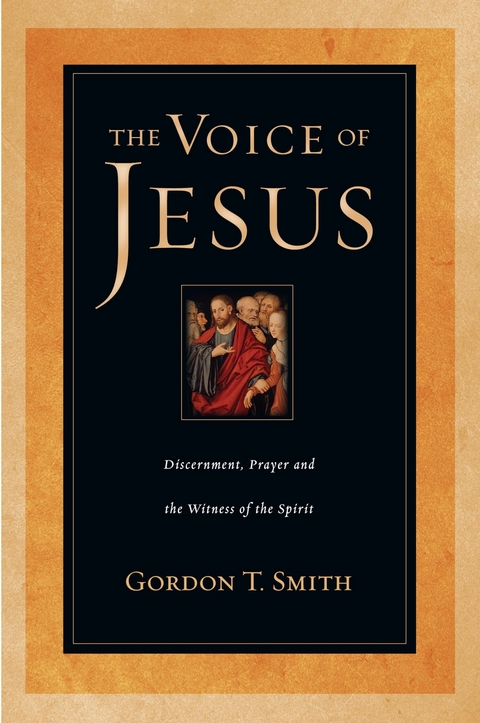
Voice of Jesus (eBook)
InterVarsity Press (Verlag)
978-0-8308-9391-1 (ISBN)
Gordon T. Smith (PhD, Loyola School of Theology, Ateneo de Manila University) is the president of Ambrose University and Seminary in Calgary, Alberta, where he also serves as professor of systematic and spiritual theology. He is an ordained minister with the Christian and Missionary Alliance and a teaching fellow at Regent College, Vancouver, British Columbia. He is the author of many books, including Courage and Calling, Called to Be Saints, Spiritual Direction, Consider Your Calling, and The Voice of Jesus.
A Personal Growth Finalist in the Word Guild Canadian Writing Awards"e;My sheep hear my voice. I know them, and they follow me."e;Jesus takes it for granted that you will hear his voice. But how do you hear it?How do you separate it out from the cacophony of other voices you hear everyday, including those of your own desires? Is your experience of Jesus' voice something purely subjective, or is it something you can talk about with others and have them confirm?Building on the rich spiritual tradition that spans the diversity of history and theology from Ignatius Loyola to John Wesley to Jonathan Edwards, Gordon T. Smith helps open your ears and heart to the depths of the inner witness of the Spirit. By learning to attend to the Spirit, Smith urges, you will learn to hear and heed the voice of Jesus in everyday life. Written with warmth and wisdom, this book speaks to the mind and heart of every Christian who longs for a closer, more intimate walk with Jesus.
Gordon T. Smith (PhD, Loyola School of Theology, Ateneo de Manila University) is the president of Ambrose University and Seminary in Calgary, Alberta, where he also serves as professor of systematic and spiritual theology. He is an ordained minister with the Christian and Missionary Alliance and a teaching fellow at Regent College, Vancouver, British Columbia. He is the author of many books, including Courage and Calling, Called to Be Saints, Spiritual Direction, Consider Your Calling, and The Voice of Jesus.
2
Three Voices,
One Tradition
A discussion about discernment is a reflection on the nature of religious experience. Experience is inherently pliable and intangible and thus hard to define. We affirm that the Spirit of God communicates inwardly to the consciousness of those who are prepared to listen. Fine and good. But what form does this take? And how is it recognized? How can we talk about it meaningfully?
It is imperative that we affirm and reaffirm that what we seek is not some vague experience or titillating encounter but nothing other than an experience of the triune God. We seek to know the Father. We believe and want to act on the conviction that it is possible to have a dynamic and personal relationship with Christ, a relationship that is mediated to us by his Spirit. The content of our experience, then, is Jesus. It is a false spiritual encounter if it fails to affirm the Jesus of holy Scripture—the human, historical Jesus who was crucified and now reigns as risen Lord. We seek an experience of Jesus that is congruent with the historic faith of the church.
Therefore, we need a language to be able to speak about this experience, not only to make sense of our own encounters with Jesus but also as a way to be in conversation with others about our experience. This does not mean a scientific analysis of our spiritual experience that essentially reduces experience to only that which is empirically verifiable. But it does mean that we have a common understanding, with terms of reference, and a grammar that authenticates and strengthens that experience. To find this, we must turn to the Christian spiritual heritage so that our experience and our conversation are informed by the Christian tradition.
The Reality of a Christian Tradition Concerning the Inner witness
In Christian history and thought, the language of “tradition” speaks of a continuous witness in the life and teaching of the church that gives wisdom and guidance to succeeding generations of Christians. For the central themes of Christian thought, the tradition is clear. It is captured in the wonderful words of the ancient creeds, which arose out of the early ecumenical councils. But when it comes to discerning the voice of Jesus, we have no such creedal affirmations to which we can appeal. We turn instead to the writings of our spiritual fathers and mothers to determine if there is a pattern of thought and teaching that might point to an ongoing witness of the Spirit in the life of the church.
What we find is distinctive and compelling. There is a tradition that finds expression right across the spectrum of theological perspectives. As we explore these diverse streams, we discover a remarkable congruence that speaks, in turn, of a common heritage. In other words, as we seek to make sense of the experience of the Spirit in our day, we are not merely drawing on various bits of helpful wisdom from our spiritual heritage. Rather, an examination of this heritage points to a distinctive and specific tradition.
In the chapters that follow I will draw on a breadth of spiritual counsel and wisdom from the Christian heritage. However, in a discussion regarding discernment and the inner witness of the Spirit, and particularly the interplay between these, three names invariably stand out. For me, what highlights the reality of a distinctive tradition in the Christian heritage is that though these sources represent three different theological streams of the church, they nevertheless reflect a remarkable degree of congruency. In these three sources—Ignatius Loyola, John Wesley and Jonathan Edwards—we have witnesses to a tradition that the contemporary Christian cannot afford to ignore. Here is wisdom for life in the twenty-first century, wisdom out of our Christian heritage, and not just one contribution, or the perspective of one writer or theologian, but rather three different sources that agree sufficiently such that we have, essentially, a common historic witness to a tradition.
The Remarkable Congruency of Ignatius, Wesley and Edwards
Ignatius Loyola (1491-1556) was a Spanish reformer, spiritual writer and founder of the Society of Jesus, better known as the Jesuits. John Wesley (1703-1791) was an English evangelist and founder of Methodism. And Jonathan Edwards (1703-1758) was a Puritan, Congregational theologian and American preacher, highly influential in the religious revival known as the Great Awakening. These three men, through the writings they left, point to a common tradition of spiritual discernment.
For Ignatius, our primary source is the Spiritual Exercises (begun in rough form when he was quite young but finally published in 1548), part of which includes the “Rules for Discernment.” For Wesley, his thought on this subject is available through his journal and letters, but primarily in his sermons, notably those that specifically address the matter of the inner witness. For Edwards, of particular note for our purposes is his classic work entitled Religious Affections. All three of these sources affirm that our point of departure is crucial: they stress the need for clarity about our ultimate allegiance. As Ignatius puts it in the Spiritual Exercises: “In every good choice, as far as depends on us, our intention must be simple. I must consider only the end for which I am created, that is, for the praise of God our Lord and for the salvation of my soul.”1
We hear the voice of Jesus from a posture of attentiveness and humility. If we are to hear God and live with a confidence that we walk in the light of his will and choose wisely in response to his voice, we must be clear about our ultimate allegiance. We need to be certain about whom we serve. This is the single most crucial issue when it comes to divine guidance and spiritual discernment.
The Christian community has always been profoundly impressed by two moments in redemptive history that capture this posture of heart and mind. First, we have Mary, the mother of the Lord, who at the announcement of the angel replied with the words “Here am I, the servant of the Lord; let it be with me according to your word” (Lk 1:38). And second, we have Jesus himself, who in Gethsemane said to the Father, “Not what I want, but what you want” (Mk 14:36). No caveats, no qualifiers.
However, it is misguided and simplistic to conclude that all we need to do is be committed and we will know the way. This world has been severely threatened by those who have great depth of commitment and even radical allegiance but who are crusaders—zealots passionate for what they perceive to be God’s will, but hardly a means of grace to our world. The irony is that this zeal for God can blind us to what God is actually doing and actually saying. We must be discerning.
And herein lies the genius of Ignatius, Wesley and Edwards. For all of them, spiritual transformation comes not so much through zeal or determination as through what is happening to us affectively, the emotional dispositions of our hearts. Listening to God is a matter of being attentive to the affective orientation of one’s inner consciousness. To discern, then, requires that we develop the capacity to listen with heart and mind. Ignatius, Wesley and Edwards each approaches this question differently, but as we will see, taken together they profile a remarkable congruency of understanding—a threefold witness to a common tradition.
Ignatius Loyola
Ignatius Loyola was a Basque soldier who, during a time of convalescence after having been wounded in battle, read a classic devotional book on the lives of Christ and of the saints. Immersed in this spiritual reading, he devoted himself to Christ and to his service.
During this time of recuperation, Ignatius also became conscious of the movements of his heart and mind, particularly his emotional ups and downs. He sought to make sense of their relationship to his newfound commitments. As he monitored his affective responses, he grew in his capacity to discern their significance.
Later, while under the influence of Benedictine monks, he was introduced to spiritual writings of the late Middle Ages, including those of the devotional masters of the Brethren of the Common Life (best known, perhaps, through the work attributed to Thomas à Kempis, Imitation of Christ). From this input, building on what he was learning about his own heart, Ignatius formulated an approach to the spiritual life that is encapsulated in his classic work, Spiritual Exercises.2
The Exercises presuppose that there is a choice to be made, what Ignatius called an “election.” While the Exercises can be used as a “school of prayer,” the original design was that through these exercises the prayer would be enabled to make a vital life decision. The intent of the Exercises is to assist those who seek to discover and follow the will of God for them as individuals. This speaks, then, not of a general, moral will of God but of the particular will for one’s immediate life situation. And Ignatius’s approach is rooted in the conviction that this choice can be made with the assistance of the Holy Spirit through the means outlined in the Exercises. However, while there are exercises and disciplines through which the pray-er is led, the bottom line is that real guidance is provided by the Spirit.
A compelling phrase captures the notion of discernment in Ignatian spirituality; it is the vision of finding God in all things. Discernment for Ignatius and his followers is a matter of attending to, and being conscious of, the...
| Erscheint lt. Verlag | 26.10.2018 |
|---|---|
| Verlagsort | Lisle |
| Sprache | englisch |
| Themenwelt | Religion / Theologie ► Christentum ► Moraltheologie / Sozialethik |
| Schlagworte | Christian • christian growth • Christian Life • christian living • God • Jesus • spiritual growth • Spiritual life |
| ISBN-10 | 0-8308-9391-1 / 0830893911 |
| ISBN-13 | 978-0-8308-9391-1 / 9780830893911 |
| Informationen gemäß Produktsicherheitsverordnung (GPSR) | |
| Haben Sie eine Frage zum Produkt? |
 EPUB (Adobe DRM)
Kopierschutz: Adobe-DRM
Adobe-DRM ist ein Kopierschutz, der das eBook vor Mißbrauch schützen soll. Dabei wird das eBook bereits beim Download auf Ihre persönliche Adobe-ID autorisiert. Lesen können Sie das eBook dann nur auf den Geräten, welche ebenfalls auf Ihre Adobe-ID registriert sind.
Details zum Adobe-DRM
Dateiformat: EPUB (Electronic Publication)
EPUB ist ein offener Standard für eBooks und eignet sich besonders zur Darstellung von Belletristik und Sachbüchern. Der Fließtext wird dynamisch an die Display- und Schriftgröße angepasst. Auch für mobile Lesegeräte ist EPUB daher gut geeignet.
Systemvoraussetzungen:
PC/Mac: Mit einem PC oder Mac können Sie dieses eBook lesen. Sie benötigen eine
eReader: Dieses eBook kann mit (fast) allen eBook-Readern gelesen werden. Mit dem amazon-Kindle ist es aber nicht kompatibel.
Smartphone/Tablet: Egal ob Apple oder Android, dieses eBook können Sie lesen. Sie benötigen eine
Geräteliste und zusätzliche Hinweise
Buying eBooks from abroad
For tax law reasons we can sell eBooks just within Germany and Switzerland. Regrettably we cannot fulfill eBook-orders from other countries.
aus dem Bereich


