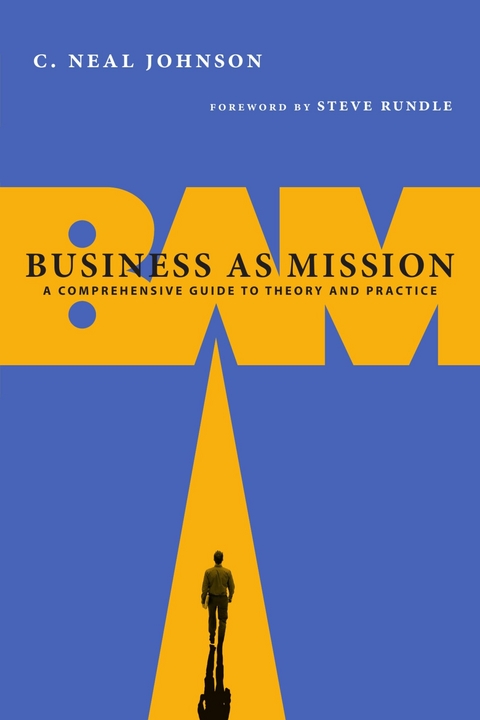
Business as Mission (eBook)
528 Seiten
IVP Academic (Verlag)
978-0-8308-6947-3 (ISBN)
C. Neal Johnson (Ph.D., Fuller Theological Seminary) is founding dean of the School of Business and is professor of international business at Bakke Graduate University in Seattle, Washington. He has had an extensive and unique thirty-year career as an attorney, banker, educator, business consultant and entrepreneur both domestically and internationally.
C. Neal Johnson (Ph.D., Fuller Seminary) is Professor of Business and Management at Hope International University where he specializes in teaching and speaking internationally on Business as Mission (BAM), Missional Entrepreneurship, Entrepreneurship, Globalization and International Management. In addition, he is the Founder and Executive Directon of HIU's Center for Business as Mission which is focused on going beyond traditional business education and helping transform global communities through Christian business and entrepreneurial education. Steve Rundle is associate professor of economics and business as mission at Biola University in La Mirada, California. His teaching and research interests are focused on the intersection between international economics and faith-based business. He is also the editor of Economic Justice in a Flat World: Christian Perspectives on Globalization.
2
BAM Models
Model: A standard for imitation, comparison or emulation; a pattern.
“The way you know you are successful is when the powerless value the powerful and the powerful value the powerless. Without the powerless being valued, there is rebellion. Without the powerful being valued, there is domination.
“If God is there, He is in the powerless and the powerful, and seeks to see them connected. The marketplace is the vehicle that connects the two.”
Lowell Bakke and Gwen Dewey
“We worked night and day, laboring and toiling so that we would not be a burden to any of you. We did this . . . to make ourselves a model for you to follow.”
2 Thessalonians 3:8-9
It is somewhat presumptuous, if not wholly counterproductive, to attempt to corral the myriad expressions of BAM into a one-size-fits-all model or mold, or even to list the experiential best practices of companies that are engaged in this movement. Such attempts fly in the face of the critical importance of contextualization and work against the value of the emic and etic perspectives. There is no such thing as a ready-made BAM formula or kit—“BAM in a Box”—and any who would try to create such are arguably working against the primal forces of nature (and God) in at least four ways.
First, the essence of entrepreneurship is creative risk-taking, engaging a complex web of factors and attempting to create something productive and profitable where it did not previously exist. This aspect of business is nothing short of the finest artistic creativity of which humanity is capable. Those engaged in creating new businesses, new products, new processes, new markets and new technologies are usually type-A personalities who will find or invent totally unique, imaginative ways of leveraging business for mission and ministry. BAM is not about restricting those God-given creative capacities and gifts, but about releasing, harnessing and leveraging it to serve God and his kingdom through purposeful, beneficial service to humankind in the name and love of Jesus. Certainly BAM practitioners can and should learn from each other, but how they adapt those lessons to their own particular businesses, products, markets, communities and cultural contexts will be as individual and different as the businesses themselves.
Second, our Lord is creative and is continually showing us an infinite variety of ways to minister to our fellow humans on this planet. One has only to look at the countless forms of life found in nature, whether in the cosmos itself or in the more earthly geologic formations, the animal kingdom, aquatic life or the world of plants, insects, bacteria, germs, atomic particles, and subatomic particles. Consider the genius of human life and the creative intelligence at work in creating the human body. God is a God of variety who delights in creative expressions of his goodness and purpose. Surely, to fulfill the Great Commission (disciple the nations), the great commandment (love people) and the cultural mandate (steward the world), God expects his created beings to use every ounce of their creative abilities in pursuit of his kingdom’s goals.
Third, having said that, it is also true that the Lord wants us to learn from each other and to build our lives and ministries on solid foundations gained from our individual and collective experiences. Etched over the library entrance to the University of Colorado library (where I spent many formative hours) are the words of Cicero, “He who knows only his own generation remains always a child.” With sincere apologies to Cicero, it could just as easily be said of business in general and BAM in particular, that “He who knows only his own company and context remains always at a disadvantage.” In that light, the following examples are company and contextual BAM experiences, a collage of human stories or, more academically, case studies. More to the point, they are examples of inspirational efforts that God’s people (the church) have undertaken to see his love spread by and through the business community. They are definitely not presented as BAM molds into which a company must fit or a wooden formula that dictates what a true BAM Company looks like. Quite the opposite. They are presented for mutual edification and inspiration, and as spurs to creative adaptation and imaginative imitation.
Fourth, the following illustrations are not models. They are merely examples or stories of what various BAMers are doing in their contexts. Nonetheless, I unabashedly use the term model because each company I discuss is a concrete example of what has worked with those people in that place at that time. In that sense each company is a case study or, more to the point, a living laboratory that adds to our body of knowledge about BAM. These companies are, after all, God’s pioneers in the BAM mission field—a first generation of intentional BAMers who will make all of the mistakes (and successes) that pave the way to more effective BAM and greater victory for Christ in the future.
Generic Models
Titling their book Transform the World, Sharon Swarr and Dwight Nordstrom cite the “unprecedented opportunities” and “limitless potential” of BAM. As they wrestled with defining generic BAM models, they saw the chief categories as being functional BAM missional opportunities: mentoring or coaching, venture capital and other types of investments, short-term teams to help new businesses, employment with a multinational firm, training entrepreneurial Great Commission teams to undertake “business planting in frontier nations,” franchising a business by planting it “in new locations around the world,” and working with microeconomic programs.[1]
This functional classification approach is quite valid for classifying BAM models. Another equally valid but quite different approach was enunciated by John Warton, international president of Business Professional Network. He sees “seven primary models of ‘Doing Mission through Business’ being employed in many parts of the world today.” His models reflect the range of venues in which business can be carried out crossculturally and internationally. That is, he sees BAM as mission through Christian participation in transnational corporations, multinational corporations, new businesses or joint ventures, training programs and consultancies, small and medium size enterprises, or microenterprises.[2]
Regardless of approach—by functions, venues or otherwise—it is clear that an almost endless variety of generic BAM models exists to implement mission opportunities. In order to understand these models and how they relate to each other (and to BAM) some working definitions are in order. Some will undoubtedly see these definitions or divisions (and those presented later in the book) as splitting hairs, since in today’s multicultural, pluralistic world, all BAM is next door as well as overseas and in both small and large companies. Perhaps this criticism is right, but since the state of the movement and BAM are still embryonic, people are searching for labels to define both what they are today and where they will be tomorrow. Accordingly, the following definitions or divisions are useful, even though all aspects of business and mission are trending toward (and may eventually fall under) the single umbrella term Business as Mission.[3]
- Kingdom Companies. A KC is a Christian-led company, usually in a monocultural setting, whose CEO is intentionally integrating the Christian faith into his company’s DNA and attempting to operate his company by biblical principles.
- BAM Companies. These are KCs that operate crossculturally, whose CEO engages the company in holistic community development projects that have kingdom impact. (See the discussion in chap. 1.)
- Great Commission Companies. GCCs are larger BAM companies that operate with sizable employee bases, greater resources and are often managed through executive leadership teams. The term was coined by Steve Rundle and Tom Steffen and is fully defined and developed in their seminal book Great Commission Companies.[4]
- Global outsourcing. BAM through global outsourcing was developed by Tom Sudyk through his Evangelistic Commerce Group (EC). It is a unique model that reflects a refreshing, creative BAM strategy for mission. Calling BAM “a new frontier,” Sudyk and his EC Group utilize the outsourcing needs of U.S. firms to create BAM businesses overseas.[5] That is, EC approaches U.S. firms that have outsourcing needs and asks them to allow EC to meet those needs and simultaneously support Christian mission. He then sets up a BAM Company in a developing country to meet the new contractual requirements. For example, he contracts with U.S. hospitals to do transcription services from his BAM Company in India.
- Overseas private equity (OPE). This term is used to denote Christian businesspersons (would-be BAMers) going outside of their own nation, usually from developed to underdeveloped nations, and buying or investing heavily in a company or factory they find there and then using that as a ministry center and a mission outreach platform.[6] It should be noted that OPE is markedly different than the EC model. In OPE, BAMers actually start, buy or invest in overseas businesses and then leverage the existing product lines and sales channels to commercial and spiritual advantage. EC,...
| Erscheint lt. Verlag | 10.10.2011 |
|---|---|
| Vorwort | Steven Rundle |
| Verlagsort | Lisle |
| Sprache | englisch |
| Themenwelt | Religion / Theologie ► Christentum ► Kirchengeschichte |
| Schlagworte | christian missionary • Christian Missions • Church • God • Gospel • Great Commission • ministry • Missiology • Missionary • missions • share the gospel |
| ISBN-10 | 0-8308-6947-6 / 0830869476 |
| ISBN-13 | 978-0-8308-6947-3 / 9780830869473 |
| Informationen gemäß Produktsicherheitsverordnung (GPSR) | |
| Haben Sie eine Frage zum Produkt? |
 EPUB (Wasserzeichen)
DRM: Digitales Wasserzeichen
Dieses eBook enthält ein digitales Wasserzeichen und ist damit für Sie personalisiert. Bei einer missbräuchlichen Weitergabe des eBooks an Dritte ist eine Rückverfolgung an die Quelle möglich.
Dateiformat: EPUB (Electronic Publication)
EPUB ist ein offener Standard für eBooks und eignet sich besonders zur Darstellung von Belletristik und Sachbüchern. Der Fließtext wird dynamisch an die Display- und Schriftgröße angepasst. Auch für mobile Lesegeräte ist EPUB daher gut geeignet.
Systemvoraussetzungen:
PC/Mac: Mit einem PC oder Mac können Sie dieses eBook lesen. Sie benötigen dafür die kostenlose Software Adobe Digital Editions.
eReader: Dieses eBook kann mit (fast) allen eBook-Readern gelesen werden. Mit dem amazon-Kindle ist es aber nicht kompatibel.
Smartphone/Tablet: Egal ob Apple oder Android, dieses eBook können Sie lesen. Sie benötigen dafür eine kostenlose App.
Geräteliste und zusätzliche Hinweise
Buying eBooks from abroad
For tax law reasons we can sell eBooks just within Germany and Switzerland. Regrettably we cannot fulfill eBook-orders from other countries.
aus dem Bereich