


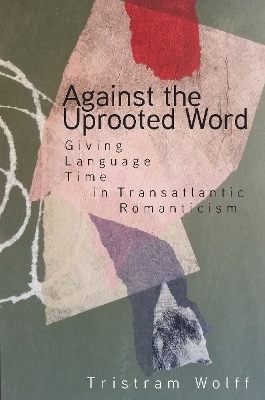
Against the Uprooted Word
Giving Language Time in Transatlantic Romanticism
Seiten
2022
|
New edition
Stanford University Press (Verlag)
978-1-5036-3276-9 (ISBN)
Stanford University Press (Verlag)
978-1-5036-3276-9 (ISBN)
In this revisionist account of romantic-era poetry and language philosophy, Tristram Wolff recovers vibrant ways of thinking language and nature together.
Wolff argues that well-known writers including Phillis Wheatley Peters, William Blake, William Wordsworth, and Henry David Thoreau offer a radical chronopolitics in reaction to the "uprooted word," or the formal analytic used to classify languages in progressive time according to a primitivist timeline of history and a hierarchy of civilization. Before the bad naturalisms of nineteenth-century race science could harden language into place as a metric of social difference, poets and thinkers try to soften, thicken, deepen, and dissolve it. This naturalizing tendency makes language more difficult to uproot from its active formation in the lives of its speakers. And its "gray romanticism" simultaneously gives language different kinds of time—most strikingly, the deep time of geologic form—to forestall the hardening of time into progress.
Reorienting romantic studies to consider colonialism's pervasive effects on theories of language origin, Wolff shows us the ambivalent position of romantics in this history. His reparative reading makes visible language's ability to reimagine social forms.
Wolff argues that well-known writers including Phillis Wheatley Peters, William Blake, William Wordsworth, and Henry David Thoreau offer a radical chronopolitics in reaction to the "uprooted word," or the formal analytic used to classify languages in progressive time according to a primitivist timeline of history and a hierarchy of civilization. Before the bad naturalisms of nineteenth-century race science could harden language into place as a metric of social difference, poets and thinkers try to soften, thicken, deepen, and dissolve it. This naturalizing tendency makes language more difficult to uproot from its active formation in the lives of its speakers. And its "gray romanticism" simultaneously gives language different kinds of time—most strikingly, the deep time of geologic form—to forestall the hardening of time into progress.
Reorienting romantic studies to consider colonialism's pervasive effects on theories of language origin, Wolff shows us the ambivalent position of romantics in this history. His reparative reading makes visible language's ability to reimagine social forms.
Tristram Wolff is Assistant Professor of English and Comparative Literary Studies at Northwestern University.
Introduction: Pulling Roots
1. Giving Language Time
2. The Transported Word: Wheatley's Part
3. Voices of the Ground: Blake's Language in Deep Time
4. Radical Diversions: Wordsworth's Overgrowth
5. The Primitive Today: Thoreau in the Wild
Conclusion: Deracination
| Erscheinungsdatum | 16.09.2022 |
|---|---|
| Zusatzinfo | 3 halftones |
| Verlagsort | Palo Alto |
| Sprache | englisch |
| Maße | 152 x 229 mm |
| Themenwelt | Geisteswissenschaften ► Sprach- / Literaturwissenschaft ► Anglistik / Amerikanistik |
| Geisteswissenschaften ► Sprach- / Literaturwissenschaft ► Literaturwissenschaft | |
| ISBN-10 | 1-5036-3276-8 / 1503632768 |
| ISBN-13 | 978-1-5036-3276-9 / 9781503632769 |
| Zustand | Neuware |
| Informationen gemäß Produktsicherheitsverordnung (GPSR) | |
| Haben Sie eine Frage zum Produkt? |
Mehr entdecken
aus dem Bereich

aus dem Bereich
Poetik eines sozialen Urteils
Buch | Hardcover (2023)
De Gruyter (Verlag)
CHF 83,90


