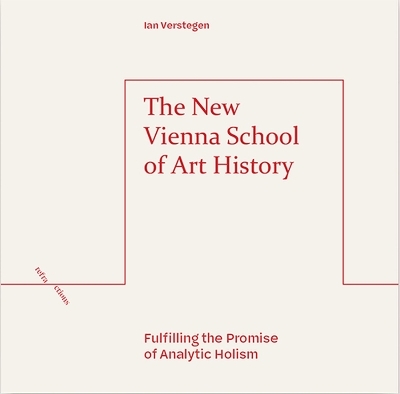
The New Vienna School of Art History
Edinburgh University Press (Verlag)
978-1-4744-8976-8 (ISBN)
This book is an account of the theory and practice of practitioners of the so-called "second" or "younger" Viennese school associated with Hans Sedlmayr and Otto Pächt and their short-lived journal, Kunstwissenschaftliche Forschungen. It demonstrates the strong dependence of these writers on the work of Gestalt psychology which was emerging at the time. Gestalt theory emerges as the master key to interpreting Sedlmayr and Pächt’s ideas about art and history and how it affected their practices.
This fresh interpretive apparatus casts light on the power and originality of Sedlmayr’s and Pächt’s theoretical and empirical writings, revealing a practice-based approach to history that is more attuned to the visuality of art.
Verstegen demonstrates the existence of a genealogy of Vienna formalism coursing throughout most of the twentieth century, encompassing Johannes Wilde and his students at the Courtauld as well as Otto Demus in Byzantine studies. By bringing Gestalt theory to the surface, he dispels misunderstandings about the Vienna School theory and attains a deeper understanding of the promise that a Gestalt analytic holism – a non-intuitionist account of the relational logic of sense – is offered.
Ian Verstegen is Associate Director of Visual Studies at University of Pennsylvania. Trained in Italian Renaissance art history, he also writes on art theory and historiography. He is the author of Arnheim, Gestalt and Art: A Psychological Theory (2004) and Arnheim, Gestalt and Media: An Ontological Theory (2018).
Series Editor’s Preface
Preface by Richard Woodfield
Introduction: ‘In the Beginning was the Eye, not the Word’
The Challenge and the Pay-off
The Players
The Corpus
Gestalt Theory: Basis of the Viennese Method
Doing Vienna School Art History
Part I: Theory and Methodology
1. The Crisis of the Sciences, Art History and the Vienna School
Gestalt Psychology
Holism and Politics
Sedlmayr’s Turn Towards Iconology
2. The Basics of Strukturforschung
Hamburg Iconology
Two Sciences of Art
Mental Set (Einstellung)
Embedded Behaviour
Reflexivity and Progress
3. Struktur, History and Determinism
Genius
Social Gestalten – Alfred Vierkandt
Historical Chains
Historical Compulsion
Part II: Case Studies
4. Hans Sedlmayr’s Borromini
The Book
Sedlmayr’s Method
Gebilde – Borromini’s Works
Architektur – Borromini’s Theory
Dokument – Borromini’s Character
5. Otto Pächt and ‘National’ Constants in Late Gothic Painting
Design Principles: Technical and Aesthetic Space
Design Principles: Surface and Pattern
The Netherlandish Design Principle
The Dutch Design Principle
The French Design Principle
Schapiro’s Critique
Reconstituting Art Historical Constants
Whither Zeitgeist?
6. Johannes Wilde on Michelangelo: The Image in Space
Wilde and his Historical Method
Function, Parts and Wholes
An Erudite Chapel?
Gestalt, Parts and Wholes
7. Otto Demus, Byzantine Art and the Spatial Icon
Towards Byzantine Mosaic Decoration
The Icon in Space
Beyond Byzantine Mosaic Decoration?
Non-Western Art and Gestalt Restructuring
Conclusion: The Vienna School Today
| Erscheinungsdatum | 02.12.2022 |
|---|---|
| Reihe/Serie | Refractions |
| Zusatzinfo | 4 black and white illustrations, 14 colour illustrations, 6 black and white line art |
| Verlagsort | Edinburgh |
| Sprache | englisch |
| Maße | 210 x 210 mm |
| Themenwelt | Kunst / Musik / Theater ► Kunstgeschichte / Kunststile |
| Geisteswissenschaften ► Philosophie ► Philosophie der Neuzeit | |
| ISBN-10 | 1-4744-8976-1 / 1474489761 |
| ISBN-13 | 978-1-4744-8976-8 / 9781474489768 |
| Zustand | Neuware |
| Informationen gemäß Produktsicherheitsverordnung (GPSR) | |
| Haben Sie eine Frage zum Produkt? |
aus dem Bereich