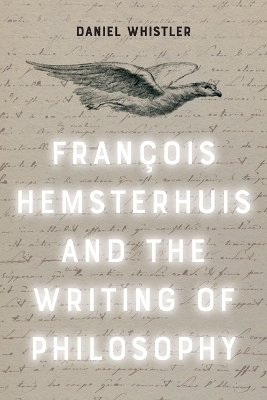
Francois Hemsterhuis and the Writing of Philosophy
Edinburgh University Press (Verlag)
978-1-3995-0982-4 (ISBN)
François Hemsterhuis (1721-1790) was the most significant Dutch philosopher after Spinoza. Daniel Whistler argues that Hemsterhuis’ philosophy matters and that its exclusion from the canon of modern philosophy has been unjust. This is not just because of its reception history - its influence on later German thinkers, such as Goethe, Hamann, Hegel, Herder, Hölderlin, Jean Paul, Kant, Jacobi, Novalis, Schelling, the Schlegels, Schleiermacher, Wieland - but is primarily because Hemsterhuis’ philosophy contains a rich assemblage of ideas and philosophical practices.
Whistler looks specifically at Hemsterhuis’ reflections on philosophical style and the strategies he employs to communicate ideas in his late dialogues. Taking seriously Hemsterhuis’ newly-published complete correspondence as a significant philosophical text, he contends that Hemsterhuis deserves to be placed alongside Shaftesbury, Hamann, Friedrich Schlegel, Kierkegaard and Nietzsche as one of the preeminent philosophical stylists of modernity.
Daniel Whistler is Professor of Philosophy at Royal Holloway, University of London. He is author and editor of numerous volumes on eighteenth and nineteenth-century philosophy, including the three-volume Edinburgh Edition of the Complete Philosophical Works of François Hemsterhuis, The Schelling-Eschenmayer Controversy, 1801: Nature and Identity (EUP, 2020), The Edinburgh Critical History of Nineteenth-Century Christian Theology, The Schelling Reader (Bloomsbury, 2020) and the forthcoming Oxford Handbook of Modern French Philosophy (Oxford University Press, 2022).
Preface: Reasons to Read Hemsterhuis
Part One: Preliminaries
§1 Philosophy and Poetry
§2 Rupture
Part Two: Untimely Demands
Chapter One: Socrates and Newton
§3 ‘Born Greek’
§4 Geometrical Method
§5 A System of Times
Chapter Two: Analysis and Poetry
§6 ‘Poet-Philosophers’ and ‘Humble’ Analysts
§7 Sentimental Certainty
§8 The Platonic Sublime
§9 The Myth of Prometheus
Part Three: A History of Organs
Chapter Three: Organs, Instruments and Insects
§10 Insectification
§11 The Plasticity of Philosophy
§12 Perfectibility
§13 The Analogy to Morality
§14 Organology and Style
Chapter Four: Writing after Materialism
§15 Diderot Reads Hemsterhuis
§16 Hemsterhuis Reads Diderot
§17 Palingenesis and the Subversion of Materialism
§18 Post-Bonnetian Style
Part Four: Time-Images
Chapter Five: The Past and the Present
§19 The Optimum
§20 Epistolary Style
§21 Genealogy
§22 Irony and Anachronism
Chapter Six: The Archaic and the Prophetic
§23 Dreams and Shadows
§24 In the Style of Hope
Conclusion: Four Characters in Search of a Philosophy
| Erscheinungsdatum | 04.10.2022 |
|---|---|
| Verlagsort | Edinburgh |
| Sprache | englisch |
| Maße | 156 x 234 mm |
| Themenwelt | Geisteswissenschaften ► Philosophie ► Geschichte der Philosophie |
| Geisteswissenschaften ► Philosophie ► Philosophie der Neuzeit | |
| ISBN-10 | 1-3995-0982-9 / 1399509829 |
| ISBN-13 | 978-1-3995-0982-4 / 9781399509824 |
| Zustand | Neuware |
| Informationen gemäß Produktsicherheitsverordnung (GPSR) | |
| Haben Sie eine Frage zum Produkt? |
aus dem Bereich