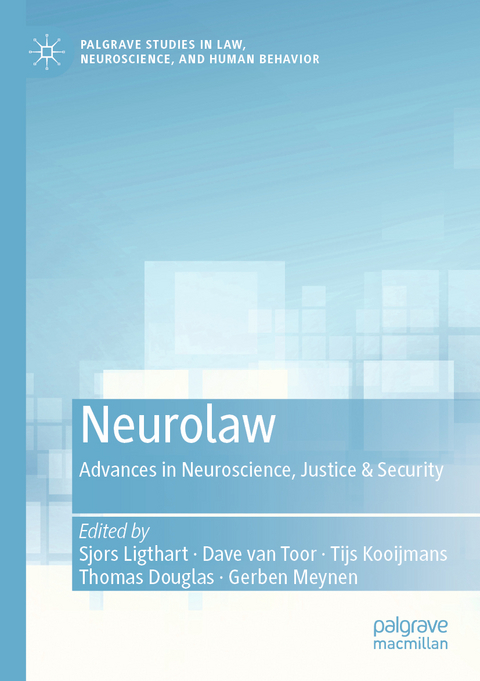
Neurolaw
Springer International Publishing (Verlag)
978-3-030-69279-7 (ISBN)
This edited book provides an in-depth examination of the implications of neuroscience for the criminal justice system. It draws together experts from across law, neuroscience, medicine, psychology, criminology, and ethics, and offers an important contribution to current debates at the intersection of these fields. It examines how neuroscience might contribute to fair and more effective criminal justice systems, and how neuroscientific insights and information can be integrated into criminal law in a way that respects fundamental rights and moral values.
The book's first part approaches these questions from a legal perspective, followed by ethical accounts in part two. Its authors address a wide range of topics and approaches: some more theoretical, like those regarding the foundations of punishment; others are more practical, like those concerning the use of brain scans in the courtroom. Together, they illustrate the thoroughly interdisciplinary nature of the debate, in which science, law and ethics are closely intertwined. It will appeal in particular to students and scholars of law, neuroscience, criminology, socio-legal studies and philosophy.
Chapter 8 is available open access under a Creative Commons Attribution 4.0 International License via link.springer.com.lt;p> Sjors Ligthart is PhD candidate in Criminal Law at Tilburg University, the Netherlands.
1. Possibilities and limitations of neuroscience in the legal process.- 2. euroscience and dangerousness evaluations: The effect of neuroscience evidence on Judges. Findings from a focus group study.- 3. The need for a partial defence of diminished capacity, and the potential role of the cognitive sciences in helping frame that defence.- 4. Coercion and control and excusing murder?.- 5. Reading the sleeping mind: Empirical and legal considerations.- 6. 'Brain-reading' in criminal justice and forensic psychiatry: Towards an integrative legal-ethical approach.- 7. A biopsychosocial approach to idiopathic versus acquired pedophilia: what do we know and how do we proceed legally and ethically?.- 8. Three rationales for a legal right to mental integrity.- 9. Neurointerventions and crime prevention: On ideal and non-ideal considerations.- 10. Neuroscience and the moral enhancement of offenders: The exceptionally good 'brain' as a thought experiment.- 11. Retributivism, consequentialism, and the role of science.
| Erscheinungsdatum | 08.05.2022 |
|---|---|
| Reihe/Serie | Palgrave Studies in Law, Neuroscience, and Human Behavior |
| Zusatzinfo | XVII, 278 p. |
| Verlagsort | Cham |
| Sprache | englisch |
| Maße | 148 x 210 mm |
| Gewicht | 389 g |
| Themenwelt | Geisteswissenschaften ► Psychologie |
| Medizin / Pharmazie ► Medizinische Fachgebiete ► Psychiatrie / Psychotherapie | |
| Schlagworte | brain scans in the courtroom • consequentialist model • diminished capacity • Emerging Technologies • forensic brain-reading • Forensic Psychiatry • human rights and the law • Idiopathic and acquired pedophilia • Legal Right to Mental Integrity • moral culpability • Neuroenhancement • Neurointerventions • Neurolaw • neuroprediction • neuroscientific technologies • philosophy of science • Philosophy of the social sciences • Science and Technology Studies • science, law and ethics • security studies |
| ISBN-10 | 3-030-69279-5 / 3030692795 |
| ISBN-13 | 978-3-030-69279-7 / 9783030692797 |
| Zustand | Neuware |
| Informationen gemäß Produktsicherheitsverordnung (GPSR) | |
| Haben Sie eine Frage zum Produkt? |
aus dem Bereich