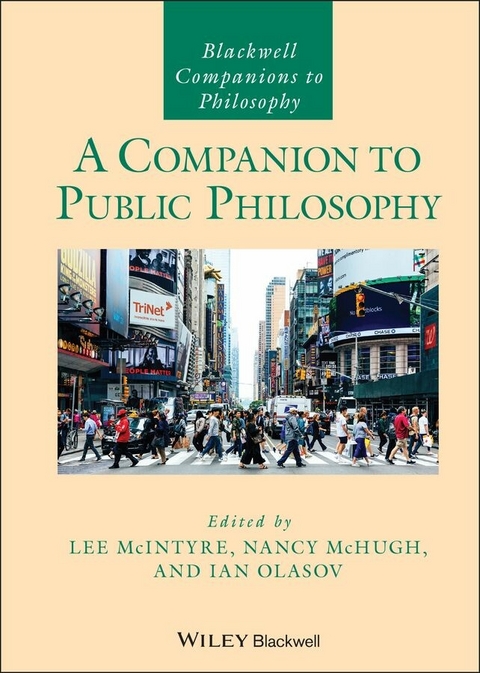
A Companion to Public Philosophy (eBook)
John Wiley & Sons (Verlag)
978-1-119-63524-6 (ISBN)
The first anthology devoted to the theory and practice of all forms of public philosophy
A Companion to Public Philosophy brings together in a single volume the diverse practices, modalities, and perspectives of this rapidly growing field. Forty-two chapters written by established practitioners and newer voices alike consider questions ranging from the definition of public philosophy to the value of public philosophy to both society and philosophy itself. Throughout the book, philosophers offer insights into the different publics they have engaged, the topics they have explored, the methods they have used and the lessons they have learned from these engagements.
The Companion explores important philosophical issues concerning the practice of philosophy in the public sphere, how public philosophy relates to advocacy, philosophical collaborations with political activists, locations where public philosophy can be done, and more. Many essays highlight underserved topics such as effective altruism, fat activism, trans activism, indigenous traditions, and Africana philosophy, while other essays set the stage for rigorous debates about the boundaries of public philosophy and its value as a legitimate way to do philosophy.
- Discusses the range of approaches that professional philosophers can use to engage with non-academic audiences
- Explores the history and impact of public philosophy from the time of Socrates to the modern era
- Highlights the work of public philosophers concerning issues of equity, social justice, environmentalism, and medical ethics
- Covers the modalities used by contemporary public philosophers, including film and television, podcasting, internet memes, and community-engaged teaching
- Includes essays by those who bring philosophy to corporations, government policy, consulting, American prisons, and activist groups across the political spectrum
A Companion to Public Philosophy is essential reading for philosophers from all walks of life who are invested in and curious about the ways that philosophy can impact the public and how the public can impact philosophy. It is also an excellent text for undergraduate and graduate courses on the theory and practice of public philosophy as well as broader courses on philosophy, normative ethics, and comparative and world philosophy.
The first anthology devoted to the theory and practice of all forms of public philosophy, A Companion to Public Philosophy brings together in a single volume the diverse practices, modalities, and perspectives of this rapidly growing field. Forty-two chapters written by established practitioners and newer voices alike consider questions ranging from the definition of public philosophy to the value of public philosophy to both society and philosophy itself. Throughout the book, philosophers offer insights into the different publics they have engaged, the topics they have explored, the methods they have used and the lessons they have learned from these engagements. The Companion explores important philosophical issues concerning the practice of philosophy in the public sphere, how public philosophy relates to advocacy, philosophical collaborations with political activists, locations where public philosophy can be done, and more. Many essays highlight underserved topics such as effective altruism, fat activism, trans activism, indigenous traditions, and Africana philosophy, while other essays set the stage for rigorous debates about the nature, value, and philosophical significance of the practice of public philosophy. A Companion to Public Philosophy is essential reading for philosophers from all walks of life who are invested in and curious about the ways that philosophy can impact the public and how the public can impact philosophy. It is also an excellent text for undergraduate and graduate courses on the theory and practice of public philosophy as well as broader courses on philosophy, normative ethics, and comparative and world philosophy.
Notes on Contributors
Peter Adamson is Professor of Late Ancient and Arabic Philosophy at the LMU in Munich. He is the author of Al‐Kindi and Al‐Razi in the series Great Medieval Thinkers and has edited or co‐edited many books, including The Cambridge Companion to Arabic Philosophy and Interpreting Avicenna: Critical Essays. He is also the host of the History of Philosophy podcast (https://historyofphilosophy.net/), which appears as a series of books with Oxford University Press.
Anita L. Allen is an attorney and the Henry R. Silverman Professor of Law and Professor of Philosophy at the University of Pennsylvania. A past president of the American Philosophical Association, Allen is a member of the National Academy of Medicine and the American Academy of Arts and Sciences. Allen has served on the National Commission for the Study of Bioethical Issues and the boards of the National Constitution Center and the Electronic Privacy Information Center. A globally recognized expert on privacy, data protection, and values, Allen’s books include Unpopular Privacy, The New Ethics, and Why Privacy Isn’t Everything. Allen has been a columnist and featured on NPR and in newspapers, magazines, and blogs, including The New York Times, The Stone, and What It’s Like to Be a Philosopher.
John Altmann is an independent scholar in philosophy who has published most extensively with the Popular Culture and Philosophy book series produced by OpenCourt Publishing, which seeks to disseminate philosophical ideas and facilitate a greater interest in philosophy among the general public. He has published alongside Bryan Van Norden, in the New York Times editorial The Stone, an essay titled “Was This Ancient Taoist the First Philosopher of Disability?” which pertained to Zhuangzi and the portrayals of disability in Eastern thought. He is also a member of and has published for the European Network of Japanese Philosophy as well as the Borderless Philosophy Journal.
Brian Berkey is Assistant Professor in the Department of Legal Studies and Business Ethics in the Wharton School at the University of Pennsylvania and holds a secondary appointment in the Department of Philosophy at Penn. During the 2018–19 academic year, he was a fellow‐in‐residence at the Edmond J. Safra Center for Ethics at Harvard University. He works in moral and political philosophy, including environmental ethics and business ethics. Topics that he’s published on include moral demandingness, individual obligations of justice, climate ethics and justice, exploitation, ethical consumerism, justice for non‐human animals, and effective altruism.
Reid Blackman is the founder and CEO of Virtue, where he works with senior leaders to integrate ethical risk mitigation into the development and deployment of digital products. He is the author of Ethical Machines, his work has been profiled in The Wall Street Journal, and he has contributed pieces to The Harvard Business Review, TechCrunch, and VentureBeat. He regularly speaks at businesses, universities, and nonprofits, including at The World Economic Forum, SAP, Cannes Lions, Forbes, NYU Stern School of Business, Columbia University, and AIG. Prior to founding Virtue, Reid was a professor of philosophy at Colgate University and a Fellow at the Parr Center for Ethics at the University of North Carolina, Chapel Hill. He received his B.A. from Cornell University, his M.A. from Northwestern University, and his PhD from The University of Texas, Austin.
Michael Brent is a philosopher whose work examines the ethical impacts that machine‐learning technologies and artificial intelligence systems have on individuals and societies. He has worked in the Office of Responsible AI at Microsoft, as Data Ethics Officer at Enigma Technologies, as full‐time faculty in the Department of Philosophy at the University of Denver, and as co‐founding faculty at the Brooklyn Institute for Social Research. His research has been published and cited in academic journals and discussed in popular publications like Protocol, WirtschaftsWoche, and New York Magazine. Michael earned his PhD in philosophy from Columbia University and his B.A. in philosophy from the University of Toronto. He hails originally from the Toronto area, home of such luminaries as Margaret Atwood, Catherine O’Hara, Ian Hacking, and Drake.
Adam Briggle is Associate Professor and Director of Graduate Studies in the Department of Philosophy and Religion at the University of North Texas. He also serves on the Sustainability Framework Advisory Committee for the City of Denton, Texas, which is developing a local climate action plan. He has a PhD in environmental studies with a focus on science and technology policy. He is the author of Thinking through Climate Change: A Philosophy of Energy in the Anthropocene and A Field Philosopher’s Guide to Fracking.
Evelyn Brister is Professor of Philosophy at Rochester Institute of Technology. In addition to a PhD in philosophy, she also has a master’s in environmental science. She has been president of the Public Philosophy Network and has served on the APA Committee on Public Philosophy. She is the co‐editor (with Robert Frodeman) of A Guide to Field Philosophy, a collection of essays by philosophers about collaborative projects outside academia. She also writes about environmental decision‐making and works with nonprofits and government on conservation issues.
Michael D. Burroughs is Director of the Kegley Institute of Ethics and Associate Professor of Philosophy at California State University, Bakersfield. He also serves as vice president of the Public Philosophy Network and as founding editor of Precollege Philosophy and Public Practice. As a public philosopher, Michael works to support and introduce ethics and philosophy in K–12 schools, prisons, community organizations, and many other locations. He is also a widely published researcher on topics in public philosophy, ethics, education, and childhood, including a co‐authored a book, Philosophy in Education: Questioning and Dialogue in Schools. More information on his work and current projects can be found on his professional website: www.michaeldeanburroughs.com.
Anthony L. Cashio is Associate Professor of Philosophy at The University of Virginia’s College at Wise. His work has focused on issues of social justice, the role of value‐systems in problem solving, the relationship between history and value structure, the nature of nonviolence, and the role of the environment as a social institution. He is also the co‐host of the award winning radio show and podcast Philosophy Bakes Bread.
Ruth Chang is the Professor Jurisprudence at Oxford University and a member of the American Academy of Arts and Sciences. She has an A.B. from Dartmouth College, a J.D. from Harvard Law School, and a D.Phil. In philosophy from the University of Oxford. She has held fellowship positions at Harvard, Princeton, and Stanford and has won various academic awards. Her expertise concerns philosophical questions relating to the nature of value, value conflict, decision making, rationality, the exercise of agency and choice. Her TED talk on decision making has over 8 million views and her work has been the subject of interviews by various media outlets around the world including, radio, television, magazines and international newspapers such as NPR, The New York Times, National Geographic and The Chicago Tribune. She has lectured or consulted on decision‐making for a wide range of institutions and companies including Google, the CIA, the World Bank, the U.S. Navy, video gaming and Big Pharma.
Andrea Christelle practices philosophy on the land in Sedona, Arizona.
Shanti Chu is a full‐time Instructor of Philosophy at the College of Lake County. Her courses and research focus on feminist theories of embodiment, postcolonial theory, and plant‐based eating. Her work has been featured in Through a Vegan Studies Lens, Philosophy for Girls, Eater Chicago, and ArtNews. She is focused on making philosophy palatable through her two blogs: one on ethical, affordable, and vegetarian eating in Chicago (chiveg.com); and her applied philosophy blog, where she shares students' blog posts in addition to her own writing. Shanti runs Coffee/Tea with a Splash of Philosophy tours in Chicago as a means of making philosophy more palatable while sampling coffee and tea.
Sharyn Clough is Professor of Philosophy at Oregon State University. Her research examines the complex ways in which science and politics are interwoven. Her work as a public philosopher focuses on the importance of peace literacy for deliberation about controversial science policy, and deliberations across conflicts more generally. Clough directs Phronesis Lab, where she and her students and community partners research the effectiveness of peace literacy across the curriculum. She also serves as curriculum coordinator for the Peace Literacy Institute. In addition to a monograph, Beyond Epistemology, and an edited collection, Siblings Under the Skin: Feminism, Social Justice and Analytic Philosophy, she has published over 30 essays on science, politics, and, most recently, the epistemic importance of peace skills such as empathy and intellectual humility.
Lacey J....
| Erscheint lt. Verlag | 30.3.2022 |
|---|---|
| Reihe/Serie | Blackwell Companions to Philosophy |
| Blackwell Companions to Philosophy | Blackwell Companions to Philosophy |
| Sprache | englisch |
| Themenwelt | Geisteswissenschaften ► Philosophie ► Allgemeines / Lexika |
| Schlagworte | Angewandte Philosophie • Applied Philosophy • Cultural Studies • Digital Culture & the Information Age • Digitale Kultur im Informationszeitalter • Kulturwissenschaften • Philosophie • Philosophy • Philosophy Special Topics • public philosophy • public philosophy anthology • public philosophy companion • public philosophy debates • public philosophy definition • public philosophy essays • public philosophy introduction • public philosophy issues • public philosophy practice • Spezialthemen Philosophie |
| ISBN-10 | 1-119-63524-1 / 1119635241 |
| ISBN-13 | 978-1-119-63524-6 / 9781119635246 |
| Informationen gemäß Produktsicherheitsverordnung (GPSR) | |
| Haben Sie eine Frage zum Produkt? |
 EPUB (Adobe DRM)
Kopierschutz: Adobe-DRM
Adobe-DRM ist ein Kopierschutz, der das eBook vor Mißbrauch schützen soll. Dabei wird das eBook bereits beim Download auf Ihre persönliche Adobe-ID autorisiert. Lesen können Sie das eBook dann nur auf den Geräten, welche ebenfalls auf Ihre Adobe-ID registriert sind.
Details zum Adobe-DRM
Dateiformat: EPUB (Electronic Publication)
EPUB ist ein offener Standard für eBooks und eignet sich besonders zur Darstellung von Belletristik und Sachbüchern. Der Fließtext wird dynamisch an die Display- und Schriftgröße angepasst. Auch für mobile Lesegeräte ist EPUB daher gut geeignet.
Systemvoraussetzungen:
PC/Mac: Mit einem PC oder Mac können Sie dieses eBook lesen. Sie benötigen eine
eReader: Dieses eBook kann mit (fast) allen eBook-Readern gelesen werden. Mit dem amazon-Kindle ist es aber nicht kompatibel.
Smartphone/Tablet: Egal ob Apple oder Android, dieses eBook können Sie lesen. Sie benötigen eine
Geräteliste und zusätzliche Hinweise
Buying eBooks from abroad
For tax law reasons we can sell eBooks just within Germany and Switzerland. Regrettably we cannot fulfill eBook-orders from other countries.
aus dem Bereich