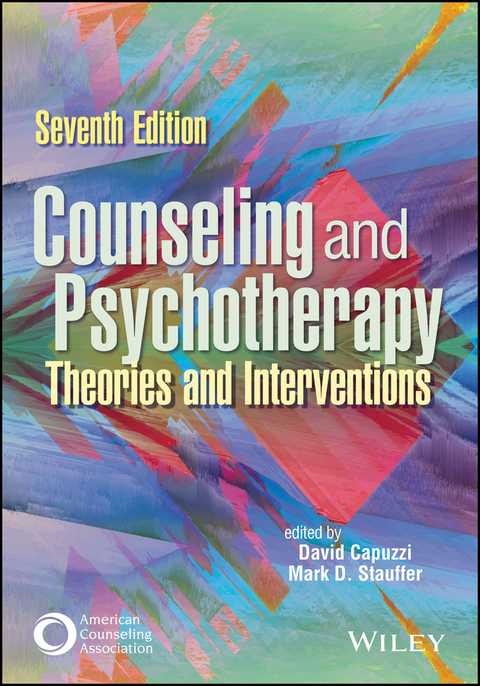
Counseling and Psychotherapy (eBook)
John Wiley & Sons (Verlag)
978-1-119-90410-6 (ISBN)
David Capuzzi, PhD, is a counselor educator and professor emeritus at Portland State University Mark D. Stauffer, PhD, is a core faculty member in the clinical mental heealth counseling program at Walden University.
"Innovative, present, and future oriented, responsive to cultural diversity and social justice, and thoughtful! This text reconceptualizes long-standing theories to demostrate their relevance to contemporary counseling. Professionals and students alike will find the case studies provoke complex thinking and analysis. Counseling and Psychotherapy is refreshing and invites us to engage in culturally responsive counsling practices."
Patricia Arredondo, EdD, President, Arredondo Advisory Group
"The 7th edition of this text is unique in that it contains chapters on all major counseling theories written by counseling scholars and practitioners who specialize in the theoretical perspectives they summarize and explore. Drs. Capuzzi, Stauffer, and the contributing authors provide numerous interventions appropriate for each theory to help students and practitioners understand how to apply the theories they are learning about in their work with clients."
Theodore P. Remley Jr., JD, PhD, University of Holy Cross
"This new edition offers an expanded approach to applying traditional and contemporary counseling theories to a broader spectrum of issues and provides students and clinicians with guidance for informed and intentional practice. Additionally, the focus on multicultural identities, intersectionality, and social justice brings each theory into the present and enhances its relevance for use with clients."
Heather J. Ambrose, PhD, Walden University
Preface
This seventh edition of Counseling and Psychotherapy: Theories and Interventions presents a representative variety of theories and conceptual frameworks that are used across helping professions to organize client case conceptualization and guide the path for therapeutic transformation. Although there are hundreds of discrete therapies, they are offshoots of greater branches of the therapeutic tradition tree. This book has been created by a diverse group of experts, who share their theoretical knowledge of different branches of theory as well as the intersectionality of their lived experience and culture. The book covers not only traditional counseling and psychotherapeutic theories but also theories that have emerged in response to multicultural and social justice work with clients. The greater a counselor’s or therapist’s awareness of the strengths and possibilities inherent in numerous theoretical frames of reference, the greater the potential for understanding the uniqueness of a particular client and for developing the most effective treatment plan.
This edition presents dynamic and fresh perspectives and includes critical material not addressed in other counseling and psychotherapy textbooks, such as a chapter that focuses on multicultural and social justice counseling through relational-cultural theory, a chapter that addresses psychodynamic models used by today’s practitioners rather than only classic psychoanalytic theory, a chapter that examines third-wave cognitive behavioral theories with mindfulness-based interventions, a chapter on feminist theory, a chapter on integrating theories via emotion-focused therapy, and a chapter on using creative approaches in the context of counseling and psychotherapy. The book’s unique approach and expanded perspectives enhance its contemporary relevance and should increase reader interest in the material.
This book is unique in both format and content. All the contributing authors are experts who provide state-of-the-art information about theories of counseling and psychotherapy (see the “Meet the Contributors” section for their backgrounds). In addition, each chapter discusses applications of the theory as it relates to one particular case study of a hypothetical client named Clarita, who is introduced here in this Preface.
FEATURES OF THE BOOK
This book is designed for students who are beginning their study of individual counseling and psychotherapy. It presents a comprehensive overview of relational-cultural, psychodynamic, Jungian, Adlerian, existential, person-centered, Gestalt, cognitive behavioral, third-wave cognitive behavioral, rational emotive, reality therapy/choice, family, feminist, constructivist, and emotion-focused theories, along with a discussion of how to use creative approaches in the context of those theories.
We know that one book cannot adequately address all the factors connected with a given theory; entire texts have been written discussing each of the theories in this book. We have, however, attempted to provide readers with a consistent approach to analyzing and studying each theory and have included examples of how to apply the theory to the case of Clarita.
The format for the book is designed so that readers can compare how adherence to a theory influences the counseling and treatment plan. Each chapter contains theoretical and applied content. The theories presented are bookended by an opening chapter on the helping relationship and an ending chapter on using creative approaches in the context of counseling and psychotherapy.
THE FORMAT FOLLOWED FOR CHAPTERS 2–17
As noted earlier, we wanted the reader to be able to make comparisons between and among the theories by having all the contributors follow the same outline and develop a treatment plan, focused on goals, for one hypothetical client named Clarita. The authors of Chapters 2 through 17 followed the outline below as they discuss each theory in relation to the case study of Clarita.
- Background
This section includes historical information related to the development of the theoretical system and the individual(s) responsible for its development.
- Human Nature: A Developmental Perspective (primary)
This section discusses how the theory defines an individual’s developmental process over time.
- Major Constructs
This section includes the structural components of the theory.
- Applications
This section includes the following secondary areas:
- Overview: An introduction to the five areas that follow.
- Goals of counseling and psychotherapy: A description of desired client outcomes based on the tenets of the theory.
- The process of change: The factors within the theory that address what brings about change in the individual.
- Techniques and interventions: Techniques for implementing the process of change. The chapter authors name and describe five to six specific traditional and current techniques and interventions.
- Brief intervention strategies: Techniques and interventions for implementing the process of change using a brief approach.
- Clients with serious mental health issues: A discussion of how the theory applies to counseling clients with mental disorders. The chapter authors delineate and discuss what types of mental disorders can be successfully “treated” using this theoretical approach.
- Supporting Research and Limitations
This section includes the following secondary areas:
- Overview: An introduction to the two areas that follow.
- Supporting research: Current research studies that form the bases for continued use of this theoretical system.
- Limitations: A description of the factors that limit the use of this theoretical system with clients and types of presenting problems.
- The Case of Clarita: Approach
This section includes a case study writeup consistent with the theory and emphasizes the goals and interventions/techniques that will be used when counseling Clarita. The goals and interventions/techniques should be directly connected to the theory being used for the case study.
THE CASE OF CLARITA
Client Demographics
The client, Clarita, is a 32-year-old Latinx woman. She is the oldest of five children and was raised in a predominantly Latinx neighborhood in Puerto Rico. She attended Catholic schools, and her religion is a very significant part of her life. She is a single parent raising two children, a 6-year-old son and an 8-year-old daughter. She is bilingual, graduated from college with honors, has a degree in education, and for the past 4 years has taught middle school math and science. She and her husband of 5 years divorced 3 years ago. Recently, Clarita was forced to move from Puerto Rico to Florida as a result of a Category 5 hurricane, which devastated the island. Although she jokes about being a “climate refugee,” she believes it is true and is not sure whether she will be able to move back home anytime soon. She receives no financial assistance from her ex-husband, and the only knowledge the children have of their father is through communication with their paternal grandparents.
Presenting Problems
Clarita arrived 15 minutes early for her initial appointment. She related easily and expressed herself well, but her body appeared tense and her voice was strained. She expressed appreciation for getting an early appointment because she felt that she could not have waited much longer. She had been referred to the mental health agency by her physician because of insomnia and frequent unexplained crying spells. During the intake process, Clarita stated that she is depressed, unable to sleep because of reoccurring nightmares, not eating, losing control of her two children, and having difficulty missing and dealing with distant family members, who are now scattered as a result of the hurricane destruction. She said that she has thought about suicide but stops because of the guilt she feels about abandoning her children and the tenets of her religion. She has difficulty concentrating, and this is affecting her teaching. Clarita has been absent frequently from work, and her principal is recommending that she takes a leave of absence, which is causing her great stress because she needs the income to support her children. Luckily, she found a new teaching position to apply for, but if she leaves her teaching position, she would be forced to uproot to yet another place. Clarita is unable to maintain meaningful relationships and, when asked to describe herself, she used terms such as insecure, frightened, distrustful of self and others, lonely, and lacking hope.
Family Background
From information gathered during the intake process, Clarita described her family of origin as very close knit, held together by both cultural and religious values. She was raised to be proud of her Latinx heritage, her language, and her culture’s traditions. She has three younger brothers and one younger sister, all of whom looked to her for advice and support. Education was emphasized in her home, and her academic success was the center of much family pride. She was touted as a model to her siblings and was expected to perform in an exemplary way not only in school but also in other aspects of her life.
Clarita’s parents were self-educated and operated a small business near their home. Because the business demanded a large time commitment from both parents, Clarita often found...
| Erscheint lt. Verlag | 29.3.2022 |
|---|---|
| Sprache | englisch |
| Themenwelt | Geisteswissenschaften ► Psychologie |
| Medizin / Pharmazie ► Gesundheitsfachberufe | |
| Medizin / Pharmazie ► Medizinische Fachgebiete ► Psychiatrie / Psychotherapie | |
| Schlagworte | Psychologie • Psychology • Psychotherapie u. Beratung • Psychotherapy & Counseling |
| ISBN-10 | 1-119-90410-2 / 1119904102 |
| ISBN-13 | 978-1-119-90410-6 / 9781119904106 |
| Informationen gemäß Produktsicherheitsverordnung (GPSR) | |
| Haben Sie eine Frage zum Produkt? |
 EPUB (Ohne DRM)
Digital Rights Management: ohne DRM
Dieses eBook enthält kein DRM oder Kopierschutz. Eine Weitergabe an Dritte ist jedoch rechtlich nicht zulässig, weil Sie beim Kauf nur die Rechte an der persönlichen Nutzung erwerben.
Dateiformat: EPUB (Electronic Publication)
EPUB ist ein offener Standard für eBooks und eignet sich besonders zur Darstellung von Belletristik und Sachbüchern. Der Fließtext wird dynamisch an die Display- und Schriftgröße angepasst. Auch für mobile Lesegeräte ist EPUB daher gut geeignet.
Systemvoraussetzungen:
PC/Mac: Mit einem PC oder Mac können Sie dieses eBook lesen. Sie benötigen dafür die kostenlose Software Adobe Digital Editions.
eReader: Dieses eBook kann mit (fast) allen eBook-Readern gelesen werden. Mit dem amazon-Kindle ist es aber nicht kompatibel.
Smartphone/Tablet: Egal ob Apple oder Android, dieses eBook können Sie lesen. Sie benötigen dafür eine kostenlose App.
Geräteliste und zusätzliche Hinweise
Buying eBooks from abroad
For tax law reasons we can sell eBooks just within Germany and Switzerland. Regrettably we cannot fulfill eBook-orders from other countries.
aus dem Bereich