


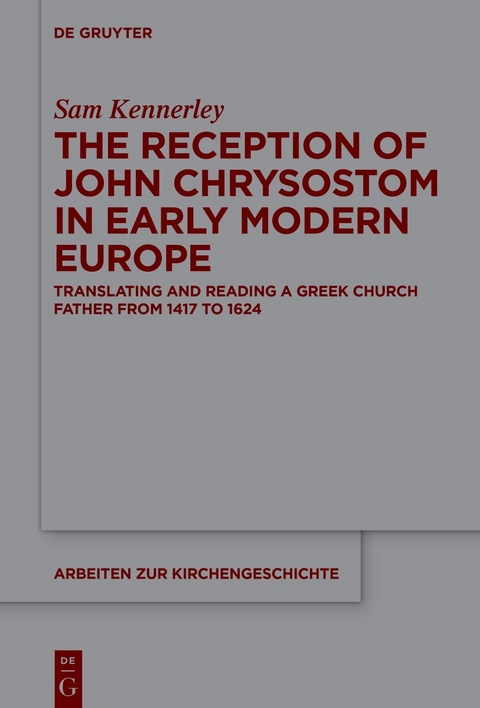
The Reception of John Chrysostom in Early Modern Europe
Translating and Reading a Greek Church Father from 1417 to 1624
Seiten
2022
De Gruyter (Verlag)
978-3-11-070884-4 (ISBN)
De Gruyter (Verlag)
978-3-11-070884-4 (ISBN)
Die seit 1925 erscheinenden Arbeiten zur Kirchengeschichte bilden eine der traditionsreichsten historischen Buchreihen im deutschsprachigen Raum. Sie enthalten Forschungen zur Kirchen- und Dogmengeschichte des Christentums aller Epochen, veröffentlichen aber auch Arbeiten aus verwandten Disziplinen wie beispielsweise der Archäologie, Kunstgeschichte oder Literaturwissenschaft. Kennzeichnend für die Reihe ist der durchgängige Anspruch, historisch-methodische Präzision mit systematischen Kontextualisierungen des jeweiligen Gegenstandes zu verbinden. In jüngerer Zeit erscheinen verstärkt Arbeiten zu Themen einer Kultur- und Ideengeschichte des Christentums in einem methodisch offenen christentumsgeschichtlichen Horizont.
The Reception of John Chrysostom in Early Modern Europe explores when, how, why, and by whom one of the most influential Fathers of the Greek Church was translated and read during a particularly significant period in the reception of his works. This was the period between the first Neo-Latin translation of Chrysostom in 1417 and the final volume of Fronton du Duc’s Greek-Latin edition in 1624, years in which readers and translators from Renaissance Italy, the Byzantine Empire, and the Basel, Paris, and Rome of a newly-confessionalised Europe found in Chrysostom everything from a guide to Latin oratory, to a model interpreter of Paul. By drawing on evidence that ranges from Greek manuscripts to conciliar acts, this book contextualises the hundreds of translations and editions of Chrysostom that were produced in Europe between 1417 and 1624, while demonstrating the lasting impact of these works on scholarship about this Church Father today.
The Reception of John Chrysostom in Early Modern Europe explores when, how, why, and by whom one of the most influential Fathers of the Greek Church was translated and read during a particularly significant period in the reception of his works. This was the period between the first Neo-Latin translation of Chrysostom in 1417 and the final volume of Fronton du Duc’s Greek-Latin edition in 1624, years in which readers and translators from Renaissance Italy, the Byzantine Empire, and the Basel, Paris, and Rome of a newly-confessionalised Europe found in Chrysostom everything from a guide to Latin oratory, to a model interpreter of Paul. By drawing on evidence that ranges from Greek manuscripts to conciliar acts, this book contextualises the hundreds of translations and editions of Chrysostom that were produced in Europe between 1417 and 1624, while demonstrating the lasting impact of these works on scholarship about this Church Father today.
lt;strong>Sam Kennerley, Peterhouse, Cambridge, Großbritannien.
| Erscheinungsdatum | 10.05.2022 |
|---|---|
| Reihe/Serie | Arbeiten zur Kirchengeschichte ; 157 |
| Zusatzinfo | 2 b/w and 6 col. ill. |
| Verlagsort | Berlin/Boston |
| Sprache | englisch |
| Maße | 155 x 230 mm |
| Gewicht | 613 g |
| Themenwelt | Geisteswissenschaften ► Religion / Theologie ► Christentum |
| Schlagworte | chrysostom • Erasmus • Erasmus von Rotterdam • Johannes Chysostomos • Reception • Renaissance • Rezeption |
| ISBN-10 | 3-11-070884-1 / 3110708841 |
| ISBN-13 | 978-3-11-070884-4 / 9783110708844 |
| Zustand | Neuware |
| Informationen gemäß Produktsicherheitsverordnung (GPSR) | |
| Haben Sie eine Frage zum Produkt? |
Mehr entdecken
aus dem Bereich



aus dem Bereich


