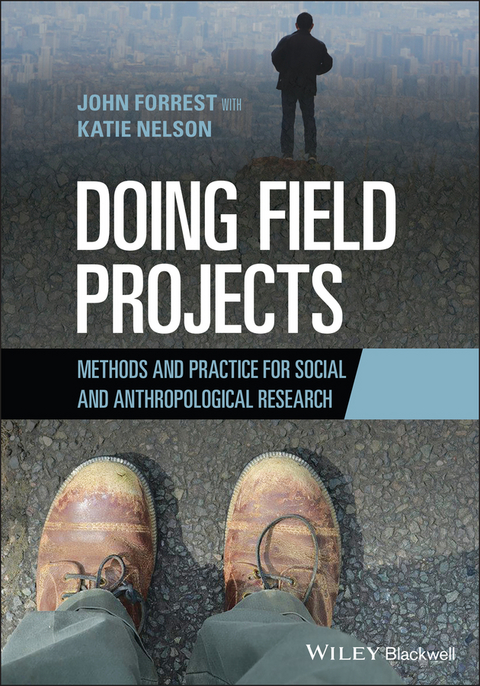
Doing Field Projects (eBook)
John Wiley & Sons (Verlag)
978-1-119-73462-8 (ISBN)
A must-read guide to conducting qualitative field research in the social sciences
Doing Field Projects: Methods and Practice for Social and Anthropological Research delivers a thorough and insightful introduction to qualitative field methods in the social sciences. Ideal for undergraduate students just starting out in fields like anthropology, sociology, and related subjects, the book offers readers twenty instructive projects. Each project is well-suited as a standalone exercise, or several may be combined as a series of field work assignments.
From interview techniques to participant observation, kinship analysis, spatial mapping, photo and video documentation, and auto-ethnography, Doing Field Projects covers each critical area of qualitative fieldwork students are likely to encounter. Every project also contains discussions of how to execute the research, avoid common problems and mistakes, and present the uncovered data in several different formats.
This important resource also offers students:
- A thorough introduction to fieldwork, including the history of fieldwork methods, the shift from colonial to post-colonial anthropology, and discussion of fieldwork vs. ethnography
- Comprehensive explorations of getting started with fieldwork, including necessary equipment, research design, data presentation, and journal keeping
- Practical discussions of the ethics of fieldwork, including the 'Do No Harm' principle, institutional approval, openness, and anonymity
- In-depth examinations of autoethnography, proxemics, mapping, recorded interviews, participant observation, and engaged anthropology
- The opportunity to conduct a complete fieldwork course using digital and online resources only
- Supporting learning material for each chapter, including a brief outline of Learning Goals and a paragraph summarizing the contents
Doing Field Projects: Methods and Practice for Social and Anthropological Research is the perfect guide for undergraduate students taking courses and programs in which qualitative field methods are central to the field, like anthropology and sociology.
JOHN FORREST is Professor Emeritus of Anthropology at Purchase College, State University of New York, USA. His anthropological research interests include dance, music, aesthetics, ritual, and Biblical studies. He has conducted extensive fieldwork projects in the United States (North Carolina and New Mexico), Argentina, and England. He currently resides in Cambodia, where he teaches and conducts field research.
KATIE NELSON is Instructor of Anthropology and Sociology at Inver Hills Community College, USA. Her research interests include teaching and learning in anthropology, and migration, identity, belonging, and citizenship in human history and in the contemporary United States, Mexico, and Morocco.
JOHN FORREST is Professor Emeritus of Anthropology at Purchase College, State University of New York, USA. His anthropological research interests include dance, music, aesthetics, ritual, and Biblical studies. He has conducted extensive fieldwork projects in the United States (North Carolina and New Mexico), Argentina, and England. He currently resides in Cambodia, where he teaches and conducts field research. KATIE NELSON is Instructor of Anthropology and Sociology at Inver Hills Community College, USA. Her research interests include teaching and learning in anthropology, and migration, identity, belonging, and citizenship in human history and in the contemporary United States, Mexico, and Morocco.
Preface (Including a Word to Instructors) vi
Foreword (Including a Word to Student Readers) ix
1 Introduction 1
2 Getting Started 22
3 Ethics of Fieldwork 27
4 Research Design 33
5 Self-Study 39
6 Proxemics 52
7 Mapping 59
8 Recorded Interviews 77
9 Participant Observation 94
10 Engaged Anthropology 100
11 Process Documentation 111
12 Visual Anthropology 117
13 Sensory Observation 129
14 Performance 138
15 Life Histories (and Oral History) 147
16 Charting Kinship 158
17 Digital Ethnography (1) Social Media 167
18 Digital Ethnography (2) Online Gaming 182
19 Digital Ethnography (3) Human-Computer Interaction 186
20 Digital Ethnography (4) Online Meetings/Classes 192
21 Winding Down and Gearing Up 197
References Cited 205
Index 212
Preface (Including a Word to Instructors)
Most of the projects in this book were originally designed for undergraduate majors in anthropology, and they have been thoroughly tested over more than 20 years of teaching them. However, they may also be useful to anyone with an interest in qualitative methods, including postgraduate students in anthropology as well as researchers in related fields. Prior to the 1980s, there was precious little interest in teaching fieldwork methods to undergraduates, especially in the United States. There were some individual instructors who took it upon themselves to teach and supervise fieldwork projects, but no overall institutional expectation that undergraduates need be trained as fieldworkers, and, in fact, there was a significant contingent within the discipline that was actively hostile to the idea of undergraduates conducting fieldwork. There was not even a uniform interest in teaching field methods to doctoral candidates in those days. Eventually seminars and field schools, such as the one created by H. Russell Bernard, set about ensuring that professional fieldworkers had a solid methodological grounding before embarking on sustained fieldwork. Such seminars produced invaluable written resources for the novice fieldworker, and they continue to proliferate. These resources are, however, geared to a level of professionalism that is unnecessary for many undergraduate projects.
Undergraduate student needs are highly varied, but, no matter what their personal and professional goals in life are, they can all benefit from having some grounding in anthropological methods. While it is typical for a biology or chemistry course to have a lab component, it is less common for cultural anthropology courses to have a methods course. This is true for a number of reasons. First, anthropological fieldwork does not happen in a self-contained laboratory. Therefore, it is not easy to supervise. Second, fieldwork can take considerable amounts of time (with much of it unproductive). Third, there are numerous ethical concerns about dealing with human subjects that have to be monitored carefully. Fourth, setting up the kind of fieldwork projects that undergraduates can productively engage in is a challenge. The last issue is the reason for this book. Undergraduate fieldwork is similar to graduate work in some ways, but not identical by any means, and should really be handled differently. Hence the projects in this volume.
This book is the product both of my own intensive professional experience as a fieldworker over a period of 40 years in the swamps of the Tidewater of North Carolina, the pueblos and Hispano villages of New Mexico, Buenos Aires and surrounds (my birthplace), and urban Cambodia (where I currently live), as well as smaller projects in England, Ukraine, Mari-El in the Russian Federation, and northern Italy, and of my experience designing and teaching a fieldwork methods course for undergraduates, which ran annually for over 20 years. I also introduced fieldwork methods into my Introduction to Anthropology course, not as a full-blown lab section akin to bio or chem lab, but as a paper requirement in the second half of the semester, where students could pick one assignment to pursue. Many examples in this book can be used in this way.
This book is designed to be a self-contained text for undergraduate instruction, but, if you are an instructor considering using these projects for your classes, either as individual exercises, or strung together as a full-blown course, you should realize that, despite the personal details and the specificity, there is a great deal of flexibility built into each exercise, and you should feel free to add and modify as you see fit. In certain spheres, such as the development of research design, it is expected that you will have your own needs and ideas, and you should treat the suggestions here as a rough template only. Most of the projects can be used on their own, although some of the later ones build on skills acquired in earlier ones, and several require the kind of planning that is, perhaps, impractical for a stand-alone exercise in a course for which a field project is only an adjunct.
Although this text is designed for use in undergraduate courses in anthropology, it is not limited to that audience. Postgraduate students may also use it to gain insight into qualitative fieldwork as a method, particularly at the beginning of their studies. Trainees in a variety of disciplines from sociology and social psychology to market research and hotel management can also use relevant projects to apply qualitative methods of investigation to their own specialties. These days, there is a common popular belief that if social data under investigation are quantified, the resultant “study” is somehow more rigorous (that is, more “scientific”) than a qualitative one. This perception may sometimes be reasonable, but it does not have to be. Qualitative investigations can be designed in a thoroughly rigorous manner, and may yield results that are more nuanced and insightful (and, therefore, more “useful”), than a strictly quantitative one. In that regard, the methods outlined in this text can be used by anyone interested in facets of social research, so that the projects can be tailored for use by people in human resources, public relations, political campaigns, workplace efficiency, and the like, where a deeper understanding of various components of the social landscape can be beneficial.
My goals as a teacher of anthropology have been student-centered from the outset. To this end, I have always valued an approach to teaching anthropological theory that addresses the crucial question of where our raw information comes from, what it looks like, and how it is used to generate theory. When undergraduates engage in fieldwork for themselves, they gain an understanding of both the strengths and weaknesses of the anthropological method. They also start to gain practical insight into explanatory modeling and theory building, which helps in their critical reading of classic texts in anthropology.
The projects in this text can be used individually as assignments in a variety of anthropology courses (including Intro to General or Social/Cultural Anthropology), or chosen units can be pieced together to form an entire qualitative methods course – for undergraduate majors in anthropology, or in allied fields where such fieldwork is applicable. There are too many projects described here for a methods class covering a 12- to 15-week term, or even a whole academic year, so a certain amount of selection is necessary. Furthermore, a number of the projects deal with topics that are not pertinent to the needs and interests of all instructors and can be omitted. My purpose is to open up as many choices as possible and leave it up to individual instructors to determine how to make use of the projects independently or woven together.
Both because the world is now dominated by digital technology and because the COVID-19 pandemic beginning in 2019 forced many universities to switch to online resources for teaching, there are a number of ways to use this book in a socially distanced manner. There are four chapters devoted exclusively to digital ethnography (17–20) and many projects, such as those that involve interviews, contain suggestions for carrying them out online rather than in person. There is enough such material presented here that the book can be used exclusively as an online tool if the need arises.
Chapters both before and after the projects themselves analyze the history of fieldwork in anthropology in Europe and North America, pointing out the pros and cons of the method, as well as underlining certain pitfalls and biases that can easily (and unwittingly) creep in. These chapters also investigate the complex process of writing field notes themselves, as well as problematizing the numerous ways – good and bad – that field notes have been, and can be, converted into finished ethnographic writing. My intention in these chapters, as well as in the projects themselves, is to give instructors scope for further discussion with their students concerning the importance of the fieldwork method in anthropology, along with consideration of the numerous debates that continue to surface regarding its reliability and utility.
Throughout the projects presented here there is an awareness that the fieldworker is the instrument of field study, in the same way that a telescope is the instrument of astronomy or the microscope of microbiology, and I have made an effort to incorporate self-analysis and self-reflection on the part of the novice fieldworker in the process of data collection whenever possible. Such self-awareness is also reflected periodically in some of my project descriptions by way of highlighting how critical it is for the accurate interpretation of the results of fieldwork to understand the personal biases and interests of the person gathering the data. To that end, I often include my own field notes and project data as examples, as well as those of my former students, as I do when I am teaching. I hope these examples can be used as springboards for instructors to incorporate their own experiences into their teaching of these projects, rather than as replacements.
I would like to thank a number of colleagues for insightful comments during the preparation of this manuscript, including Shaka McGlotten, who helped with the chapters on digital ethnography, as well as Alasdair Clayre of UNIMAS Kuching, James Peacock, UNC Chapel Hill, and former students Janette Yarwood, and Elisabeth Jackson. I would like to give special thanks to all the anonymous reviewers of the many versions of the manuscript...
| Erscheint lt. Verlag | 25.3.2022 |
|---|---|
| Co-Autor | Katie Nelson |
| Sprache | englisch |
| Themenwelt | Geisteswissenschaften ► Archäologie |
| Geschichte ► Allgemeine Geschichte ► Vor- und Frühgeschichte | |
| Sozialwissenschaften ► Ethnologie | |
| Sozialwissenschaften ► Politik / Verwaltung | |
| Schlagworte | Anthropological Theory & Methods/Ethnography • Anthropologie • Anthropologie / Theorie u. Methoden, Ethnographie • Anthropology • Feldforschung • field research guide • field research handbook • qualitative field research handbook • qualitative interview guide • Qualitative research • qualitative research guide • qualitative research handbook • Social & Cultural Anthropology • Social science research • Soziale u. kulturelle Anthropologie • undergrad research guide |
| ISBN-10 | 1-119-73462-2 / 1119734622 |
| ISBN-13 | 978-1-119-73462-8 / 9781119734628 |
| Informationen gemäß Produktsicherheitsverordnung (GPSR) | |
| Haben Sie eine Frage zum Produkt? |
 EPUB (Adobe DRM)
Kopierschutz: Adobe-DRM
Adobe-DRM ist ein Kopierschutz, der das eBook vor Mißbrauch schützen soll. Dabei wird das eBook bereits beim Download auf Ihre persönliche Adobe-ID autorisiert. Lesen können Sie das eBook dann nur auf den Geräten, welche ebenfalls auf Ihre Adobe-ID registriert sind.
Details zum Adobe-DRM
Dateiformat: EPUB (Electronic Publication)
EPUB ist ein offener Standard für eBooks und eignet sich besonders zur Darstellung von Belletristik und Sachbüchern. Der Fließtext wird dynamisch an die Display- und Schriftgröße angepasst. Auch für mobile Lesegeräte ist EPUB daher gut geeignet.
Systemvoraussetzungen:
PC/Mac: Mit einem PC oder Mac können Sie dieses eBook lesen. Sie benötigen eine
eReader: Dieses eBook kann mit (fast) allen eBook-Readern gelesen werden. Mit dem amazon-Kindle ist es aber nicht kompatibel.
Smartphone/Tablet: Egal ob Apple oder Android, dieses eBook können Sie lesen. Sie benötigen eine
Geräteliste und zusätzliche Hinweise
Buying eBooks from abroad
For tax law reasons we can sell eBooks just within Germany and Switzerland. Regrettably we cannot fulfill eBook-orders from other countries.
aus dem Bereich