


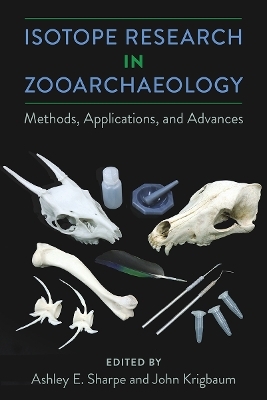
Isotope Research in Zooarchaeology
Methods, Applications, and Advances
Seiten
2022
University Press of Florida (Verlag)
978-0-8130-6941-8 (ISBN)
University Press of Florida (Verlag)
978-0-8130-6941-8 (ISBN)
Through case studies of faunal remains from Roman Britain, prehistoric Southeast Asia, ancient African pastoral cultures, and beyond, this volume illustrates some of the ways stable isotope analysis of ancient animals can address key questions in human prehistory.
New techniques for understanding animal
and human interactions in the pastThrough case studies of faunal remains from Roman
Britain, prehistoric Southeast Asia, ancient African pastoral cultures, and
beyond, this volume illustrates some of the ways stable isotope analysis of
ancient animals can address key questions in human prehistory.
Contributors use a diverse set of isotopic
techniques to investigate social and biological topics, including human paleodiets and foodways,
hunting and procurement strategies, exchange patterns, animal husbandry and the
genetic consequences of domestication, and short- and long-term environmental
change. They demonstrate how different isotopes can be used alone or in
conjunction to address questions of animal diet, movement, ecology, and
management. Studies also examine how sampling strategies, statistical
techniques, and regional and temporal considerations can influence isotopic
results and interpretations.
By applying these new
methods in concert with traditional zooarchaeological analyses, archaeologists
can explore questions about human ecology and environmental archaeology that
were previously deemed inaccessible.
New techniques for understanding animal
and human interactions in the pastThrough case studies of faunal remains from Roman
Britain, prehistoric Southeast Asia, ancient African pastoral cultures, and
beyond, this volume illustrates some of the ways stable isotope analysis of
ancient animals can address key questions in human prehistory.
Contributors use a diverse set of isotopic
techniques to investigate social and biological topics, including human paleodiets and foodways,
hunting and procurement strategies, exchange patterns, animal husbandry and the
genetic consequences of domestication, and short- and long-term environmental
change. They demonstrate how different isotopes can be used alone or in
conjunction to address questions of animal diet, movement, ecology, and
management. Studies also examine how sampling strategies, statistical
techniques, and regional and temporal considerations can influence isotopic
results and interpretations.
By applying these new
methods in concert with traditional zooarchaeological analyses, archaeologists
can explore questions about human ecology and environmental archaeology that
were previously deemed inaccessible.
Ashley E. Sharpeis research archaeologist at the Smithsonian Tropical Research Institute’s Center for Tropical Paleoecology and Archaeology. John Krigbaum is professor of anthropology at the University of Florida.
| Erscheinungsdatum | 13.10.2022 |
|---|---|
| Zusatzinfo | 42 b/w illus., 10 tables |
| Verlagsort | Florida |
| Sprache | englisch |
| Maße | 152 x 228 mm |
| Gewicht | 151 g |
| Themenwelt | Geisteswissenschaften ► Archäologie |
| ISBN-10 | 0-8130-6941-6 / 0813069416 |
| ISBN-13 | 978-0-8130-6941-8 / 9780813069418 |
| Zustand | Neuware |
| Informationen gemäß Produktsicherheitsverordnung (GPSR) | |
| Haben Sie eine Frage zum Produkt? |
Mehr entdecken
aus dem Bereich



aus dem Bereich
maternal health science and the reproduction of harm
Buch | Softcover (2024)
University of California Press (Verlag)
CHF 52,35
long-lasting legacies of colonialism and nationalism in Israel, …
Buch | Softcover (2025)
Vernon Press (Verlag)
CHF 109,95
Holocaust heritage, noncitizen futures, and black power in Berlin
Buch | Softcover (2022)
University of California Press (Verlag)
CHF 52,35


